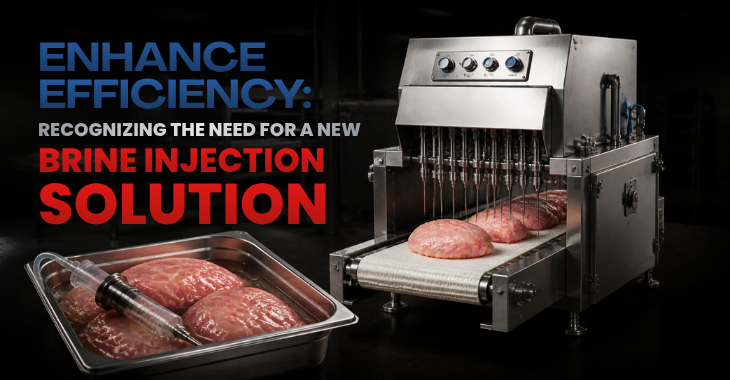
In meat and poultry processing, brine injection is not just a step in production – it directly affects yield, texture, flavor consistency, food safety, and overall profitability. Many processors start with a basic or smaller brine injection system that works well in the early stages of growth. But as production volumes increase, product lines expand, and customer expectations rise, that same system can quietly become a bottleneck.
Outgrowing a brine injection system rarely happens overnight. Instead, it shows up through small, recurring problems: inconsistent pickup, more rework, frequent downtime, frustrated operators, or declining product quality. These issues are often accepted as “part of the process,” when in reality they are signals that the equipment is no longer aligned with the operation’s needs.
This article walks through the most common signs that your current brine injection system may be holding you back- and how modern commercial brine injectors are designed to solve these challenges in real processing environments. The focus here is not on selling equipment, but on helping processors identify problems early and understand what solutions actually look like on the production floor.
1. Inconsistent Brine Pickup and Yield Loss
One of the earliest and most costly signs of an undersized or outdated brine injector is inconsistent brine pickup. When injection levels vary from batch to batch-or even piece to piece-it directly affects yield, margins, and customer satisfaction.
Processors may notice:
- Finished product weights that don’t match targets
- Over-injected products leading to purge loss
- Under-injected products that appear dry or lack flavor
- Frequent adjustments by operators to “chase” pickup numbers
In many older or entry-level systems, brine distribution depends heavily on manual settings, worn needles, or uneven pressure across the injection head. As throughput increases, these systems struggle to maintain uniform pressure and flow.
Modern commercial brine injectors are engineered to deliver consistent, repeatable pickup percentages by using stable pressure systems, evenly distributed needle patterns, and reliable pump designs. When pickup becomes predictable, yield stabilizes-and planning becomes easier across purchasing, production, and sales.
2. Excessive Rework and Product Downgrades
If your team spends increasing time trimming, reprocessing, or downgrading product due to injection issues, that’s a strong indicator the system is no longer keeping up.
Common rework scenarios include:
- Uneven injection marks or blotchy appearance
- Localized pockets of brine causing texture defects
- Product damage from bent or clogged needles
- Inconsistent marinade absorption after injection
Rework not only increases labor costs but also disrupts production flow and reduces usable yield. Over time, these hidden costs often exceed the perceived savings of holding onto older equipment.
Commercial injectors address this by combining uniform needle penetration, controlled injection force, and consistent conveyor movement. The result is cleaner injection patterns, better product integrity, and fewer downstream corrections.
3. Your Line Speed Has Increased – But the Injector Hasn’t
As businesses grow, line speeds naturally increase. New packaging equipment, faster tumblers, or expanded chilling capacity often push injection systems beyond what they were designed to handle.
Signs of a mismatch between line speed and injector capacity include:
- Operators slowing down upstream or downstream equipment
- Injection becoming the rate-limiting step
- Pressure drops during continuous operation
- Increased mechanical stress on pumps and needles
Older or smaller injectors are often built for intermittent use, not sustained high-throughput production. When forced to run continuously, they experience overheating, pressure instability, and accelerated wear.
Commercial-grade brine injectors are designed for continuous-duty operation, allowing processors to maintain consistent output across long shifts without sacrificing injection accuracy. This alignment between speed and stability is critical for scaling operations.
4. Frequent Needle Clogging and Maintenance Downtime
Needle-related issues are one of the most common frustrations on the processing floor. If your team is constantly stopping production to clean, replace, or realign needles, your injector may be working against you.
Common causes include:
- Poor brine filtration compatibility
- Weak or inconsistent pump pressure
- Needle designs that are difficult to remove and clean
- Brine recipes with particulates not suited to older systems
Every unplanned stop impacts efficiency and morale. Over time, operators may adjust recipes or processes just to keep the machine running – often at the expense of product quality.
Modern injectors are designed with easy-to-remove needle blocks, better filtration support, and stable pressure systems that reduce clogging. Faster cleaning and predictable maintenance cycles mean less downtime and more control over production schedules.
5. Limited Control Over Injection Pressure and Patterns
As product lines diversify, so do injection requirements. A whole muscle cut, a poultry breast, and a boneless roast all require different injection pressures and patterns.
Older systems often provide:
- One-size-fits-all pressure settings
- Limited adjustability across zones
- Manual trial-and-error changes
This lack of control forces processors to compromise-either under-injecting some products or risking damage on others.
Commercial brine injectors offer adjustable pressure control, consistent flow across multiple needles, and flexible configurations. This allows processors to fine-tune injection based on product type rather than adapting products to equipment limitations.
6. Labor Dependency Is Increasing Instead of Decreasing
If your injection process requires constant operator intervention, it may be a sign that automation and ergonomics are lagging behind production needs.
Warning signs include:
- Manual adjustments during every run
- Heavy reliance on experienced operators to “feel” correct settings
- Training challenges for new staff
- Higher risk of human error
In today’s labor environment, systems that depend heavily on operator skill are increasingly risky.
Modern commercial injectors are designed to simplify operation through intuitive controls, repeatable settings, and stable mechanical performance. This reduces training time, improves consistency, and makes production less vulnerable to staffing changes.
7. Sanitation and Compliance Are Becoming Harder to Maintain
Food safety standards continue to evolve, and equipment that was acceptable years ago may now create sanitation challenges.
Indicators include:
- Hard-to-clean frames or brine tanks
- Areas where residue accumulates
- Extended washdown times
- Increased scrutiny during audits
Injectors built with mixed materials, complex assemblies, or limited access points can slow sanitation and increase risk.
Commercial systems emphasize stainless steel construction, open-frame designs, removable components, and smooth surfaces. These features reduce cleaning time and help processors maintain consistent compliance with USDA and customer requirements.
8. Maintenance Costs Are Quietly Rising
While the machine may still be running, increasing maintenance costs are a strong signal that it’s reaching its practical limits.
Watch for:
- Frequent pump repairs
- Replacement parts becoming harder to source
- Temporary fixes becoming permanent solutions
- Rising spare parts inventory
At a certain point, maintaining older equipment becomes more expensive than investing in a modern system designed for current production demands.
Commercial brine injectors are built with durable components, accessible service points, and standardized parts, helping reduce long-term maintenance burden and unexpected failures.
9. Your Product Quality Is Inconsistent Across Batches
Customers notice inconsistency-even when internal teams become used to it.
Signs include:
- Variations in texture or juiciness
- Inconsistent flavor absorption
- Differences in purge levels during storage
Injection consistency plays a major role in how products perform after packaging and distribution.
Upgrading to a system that delivers uniform injection cycle after cycle helps protect brand reputation and reduces customer complaints.
10. Your Business Has Grown, but the Equipment Hasn’t
Perhaps the most telling sign is this: your business goals have changed, but the injector hasn’t.
If you’re:
- Adding new SKUs
- Supplying larger customers
- Running longer shifts
- Planning future expansion
Then your injection system must support where you’re going-not just where you’ve been.
Modern commercial brine injectors, like those integrated into Promarksvac’s processing solutions, are designed with scalability, reliability, and real-world processing challenges in mind. The goal is not to replace equipment prematurely, but to ensure each piece of the line contributes to efficiency rather than limiting it.
Final Thoughts: Recognizing the Right Time to Upgrade
Outgrowing a brine injection system is not a failure-it’s a sign of progress. The key is recognizing the warning signs early, before small inefficiencies turn into major operational constraints.
By evaluating yield consistency, downtime, labor dependency, sanitation effort, and long-term maintenance costs, processors can make informed decisions based on data-not frustration.
A well-designed commercial brine injector doesn’t just inject brine. It protects yield, supports food safety, stabilizes production, and gives processors confidence as they scale.
For facilities reassessing their current injection process, understanding these signs is the first step toward building a more efficient, reliable, and future-ready operation.