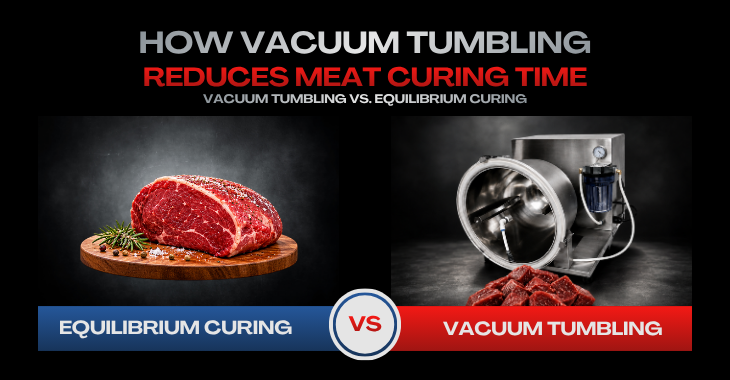
Vacuum Tumbling vs. Equilibrium Curing
For meat processors, curing time can have a major impact on production capacity. Traditional equilibrium curing methods can require days or even weeks before a large cut of meat reaches the desired level of cure throughout its interior. While this method has been used successfully for generations, the extended holding period can create challenges for processors dealing with limited cooler space, labor requirements, inventory costs, production scheduling, and customer demand.
This is where vacuum tumbling can make a significant difference. Vacuum tumbling combines mechanical action with a controlled vacuum environment to improve the contact between meat and curing ingredients. Instead of simply allowing curing agents to gradually move into the meat during refrigerated storage, tumbling repeatedly moves, massages, and exposes the product to the curing solution. The result can be faster and more uniform distribution of curing ingredients, potentially allowing processors to shorten processing cycles compared with conventional equilibrium curing.
But how much faster is vacuum tumbling, and can a vacuum tumbler turn a four-week equilibrium curing process into a matter of hours? The answer is more complicated than simply comparing two numbers. Curing time depends on the meat cut, thickness, cure formulation, temperature, product composition, vacuum level, tumbler design, loading conditions, tumbling intensity, and the required finished-product characteristics. Therefore, there is no universal vacuum tumbling time that can replace every traditional curing process. However, understanding why vacuum tumbling can accelerate curing and improve cure distribution gives meat processors a much better foundation for designing an efficient production process.
What Is Equilibrium Curing?
Before comparing vacuum tumbling with mechanical curing, it is important to understand what happens during traditional equilibrium curing. In an equilibrium curing process, meat is exposed to a curing mixture containing ingredients such as salt and other curing agents according to the processor’s validated formulation. The product is then held under controlled refrigerated conditions while the curing ingredients gradually migrate into the meat.
The movement of curing ingredients is largely driven by concentration gradients and diffusion. In simple terms, when the concentration of a particular curing component is higher outside the meat than inside it, that component tends to move toward areas of lower concentration. This process does not happen instantly: a small or thin piece of meat may reach the desired internal condition relatively quickly, while a thick muscle such as a whole beef eye round can require considerably more time.
The thicker the product, the greater the distance that curing ingredients need to travel to reach the center. This is one of the biggest limitations of relying exclusively on equilibrium curing for large intact muscles. A processor may have a properly formulated cure, but the ingredients still need sufficient time to move through the product.
Why Does Traditional Curing Take So Long?
The biggest factor is mass transfer. Curing ingredients must move from the surrounding curing environment into the meat, and this movement is influenced by the structure of the muscle, temperature, concentration differences, moisture content, and the distance from the surface to the center.
Consider a thick beef eye round. The exterior of the muscle is directly exposed to the curing solution, but the center is not, so the curing agents must progressively move inward. If the processor simply places the meat in a curing environment and waits, the process depends heavily on natural movement through the muscle. That can work, but it takes time, and from a commercial production perspective, time has a cost.
Long curing cycles can mean:
- More cooler space occupied by product
- Longer production schedules
- Higher inventory carrying costs
- More time between production and sale
- Additional handling requirements
- Reduced processing capacity
- Less flexibility when customer orders increase
For a small processor, the problem may be limited cooler capacity. For a larger processor, the problem may be throughput. This is why many meat processors investigate mechanical methods such as vacuum tumbling.
What Is Vacuum Tumbling?
Vacuum tumbling is a mechanical meat-processing technique that combines controlled tumbling or massaging with vacuum. Meat and the appropriate curing or marinating solution are placed inside a rotating tumbler drum, and the chamber is then placed under vacuum while the drum rotates at a controlled speed. As the drum turns, the meat repeatedly moves, falls, contacts the drum surface, and interacts with the surrounding curing solution.
Instead of allowing the product to remain stationary, the tumbler continuously changes the relationship between the meat and the curing solution. The vacuum environment adds another important component: by removing much of the air from the tumbler chamber, the process creates conditions that can improve contact between the curing solution and the meat surface while supporting the mechanical action of tumbling. This combination is what makes vacuum tumbling particularly useful for commercial meat processing.
How Does Vacuum Tumbling Help Reduce Curing Time?
The important distinction is that vacuum tumbling does not simply “make diffusion happen faster.” Rather, it changes the processing environment. Several mechanisms work together.
1. Mechanical Action Continuously Moves the Product
In equilibrium curing, the meat may remain relatively stationary. In a tumbler, the product is constantly moving. The repeated lifting, falling, rolling, and massaging action creates much greater interaction between the meat and curing solution, which helps keep the surface of the product exposed to the curing mixture and reduces the stagnant conditions that occur when meat simply sits in a container. Mechanical action is particularly useful when processing multiple pieces together because it continually changes the contact between individual pieces and the curing solution.
2. Vacuum Changes the Processing Environment
Vacuum is another important part of the process. Reducing pressure inside the tumbler can remove air from spaces around and within the product’s surface structure. When the system is returned toward atmospheric pressure, the pressure differential can assist the movement of liquid into accessible spaces. This is one reason vacuum tumbling is often used for products where improved absorption and distribution of marinades or curing solutions are desired. However, vacuum should not be viewed as a magic mechanism that automatically drives curing ingredients to the center of every large muscle the physical structure of the meat still matters.
3. More Consistent Contact With the Cure
Imagine placing several pieces of meat into a container of curing solution and leaving them undisturbed. The pieces at the bottom, the pieces touching each other, and the pieces exposed directly to the solution may experience somewhat different contact conditions. Tumbling changes that: the product is repeatedly redistributed, pieces that were touching one another become separated, surfaces that were facing away from the solution become exposed, and the curing mixture is continually redistributed around the product. This can improve the consistency of the curing environment.
4. Mechanical Action Can Improve Mass Transfer
The repeated mechanical movement can help disrupt boundary layers around the product surface and maintain fresh curing solution at the meat surface. This matters because mass transfer is affected not only by what is happening inside the meat but also by what is happening immediately around its surface. By continuously moving the product and curing solution, vacuum tumbling can create a more dynamic mass-transfer environment than static curing.
5. Tumbling Can Improve Product Uniformity
Speed isn’t the only advantage. For commercial meat processors, uniformity may be just as important as curing time. A process that produces one heavily affected area and another poorly cured area is not useful simply because it is fast. Vacuum tumbling is designed to improve interaction between the meat and curing solution throughout the batch, and when properly controlled, this can contribute to more consistent distribution, appearance, texture, and finished-product characteristics.
Vacuum Tumbling vs. Equilibrium Curing
The fundamental difference between the two methods is how the meat interacts with the curing environment. With equilibrium curing, the processor largely relies on time and natural movement of curing components through the product. With vacuum tumbling, the processor adds controlled mechanical action and vacuum to the process. Here is a simplified comparison:
| Factor | Equilibrium Curing | Vacuum Tumbling |
| Product movement | Minimal or none | Continuous mechanical movement |
| Vacuum | Generally not used | Controlled vacuum |
| Cure contact | Relatively static | Continuously renewed |
| Processing time | Can be long | Often significantly shorter |
| Labor | Lower active processing requirement | Requires equipment setup and monitoring |
| Cooler occupancy | Potentially longer | Potentially reduced |
| Production throughput | Limited by curing cycle | Can support shorter production cycles |
| Cure distribution | Relies heavily on diffusion | Mechanical action assists distribution |
| Process control | Primarily time, temperature and formulation | Time, temperature, vacuum, speed, loading and formulation |
| Batch consistency | Depends heavily on static conditions | Can improve with controlled tumbling |
This doesn’t mean that vacuum tumbling automatically replaces equilibrium curing in every application. Instead, it provides processors with another tool for controlling the curing process.
Can Vacuum Tumbling Replace a Four-Week Equilibrium Cure?
This is one of the most important questions, and one that requires caution. Suppose a processor currently uses an equilibrium curing process requiring approximately four weeks for a particular product. It would be tempting to say: “Use a vacuum tumbler for X hours and you will achieve the same cure.” That would be an oversimplification. There is no universal conversion between equilibrium curing time and vacuum tumbling time, and a four-week equilibrium process does not automatically translate into a specific number of hours in a tumbler.
This is because the two processes may involve different mass-transfer conditions, product geometry, formulations, temperatures, mechanical energy, and processing objectives. A beef eye round, for example, is very different from thin slices, smaller muscles, ground meat, or injected products, and the thickness of the muscle alone can have a major impact on how quickly curing ingredients reach the center.
Therefore, the correct question is not “How many hours of tumbling equals four weeks of equilibrium curing?” A better question is “What validated combination of formulation, temperature, vacuum, tumbling time, and mechanical action achieves the required cure distribution and finished-product specifications?” That is the question commercial processors should use when developing or modifying a curing process.
The Importance of Beef Eye Round Thickness
Beef eye round is a useful example because it is a relatively large intact muscle. When curing a thick muscle, the surface and center behave differently: the exterior has immediate contact with the curing environment, while the center does not. That means the processor must consider the distance the curing components need to travel, which is why simply looking at the weight of the meat isn’t enough when estimating curing time.
Two products may weigh the same but have different shapes and thicknesses. A long, relatively thin muscle may behave differently from a compact, thick muscle. For this reason, commercial processors should evaluate curing performance based on the actual product geometry rather than relying on a generic time recommendation.
What Factors Affect Vacuum Tumbling Time?
There are several variables that can influence the required tumbling cycle.
Meat Thickness
Thickness is one of the most important variables. The thicker the muscle, the greater the distance curing ingredients may need to travel. A process designed for smaller pieces should not automatically be applied to a whole intact muscle.
Cure Formulation
The formulation of the curing solution affects mass transfer and the final product. Salt concentration, curing agents, water content, and other ingredients all influence how the cure behaves. The formulation should always be developed and used according to applicable food-safety requirements and the processor’s validated process.
Temperature
Temperature has a significant impact on meat processing. Curing should be conducted under appropriate controlled conditions, particularly because meat is a perishable food product. A processor should not attempt to compensate for an unsuitable temperature simply by increasing tumbling time.
Vacuum Level
Vacuum level is another process variable. The goal is not necessarily to use the deepest possible vacuum the appropriate vacuum depends on the product, equipment, formulation, and desired processing characteristics. Excessive or inappropriate mechanical or vacuum conditions can potentially affect product texture and appearance.
Tumbler Speed
Drum speed determines how the product moves inside the machine. Too little movement may not provide sufficient mechanical action, while too much movement can cause excessive impact or damage, depending on the product. The correct speed is therefore a balance between effective massaging and maintaining product quality.
Load Size
The amount of meat placed into the tumbler matters. An overloaded drum may not allow the product to move properly, and an underloaded drum may also behave differently because the amount of product available for mechanical interaction changes. Processors should follow the equipment manufacturer’s recommended loading range and establish repeatable operating procedures.
Tumbling Pattern
Continuous tumbling isn’t necessarily the only approach; many processing applications use controlled cycles of movement and rest. The ideal pattern depends on the product and desired outcome, which is another reason why processing time should be treated as a parameter to be validated rather than a universal number.
Does Longer Tumbling Always Mean Better Curing?
No, this is an important misconception. It may seem logical that if tumbling improves curing, then more tumbling must produce even better results, but meat processing doesn’t work that way. Excessive mechanical action can negatively affect texture, appearance, yield, and product integrity. The objective is to find the appropriate processing window.
A good vacuum tumbling process should balance cure distribution, product quality, processing efficiency, and food safety. The fastest possible cycle isn’t necessarily the best cycle, the best cycle is the one that consistently produces the required product characteristics while meeting the processor’s validated safety and quality requirements.
How Processors Can Validate a New Tumbling Process
If a processor wants to move from a traditional equilibrium cure to vacuum tumbling, the process should be developed systematically. Rather than immediately changing production from four weeks to a short tumbling cycle, begin with controlled trials and measure the results. Depending on the product and process, processors may evaluate:
- Internal cure distribution
- Salt concentration
- Curing-agent distribution
- Product yield
- Moisture retention
- Color development
- Texture
- Appearance
- Finished-product consistency
- Processing loss
- Batch-to-batch variation
For an intact muscle, the center of the product deserves particular attention. A product can appear properly cured on the outside while still having a different internal condition, so testing should reflect the actual finished-product requirements rather than relying solely on visual appearance. For regulated curing processes, processors should also work with qualified food-safety professionals and follow applicable regulatory requirements and validated procedures.
Why Faster Curing Matters to Commercial Meat Processors
The value of vacuum tumbling isn’t simply that a processor can say, “We cured this meat faster.” The larger benefit is what shorter processing cycles can do for the entire production operation.
More Production Capacity
If a product spends fewer days occupying production and refrigerated storage capacity, the processor may be able to increase throughput without expanding the facility.
Better Cooler Utilization
Refrigerated space is expensive. Reducing the amount of time product needs to remain in a curing environment can free valuable cooler capacity for other production.
Improved Production Planning
Long curing cycles can make production scheduling difficult. A shorter, more predictable process can give processors greater flexibility when planning production around customer orders.
Reduced Work-in-Process Inventory
Products sitting in production for weeks represent capital tied up in inventory. Shorter processing cycles can potentially reduce the amount of work-in-process inventory required.
More Consistent Processing
Mechanical tumbling provides processors with controlled parameters that can be repeated from batch to batch. Instead of depending primarily on elapsed time, the process can be defined using measurable operating conditions.
Vacuum Tumbling Is About More Than Curing
One reason vacuum tumblers are widely useful in meat processing is that their application extends beyond curing. The same basic technology can be used in applications involving:
- Marinating
- Seasoning
- Brine absorption
- Meat tenderization
- Flavor distribution
- Moisture incorporation
- Processed meat preparation
This makes a vacuum tumbler a versatile piece of equipment for processors producing multiple products. Instead of having a machine that performs only one task, a properly selected tumbler can become part of a broader meat-processing workflow.
Common Mistakes When Using a Vacuum Tumbler
Treating Vacuum as a Substitute for Process Validation
Vacuum can improve processing conditions, but it doesn’t eliminate the need for validation. Processors should establish appropriate parameters for each product.
Using the Same Cycle for Every Product
A cycle that works well for one product may not work for another. Different cuts, thicknesses, formulations, and textures require different approaches.
Overloading the Tumbler
The machine needs enough room for the product to move properly. Overloading can interfere with mechanical action and reduce process consistency.
Focusing Only on Processing Time
The shortest cycle isn’t necessarily the best cycle. Processors should evaluate cure distribution and finished-product quality alongside time savings.
Ignoring Product Temperature
Temperature must remain under appropriate control throughout processing. A shorter process does not mean temperature control becomes less important.
Assuming Every Product Will Respond the Same Way
The structure of meat varies considerably. Whole-muscle products, chunks, slices, and ground products have different processing characteristics, so the process should be designed around the actual product.
Choosing a Vacuum Tumbler for Commercial Meat Processing
When selecting a vacuum tumbler, processors should look beyond drum capacity. The right machine should match the production environment and the type of products being processed. Important considerations include:
- Capacity: How much product needs to be processed per batch?
- Vacuum system: Does the machine provide the vacuum control required for the intended applications?
- Drum design: Is the interior designed to provide appropriate product movement?
- Speed control: Can the processor establish repeatable tumbling conditions?
- Construction: Is the machine built from materials appropriate for a demanding food-processing environment?
- Controls: Can operators easily monitor and reproduce process parameters?
- Cleaning: Can the equipment be efficiently cleaned and maintained?
- Production volume: Is the machine suitable for the processor’s current requirements and anticipated growth?
For processors who are moving from manual or small-batch operations into higher-volume production, these considerations can be particularly important.
The Bottom Line: Vacuum Tumbling Can Change the Curing Equation
Traditional equilibrium curing depends heavily on time. For thick meat products, curing components may require an extended period to migrate from the exterior toward the center. Vacuum tumbling introduces mechanical action and a controlled vacuum environment, creating much more dynamic interaction between the meat and curing solution. That can significantly accelerate processing compared with static curing in many applications.
But the important point is this: vacuum tumbling should not be viewed as a simple mathematical shortcut from “four weeks” to a specific number of hours. The actual processing time depends on the product and the complete process. For a beef eye round, for example, the appropriate cycle must account for muscle thickness, formulation, temperature, vacuum, tumbler speed, loading, mechanical action, and the required finished-product characteristics.
Instead of asking how many hours of tumbling equal four weeks of equilibrium curing, processors should ask: what controlled vacuum-tumbling process can consistently achieve the required cure penetration, product quality, and food-safety objectives in less time? That shift in thinking is where vacuum tumbling becomes particularly valuable.
For commercial meat processors, the goal isn’t simply to make curing faster. The goal is to create a repeatable, efficient, controlled process that produces consistent results while making better use of labor, cooler space, equipment, and production capacity. And when properly designed and validated, vacuum tumbling can be an important part of achieving that goal.
Frequently Asked Questions
How much faster is vacuum tumbling than equilibrium curing?
There is no single time-saving figure that applies to every meat product. Vacuum tumbling can substantially shorten processing time in many applications because mechanical action and vacuum improve interaction between the meat and curing solution, but the actual reduction depends on the product, formulation, thickness, temperature, vacuum level, tumbler settings, and desired endpoint.
Can vacuum tumbling replace a four-week equilibrium cure?
It may be possible to develop a substantially shorter validated process for some products, but there is no universal conversion from four weeks of equilibrium curing to a specific number of hours of vacuum tumbling. Each product and process needs to be evaluated and validated independently.
How long should beef eye round be vacuum tumbled?
There is no universally correct tumbling time for every beef eye round. Product thickness, formulation, temperature, loading, tumbler speed, vacuum conditions, and the desired finished characteristics all influence the appropriate cycle. Commercial processors should establish the cycle through controlled trials and validation rather than relying on a generic time.
Does vacuum help cure penetrate meat?
Vacuum tumbling can improve the interaction between meat and curing solution and can assist the overall mass-transfer process. However, vacuum does not eliminate the physical limitations associated with thick intact muscles. Cure penetration should be verified rather than assumed.
Is vacuum tumbling only used for curing?
No. Vacuum tumblers are also commonly used for applications involving marination, seasoning, brine absorption, tenderization, and distribution of ingredients in meat products.
What is more important: vacuum level or tumbling time?
Neither should be considered independently. Vacuum level, tumbling speed, cycle duration, product loading, temperature, and formulation work together. The ideal process is the combination that provides the required product characteristics consistently and efficiently.
Final Thoughts
For meat processors looking to increase production efficiency, curing time deserves serious attention. A traditional equilibrium cure can produce excellent results, but long processing cycles can limit throughput and consume valuable refrigerated storage capacity.
Vacuum tumbling offers a different approach by combining mechanical action with controlled vacuum conditions. Instead of allowing curing ingredients to migrate through a largely stationary product, the meat is continuously exposed to a dynamic curing environment. That can improve cure distribution and, in many applications, dramatically shorten the processing cycle.
The key is to avoid thinking of vacuum tumbling as a simple “fast-forward button” for curing. It is a process-control tool. When the equipment, formulation, temperature, vacuum, tumbling pattern, loading, and product geometry are properly matched and the resulting process is validated vacuum tumbling can help processors achieve more efficient production without sacrificing the consistency and quality their customers expect.
For processors considering the move from long equilibrium curing cycles to mechanical processing, the right vacuum tumbler can become much more than another piece of equipment. It can become an important part of a more efficient, scalable, and repeatable meat-processing operation.