Ground beef moves through more hands than almost any other meat product butcher shops, processors, restaurants, grocery retailers, and food manufacturers all handle it in serious volume. And every one of them faces the same challenge: how do you protect it, keep it looking good, and get real shelf life out of it without slowing down production?
That’s where the ground beef brick comes in. Forming ground beef into compact, uniform portions and vacuum sealing them has become a go-to solution for bulk handling and freezer storage and once you see why, it’s easy to understand the appeal.
But “vacuum packaging” isn’t a single method with a single result. The right approach depends on your product size, production volume, packaging material, equipment, and whether you’re working with fresh or frozen beef. Get it right, and you end up with a tight, professional package that stores efficiently and holds up in the freezer. Get it wrong, and you’re dealing with weak seals, lost shape, or wasted film.
This guide breaks down the best vacuum packaging methods for ground beef bricks, how each one works, what equipment you’ll need, and how to pick the right fit for your operation.
What Are Ground Beef Bricks?
Ground beef bricks are exactly what they sound like: compact, rectangular portions of ground beef formed into a consistent shape before packaging. They’re typically produced in standardized weights and dimensions, which makes them easier to stack, store, transport, and sell.
The rectangular shape is the real advantage here. It uses freezer and storage space far more efficiently than irregularly shaped packages no awkward gaps, no wasted pallet space.
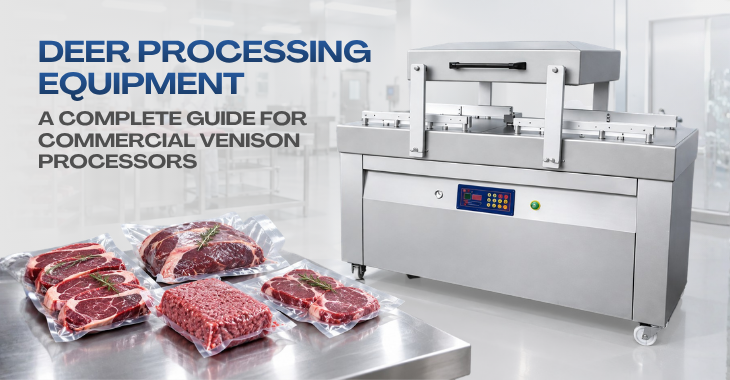
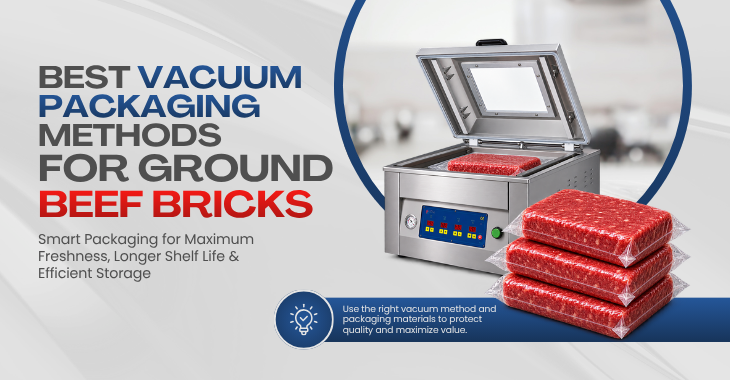
Once formed, the bricks go into high-barrier vacuum bags and get sealed with commercial vacuum packaging equipment. The result is a tight, compact package with film that conforms closely to the surface of the meat clean lines, no air pockets, no guesswork.
Why Vacuum Package Ground Beef Bricks?
Vacuum packaging pulls the air out from around the product before sealing, creating a low-oxygen environment that helps protect the meat from external exposure and freezer-related quality issues. For businesses running ground beef at commercial volume, that translates into some very practical wins.
1. It helps protect product quality. Oxygen exposure contributes to oxidation and quality changes in meat. Cutting down the air around the product helps maintain quality throughout storage.
2. It reduces freezer burn. Freezer burn happens when moisture escapes frozen food because of air exposure. A properly sealed, high-barrier package limits that exposure and protects the surface of the beef during frozen storage.
3. It creates a compact package. Because the film hugs the product so closely, a vacuum-sealed brick takes up minimal space which makes pallets, freezers, shelves, and storage areas dramatically easier to organize.
4. It improves handling. Uniform bricks are simply easier to stack, transport, inventory, and portion than loose or irregularly shaped product.
5. It looks professional. A tight vacuum seal gives the product a clean, consistent appearance the kind that reads well on a retail shelf or in a commercial kitchen.
6. It scales. For processors and high-volume operations, vacuum packaging slots directly into a larger production workflow, letting you package standardized portions efficiently and repeatably.
Best Vacuum Packaging Methods for Ground Beef Bricks
There’s more than one way to vacuum package a ground beef brick, and the best method really comes down to your production requirements and the final package you’re after. Here’s how the most common commercial methods stack up.
1. Chamber Vacuum Packaging
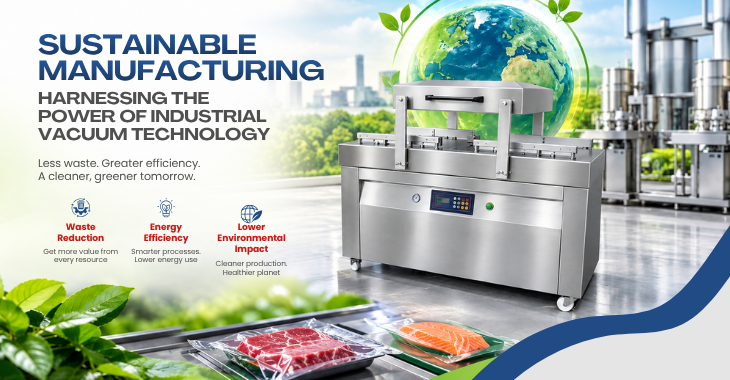
For most commercial ground beef applications, chamber vacuum packaging is the workhorse and for good reason.
A chamber vacuum sealer places the entire bag inside a sealed chamber, then removes air from both the chamber and the bag before creating the heat seal. That’s a different approach than an external suction sealer, which pulls air directly from the bag opening while the bag sits outside the machine.
How it works:
- Form the ground beef into a brick.
- Place the brick inside an appropriate vacuum pouch.
- Position the open end of the pouch across the sealing bar.
- Place the pouch inside the chamber.
- Close the chamber lid.
- Set the vacuum and sealing parameters.
- The machine removes air from the chamber and pouch.
- The pouch is heat sealed.
- The chamber returns to atmospheric pressure.
- Remove the finished package and inspect the seal.
Because the whole pouch sits inside the chamber during the cycle, the process is controlled and repeatable batch after batch, the same conditions apply.
Why it works so well for ground beef bricks: Ground beef can carry moisture and small particles that make external vacuum sealing trickier than it sounds. Chamber machines are built to handle that kind of product cleanly, delivering consistent vacuum and sealing cycles even when the product isn’t perfectly dry. They also flex across different pouch sizes, so if you’re packaging multiple brick weights, one machine can typically handle the range. For processors that need that kind of flexibility, chamber sealers are hard to beat.
2. Double-Seal Chamber Vacuum Packaging
Want an extra layer of insurance? A machine with multiple sealing bars or double-seal capability creates two parallel heat seals across the bag opening instead of one.
That redundancy matters in commercial environments where packages face heavy handling, transportation, stacking, and freezing. If one seal is ever compromised, the second is still holding.
That said, more seals aren’t a substitute for a good seal. Dialing in the right temperature, sealing time, pressure, and compatible packaging material for your specific pouch still matters more than the number of seal lines.
3. Gas Flush Vacuum Packaging
Gas flush packaging takes the process a step further. Instead of simply pulling air out and sealing, the cycle introduces a selected gas mixture after the initial vacuum stage and before sealing the same principle behind modified-atmosphere packaging.
For ground beef, gas flushing can make sense when appearance, product presentation, or specific storage requirements call for it. But it’s not a light addition it requires more equipment, a reliable gas supply, and tightly controlled packaging parameters. It’s not necessary for every ground beef brick application.
If your priority is straightforward: compact freezer storage and solid vacuum protection, standard chamber vacuum packaging is usually the simpler, more direct route.
4. Vacuum Packaging Fresh Ground Beef Bricks
Fresh ground beef demands careful handling well before it ever reaches the packaging machine. It needs to be processed under proper food-safety conditions, held at the right temperature, and packaged promptly per your facility’s procedures.
When it comes time to vacuum seal, the goal is simple: a strong, clean package where nothing product or liquid interferes with the seal.
Key considerations:
- Product temperature, Stay within the range your food-safety procedures require.
- Brick consistency, Uniform dimensions make pouch selection and cycle settings far more predictable.
- Pouch size, Leave enough room for proper positioning and a clean seal.
- Seal area, Keep it spotless. Meat particles, fat, or moisture across the sealing zone can compromise the seal entirely.
- Vacuum level, Match it to the product and material. The highest vacuum setting isn’t automatically the best one.
5. Vacuum Packaging Frozen Ground Beef Bricks
Frozen bricks can be vacuum packaged too, depending on your workflow. Some operations form and package before freezing; others freeze first and package afterward. Which approach fits best depends entirely on your production process and product requirements.
Vacuum packaging frozen bricks pays off especially when long-term freezer organization and protection are top priorities. A properly selected high-barrier pouch cuts down on air exposure and moisture loss over extended frozen storage.
Why frozen bricks benefit so much: The brick shape already saves space. Add a tight vacuum seal, and you get a package that stacks efficiently and holds up over time a real advantage for:
- Meat processors
- Butcher shops
- Wholesale meat suppliers
- Restaurants
- Foodservice operations
- Retail meat departments
- Institutional kitchens
Choosing the Right Vacuum Pouch
The machine only does half the job. The pouch matters just as much.
For ground beef bricks, the packaging film should be chosen based on the product, storage conditions, sealing equipment, handling demands, and the shelf life you’re targeting.
High-barrier packaging. A high-barrier pouch offers strong protection against oxygen and moisture transmission especially important for frozen product that may sit in storage for a long stretch.
Pouch thickness. Heavier packages or rough handling may call for thicker film. But thicker isn’t automatically better it still needs to be compatible with your sealing system and suited to the application.
Bag dimensions. Don’t grab an oversized bag just because it’s easier to load. Excess material drives up costs and makes the final package less efficient. At the same time, the pouch needs enough room to position the brick properly and seal it reliably. It’s a balance, not a default.
How to Get a Strong Vacuum Seal on Ground Beef Bricks
A great seal isn’t just about how much air the machine pulls out. A few other factors make a real difference.
- Keep the seal area clean. This is the single most important factor. Even the most powerful vacuum machine can’t compensate for a contaminated seal surface fat, moisture, or meat particles in that zone will undermine the seal every time.
- Use consistent product dimensions. Standardized bricks make packaging predictable, letting operators rely on consistent pouch sizes and machine settings.
- Don’t overfill the pouch. Leave enough space near the opening for the machine to create a clean seal.
- Dial in the right vacuum settings. More isn’t always better excessive pressure can deform softer product or create unwanted compression. Test with the actual product, pouch, and target format.
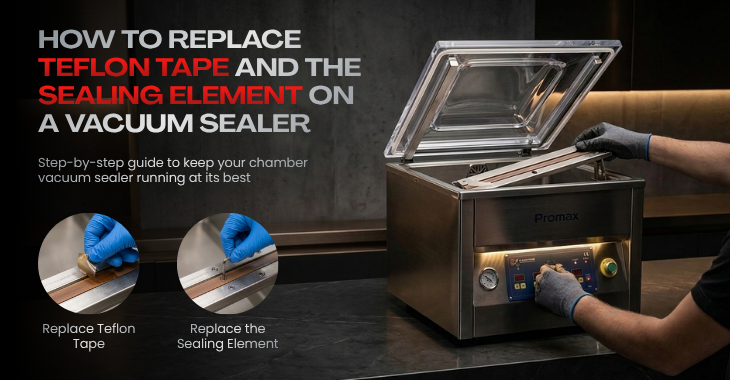
- Set the correct seal parameters. Match sealing temperature and time to the packaging material. Too little heat and the seal fails; too much and it damages the film. Always follow the film manufacturer’s specs and validate through production testing.
Common Problems and Solutions
Even with solid commercial equipment, things can go sideways. Here’s how to troubleshoot the most frequent issues.
Weak or inconsistent seals Possible causes: contamination in the seal area, incorrect sealing temperature or time, damaged sealing components, incompatible film. Solution: Clean the seal area, inspect the sealing system, and check machine settings against the pouch manufacturer’s recommendations.
Bag leaks after packaging Possible causes: a weak seal, puncture, sharp edges, or excessive handling. Solution: Inspect the pouch and seal closely. If the product itself is damaging the bag, consider a stronger or more appropriate film.
Brick loses its shape Possible cause: excessive vacuum compressing softer product. Solution: Test a lower vacuum level, or adjust the workflow to hit the appearance you’re after.
Excessive liquid in the package Possible causes: product temperature, handling, formulation, or storage conditions. Solution: Review the full process temperature, handling, formulation, storage, and packaging parameters should all be validated together for your specific product.
Chamber Vacuum Sealer vs. External Vacuum Sealer
Not every vacuum machine is built for the same job.
An external vacuum sealer removes air from the bag while it stays outside the machine a solid fit for certain applications and lower-volume operations.
A chamber vacuum sealer places the bag inside a controlled chamber for the entire cycle, which generally gives it the edge for commercial ground beef production especially with larger pouches and moisture-heavy products.
| Feature | Chamber Vacuum Sealer | External Vacuum Sealer |
|---|---|---|
| Commercial production | Excellent | Limited to certain applications |
| Moist food products | Well suited | Can be more challenging |
| Large pouches | Excellent | Depends on machine |
| Consistent vacuum cycle | Yes | Yes, depending on model |
| Multiple bag sizes | Flexible | Varies |
| High-volume processing | Well suited with the right model | Better for smaller operations |
The right call ultimately comes down to your production volume, brick dimensions, pouch size, and workflow.
Choosing the Right Vacuum Packaging Machine
There’s no one-size-fits-all machine for meat processing. When you’re evaluating equipment, weigh these factors:
- Production volume, How many bricks need to be packaged per hour or per day? A small butcher shop and a large processor are working with very different math.
- Brick size, Measure length, width, height, and weight to determine the chamber size and sealing bar configuration you need.
- Pouch size, The machine has to accommodate your chosen pouch dimensions.
- Sealing configuration, Different sealing bar setups suit different production needs.
- Vacuum pump capacity, Pump size influences cycle times and overall efficiency, but it should be weighed alongside chamber size, machine design, and expected volume not chosen in isolation.
- Machine construction, Commercial meat environments are demanding. Stainless steel and easy-to-clean surfaces matter.
- Controls and repeatability, Digital controls and programmable cycles help operators hold consistent vacuum and sealing parameters batch after batch.
Best Practices for Commercial Ground Beef Brick Packaging
A standardized packaging procedure is what turns a good process into a reliable one. Here’s a typical workflow:
- Prepare the ground beef according to your facility’s food-safety procedures.
- Form uniform bricks with consistent weights and dimensions.
- Select the correct pouch for the product and storage conditions.
- Load the pouch carefully with the brick.
- Position the bag with the open end flat on the sealing area.
- Run the vacuum cycle using validated settings.
- Seal the pouch with the correct parameters.
- Inspect the package for wrinkles, contamination, or incomplete seals.
- Cool or freeze as required.
- Store and handle properly through distribution and inventory.
Why Ground Beef Bricks Are a Natural Fit for Vacuum Packaging
Ground beef bricks combine two things that work exceptionally well together: standardized portioning and efficient packaging. The brick shape delivers a predictable package size; vacuum packaging strips away the excess air around it. Together, they add up to real gains in storage efficiency, product handling, package consistency, freezer organization, transportation, portion control, and product presentation.
For processors looking to tighten up their packaging operation, that combination is hard to pass up.
How Promarksvac Can Help With Ground Beef Packaging
Choosing the right vacuum packaging equipment comes down to your product, production volume, packaging format, and workflow there’s no universal answer.
Promarksvac offers commercial vacuum packaging solutions for businesses across the food-processing and packaging industries. For ground beef brick applications, chamber vacuum packaging equipment offers a practical, reliable solution strong seals, consistent cycles, and the flexibility to handle multiple pouch sizes.
Depending on your operation, it’s also worth evaluating the rest of your workflow meat preparation, portioning, forming, and downstream packaging systems as part of a complete solution.
The bottom line: choose equipment based on your actual production requirements, not just pump size or an advertised vacuum number.
Final Thoughts
The best vacuum packaging method for ground beef bricks depends on your product, package size, production volume, storage requirements, and overall workflow. For most commercial operations, chamber vacuum packaging strikes the right balance of flexibility, protection, and repeatable performance while businesses with specific presentation needs may lean toward gas-flush or multi-seal configurations.
Whichever method you choose, success comes down to the fundamentals: consistent brick dimensions, the right vacuum pouches, clean sealing surfaces, validated machine settings, and proper temperature control. Get those right, and vacuum packaging becomes a genuine advantage helping meat processors, butcher shops, foodservice businesses, and retailers turn out compact, durable, professionally packaged ground beef, batch after batch.
If you’re evaluating a commercial vacuum packaging solution for ground beef bricks, start with your brick dimensions, pouch size, production volume, and desired packaging cycle. Those four factors will point you toward the right machine configuration for your operation.