When people start making sausage, most of the attention goes to the meat and the seasoning. Fair enough that’s where the flavor lives. But there’s a quieter decision hiding behind every good sausage recipe, and it matters more than most beginners realize: the casing.
The casing isn’t just a wrapper. It’s the difference between a sausage that snaps when you bite into it and one that gives way too easily. It’s what holds everything together on the grill, in the smoker, or in the pan and whether it splits, shrinks, or stays put often comes down to a choice you made before you ever turned on the stuffer.
Sausage makers generally reach for one of three options: natural casings, collagen casings, or fibrous casings. Each brings something different to the table, and none of them is universally “better” they’re just built for different jobs.
So how do you know which one is right for your batch? It comes down to what kind of sausage you’re making, how you plan to cook it, the texture you’re chasing, and whether you actually want to eat the casing itself. Let’s walk through it.
What Exactly Is a Sausage Casing?
At its simplest, a sausage casing is the material that holds your seasoned, ground meat mixture together while it’s stuffed, shaped, and cooked. Once the meat is packed inside, you can form it into links, coils, or larger sausage shapes, depending on what you’re making.
Casings split into two broad camps: natural and manufactured. Natural casings come from cleaned animal intestines a method that’s been around for centuries. Manufactured casings, which include collagen and fibrous varieties, are engineered materials designed for specific sausage applications.
The right casing depends entirely on the sausage. A delicate casing built for breakfast links has no business holding a dense summer sausage together, and a casing meant to be peeled off before serving is a completely different animal from one that’s meant to be bitten into. For commercial production, the stakes go up even further consistency, stuffing speed, appearance, and how the casing performs under heat all start to matter a lot more.
Natural Casings: The Traditionalist’s Choice
Natural casings have been the backbone of sausage making for generations, and it’s easy to see why. They’re made from cleaned animal intestines usually from pigs, sheep, or cattle and they deliver something manufactured casings still struggle to fully replicate: the snap.
That satisfying resistance when you bite through the casing, right before the juicy interior comes through that’s the signature of a well-made natural casing. It’s a big part of why they remain the go-to for fresh sausages and traditional linked varieties.
What makes them worth the extra effort?
- The bite. For a lot of sausage lovers, this is non-negotiable. Natural casings offer a firm-but-tender texture that’s hard to fake.
- The look. Slight variations in size and shape give sausages that handcrafted, artisanal appearance the kind that signals “made the traditional way.”
- The flexibility. Handled correctly, natural casings stretch and move with the sausage mixture through stuffing and cooking.
- The versatility. They’re a natural fit for bratwurst, Italian sausage, breakfast links, and other fresh linked products.
The tradeoff is that they demand a bit more attention. Depending on how they’re packaged, natural casings usually need rinsing and soaking before use to remove excess salt and prep them for stuffing. They’re also less uniform than manufactured options which many makers actually see as a feature, not a bug and they’re more delicate, meaning heavy-handed stuffing pressure can cause splitting.
This is exactly why stuffing technique matters so much. The goal isn’t to cram as much meat in as possible; it’s a controlled, steady flow that fills the casing without stretching it past its limit.
Collagen Casings: Consistency You Can Count On
Collagen casings are made from you guessed it collagen, a naturally occurring protein, engineered into a more predictable, uniform casing option. They come in a range of sizes and show up in both fresh and processed sausage products.
The headline feature here is consistency. Where natural casings can vary a bit in diameter and appearance from one to the next, collagen casings are manufactured to tight specifications. If uniform links matter to you say, for retail packaging or a consistent brand look that’s a real advantage.
A few more reasons makers reach for collagen:
- Predictable sizing for a more uniform finished product
- Less prep work compared to traditional natural casings
- Easier standardization, which matters a lot at higher production volumes
- A range of diameters to suit different sausage styles
As for the eating experience, opinions are genuinely split. Some people miss the classic snap of natural casing; others prefer collagen’s cleaner, more consistent bite. Neither preference is wrong it really just depends on what you’re making and what you’re going for. Collagen tends to shine when consistency and production efficiency outweigh the desire for a traditional casing feel.
Fibrous Casings: Built for Strength, Not for Biting Into
Fibrous casings play a different role entirely. They’re most often used for larger sausages think summer sausage and big smoked links where structural support matters more than eating texture.
Unlike the thin casings used for fresh links, fibrous casings are engineered to hold their shape through long cook times and heavy processing. In most cases, they’re designed to be peeled off before the sausage is eaten, functioning more as scaffolding during production than as part of the final bite.
That makes them a completely different tool from a natural casing on a fresh bratwurst same category, entirely different job.
Natural vs. Synthetic: The Real Difference
Here’s the simplest way to think about it: natural casings are about eating experience, while manufactured casings collagen and fibrous alike are about consistency and processing performance.
| Feature | Natural Casings | Collagen Casings | Fibrous Casings |
|---|---|---|---|
| Material | Animal intestine | Manufactured collagen | Fibrous manufactured material |
| Texture | Traditional, natural bite | More uniform | Usually removed before eating |
| Appearance | Traditional, some variation | Uniform | Uniform |
| Prep required | Yes – rinsing/soaking | Minimal | Minimal |
| Best for | Fresh, traditional sausages | Fresh and processed sausages | Larger smoked/cooked sausages |
| Diameter consistency | Variable | High | High |
| Eaten with the sausage? | Yes | Usually | Usually not |
| Production consistency | Moderate | High | High |
Treat this table as a starting point, not a final answer the sausage itself should always drive the decision.
Matching the Casing to the Sausage
Fresh sausage generally comes down to a choice between natural and collagen. Want that classic bite in your Italian sausage or breakfast links? Natural casing delivers it. Need consistent sizing batch after batch? Collagen is worth a look.
Bratwurst is arguably natural casing’s best showcase that juicy interior paired with a satisfying snap is hard to beat. That said, if you’re producing at volume and need tight consistency across every link, a manufactured casing might make more practical sense.
Italian sausage, typically made in smaller linked portions, leans naturally toward well, natural casing, for that familiar texture people expect. Collagen is a solid alternative when uniformity and convenience take priority. Either way, matching casing diameter to your stuffing equipment is essential.
Smoked sausage is more of a case-by-case call. Smaller smoked links can work fine with natural or suitable collagen casings, but larger smoked products often benefit from the structural backbone fibrous casings provide. And if the casing is coming off before serving anyway, there’s no reason to prioritize its eating texture focus instead on strength, shape retention, and how easily it peels.
Don’t Overlook Casing Size
Material is only half the equation diameter matters just as much. Smaller casings suit breakfast links and other petite sausages, while larger casings are built for bigger smoked sausages and specialty logs. And whatever size you land on, it needs to match your stuffing horn.
If you’re running a Promarksvac SS-50P/100P hydraulic piston stuffer, the manual is specific on this point: select the appropriate stuffing horn and secure it to the cover before you begin stuffing. Skipping that step is asking for an uneven, frustrating stuffing session.
Beating Air Pockets
No matter which casing you choose, trapped air is the enemy. It leads to uneven sausages and inconsistent appearance the kind of thing that’s easy to avoid with a little attention up front.
Start by minimizing air in the meat mixture before you even begin stuffing. The Promarksvac piston stuffer manual recommends pressing the meat down firmly in the cylinder to push out as much trapped air as possible before you start the machine.
Speed matters too. Push too hard, and you risk overstretching the casing. Go too slow or inconsistently, and the sausage won’t fill evenly. On the SS-50P/100P, you control this by adjusting the meat output pressure turn clockwise to increase it, counterclockwise to ease off. The target isn’t maximum pressure; it’s a steady, controlled flow.
Should You Stuff It Tight?
Not as tight as you might think. One of the most common beginner mistakes is trying to pack the casing as full as physically possible. But a casing needs a little breathing room to accommodate the mixture through linking and cooking overstuff it, especially a more delicate natural casing, and you’re inviting splits.
Aim for a firm, even fill rather than maximum tightness. What that looks like exactly will depend on your casing, your recipe, and how you plan to cook it and honestly, this is one of those things you get a feel for after a few batches. Give yourself the room to learn it.
Does Meat Temperature Matter?
Yes, and it’s worth taking seriously. The Promarksvac manual specifies a minimum meat temperature of 1°C (34°F) and advises against feeding frozen meat into the piston stuffer.
Keeping your meat properly chilled throughout the process helps maintain the texture and handling characteristics you want in the final mixture but there’s a line, and frozen meat crosses it as far as this equipment is concerned.
Five Questions to Help You Choose
Still not sure which casing fits your project? Run through these:
- Do you want to eat the casing? If yes, natural or an edible manufactured casing is your answer. If it’s coming off before serving, fibrous casing may make more sense.
- Are you after that traditional snap? Natural casing is built for exactly that.
- Do your sausages need to be perfectly uniform? Collagen’s manufactured consistency has the edge here.
- Are you making something big and smoked? Fibrous casing is probably your best bet for structural support.
- Is this for commercial production? If so, consistency, casing availability, and processing speed start to matter as much as taste and texture.
Bringing It All Together
Reach for natural casing when you want the traditional sausage-making experience, when the casing itself is part of the bite, and when you’re making bratwurst, Italian sausage, or other fresh links where that classic snap is the whole point.
Reach for collagen when consistent sizing and manufactured convenience matter more than replicating a traditional feel especially useful for fresh or processed sausage where uniform production counts.
Reach for fibrous casing when you’re making larger sausages that will be smoked, cooked, or heavily processed, and where structural support during production matters more than the eating texture, since the casing typically comes off before serving anyway.
There’s no single “best” casing only the best casing for the sausage you’re making.
Getting the Meat Into the Casing
Choosing your casing is only half the job you still have to get the meat inside it cleanly and consistently. Small batches can get by with a manual stuffer, but once volume picks up, a hydraulic piston stuffer changes the game in terms of control and repeatability.
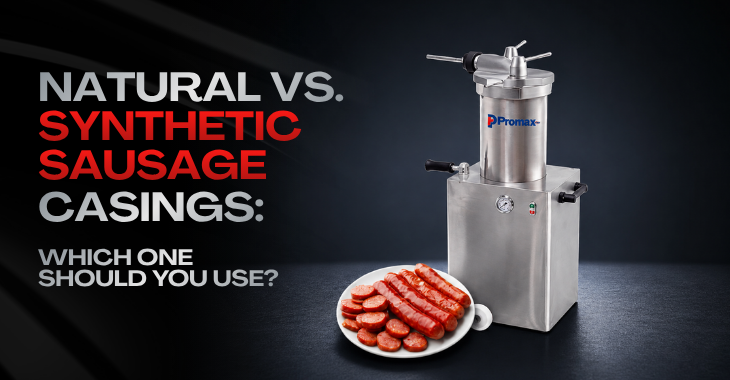
The Promarksvac SS-50P/100P is a floor-model stainless hydraulic piston stuffer built for filling both natural and synthetic casings with boneless meat of all kinds. It’s constructed primarily from stainless steel, with the piston and cover available in either corrosion-resistant anodized aluminum or stainless steel. Its hydraulic system gives you real control over output pressure and speed control that pays off whenever you’re switching between different meat mixtures and casing types.
That level of control is the difference between a stuffer that just moves meat and one that helps you produce consistent, well-filled sausage every time.
Don’t Skip the Cleanup
Great sausage starts with great ingredients, but sanitation is what keeps the whole operation safe and repeatable. Meat-processing equipment needs cleaning after every use, with procedures suited to your specific working environment.
The Promarksvac manual calls for cleaning the machine after each use and recommends developing sanitation procedures appropriate to your facility, verified accordingly. And before any cleaning or servicing of powered equipment, always disconnect and lock out the power supply electrical hazards aren’t something to work around casually.
Treat cleaning as part of the sausage-making process itself, not an afterthought you get to once things start looking dirty.
Final Thoughts
Natural versus synthetic casing doesn’t have to be a complicated decision it just has to start in the right place: with the sausage you’re trying to make.
Chasing that classic bratwurst snap? Natural casing is calling your name. Need consistency and convenience across a big batch? Collagen has you covered. Building a large smoked sausage where the casing’s job is to hold everything together during processing? Fibrous casing is built for exactly that.
Once you understand how each casing behaves, sausage making stops being just “grind meat, add seasoning” and becomes something closer to a craft one where diameter, texture, stuffing technique, and cooking method are all yours to play with.
And when you’re ready to scale up, having the right equipment behind you makes all the difference. A hydraulic piston stuffer like the Promarksvac SS-50P/100P gives you the controlled meat delivery you need to get the most out of whichever casing and whichever sausage you decide to make.