A properly sealed bag is often the final step between a packaged product and the outside environment. Whether the package contains cookies, tea, nuts, bakery products, snacks, food ingredients, or industrial components, the quality of that final seal can have a direct impact on product protection, presentation, storage, and handling.
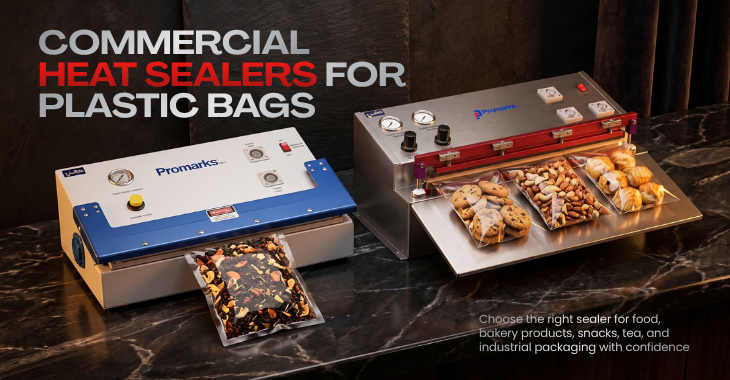
For businesses packaging products in plastic bags and flexible films, a commercial heat sealer provides a practical way to create consistent, secure seals without relying on adhesives, clips, or manually tied bags.
Heat sealing is used across a wide range of industries because the process is relatively simple: the packaging material is placed between heated sealing surfaces, heat is applied for a controlled period, and pressure creates a sealed joint as the material cools.
However, choosing a commercial sealing machine is not simply a matter of buying the largest or most powerful unit available. The right equipment depends on the packaging material, bag size, film thickness, production volume, product characteristics, and the way operators handle the bags.
This guide explains how commercial heat sealers work and how they can be used for plastic bags, food, bakery products, snacks, tea, nuts, cookies, storage packaging, bulk products, and industrial applications.
What Is a Commercial Heat Sealer?
A commercial heat sealer is a machine designed to close plastic bags, pouches, and compatible flexible packaging materials by applying controlled heat and pressure to the opening of the package.
Unlike a household bag clip or twist tie, a heat sealer creates a permanent seal across the opening of the bag. The result is a cleaner package that can be easier to store, transport, display, and handle.
Commercial heat sealers are available in different configurations. Some are designed for operators to manually position individual bags, while others are designed for higher-volume production environments where bags move through a more continuous sealing process.
The basic sealing process generally involves three factors:
- Temperature
- Sealing time
- Pressure
These factors need to be appropriate for the packaging material. Too little heat or sealing time may produce a weak seal, while excessive heat can damage the film or distort the package.
This is why commercial packaging operations should evaluate the machine and packaging material together rather than treating the sealer as a standalone piece of equipment.
How Does an Impulse Heat Sealer Work?
An impulse heat sealer uses a short burst of electrical energy to heat the sealing element. The material is positioned between the sealing jaws, the jaws are closed, and the heating element generates the heat required to form the seal.
Once the sealing cycle is completed, the heat is removed and the seal is allowed to set.
One of the advantages of impulse sealing is that the sealing element does not need to remain continuously hot between every package. This makes the technology suitable for many intermittent packaging applications.
The operator typically places the open end of the bag into the sealing area, activates the machine, and removes the sealed package after the cycle.
Impulse heat sealers can be useful for businesses packaging:
- Food products
- Bakery products
- Cookies and biscuits
- Nuts
- Tea
- Snacks
- Dry ingredients
- Retail products
- Industrial components
- General storage products
The exact suitability depends on the packaging material and the specifications of the sealing machine.
Commercial Heat Sealer for Plastic Bags
Plastic bags are among the most common packaging formats used with heat sealing equipment. They are lightweight, flexible, inexpensive compared with many rigid packaging formats, and available in numerous material constructions.
However, “plastic bag” is a broad description. Different films have different sealing characteristics.
Common packaging materials may include polyethylene-based films, polypropylene and laminated structures, depending on the application and film construction.
Before purchasing a heat sealer, a packaging operation should determine:
- What material is being sealed?
- How thick is the material?
- How wide is the required seal?
- What is the maximum bag opening?
- How many bags need to be sealed per hour?
- Will the bags be sealed manually or integrated into a production process?
These questions help determine whether a manual impulse sealer, larger commercial heat sealer, or continuous sealing system is appropriate.
Heat Sealing for Food Packaging
Food packaging is one of the most common applications for commercial heat sealing.
A sealed food package can help protect the contents from exposure to dust, moisture, handling, and other external conditions. The package also provides a practical way to portion and organize products for storage, distribution, or sale.
Heat sealing can be used for many types of dry and packaged food products, including:
- Dry ingredients
- Pasta
- Rice
- Grains
- Flour
- Spices
- Dry mixes
- Prepared food portions
- Snack products
- Bakery products
- Nuts and seeds
The appropriate packaging material is critical. The sealer should be selected according to the film or bag being used, while the package itself should be appropriate for the food product and intended storage conditions.
For commercial food operations, consistency is particularly important. A package that looks sealed is not necessarily properly sealed. A weak or incomplete seal can open during transportation or storage.
A properly selected commercial sealing machine helps operators produce more repeatable seals across a production run.
Commercial Heat Sealer for Bakery Packaging
Bakeries deal with products that need to be packaged efficiently while maintaining a clean and attractive presentation.
Bread, cookies, pastries, biscuits, rolls, cakes, and other baked products can be packaged in flexible bags and sealed using appropriate heat-sealing equipment.
For bakery businesses, a sealing machine can provide several practical benefits:
Cleaner packaging
A heat-sealed bag provides a more finished appearance than a bag that has simply been folded or closed with a clip.
Consistent closure
When the machine settings are properly established, operators can repeat the same sealing process throughout a production run.
Better handling
Sealed packages are easier to stack, move, and prepare for delivery than loosely closed bags.
Flexible package sizes
Depending on the machine configuration, businesses can seal different bag widths and package sizes.
For smaller bakeries, manual or tabletop equipment may be sufficient. Larger bakeries producing hundreds or thousands of packaged products may need a higher-throughput sealing solution.
Heat Sealing for Snacks
Snack products are another natural application for heat-sealed packaging.
Products such as popcorn, crackers, pretzels, snack mixes, dried fruit, and other dry snacks are commonly packaged in flexible bags.
The packaging requirements can vary considerably depending on the product.
For example, a delicate snack may require careful handling so the product does not become crushed during packaging. A powdery or granular product may require attention to the position of the product so that particles do not interfere with the sealing area.
A clean sealing area is important because product trapped between the sealing surfaces can compromise the quality of the finished seal.
For snack manufacturers, the goal is not simply to close the bag. The sealing process needs to fit into the entire packaging workflow, from filling and positioning to sealing, labeling, inspection, and final packing.
Commercial Heat Sealer for Tea Packaging
Tea is another product where flexible packaging and heat sealing can work well together.
Tea products can include:
- Loose-leaf tea
- Black tea
- Green tea
- Herbal tea
- Specialty tea blends
- Bulk tea
Packaging requirements vary depending on the type of tea and the packaging structure.
A heat sealer can be used to close compatible plastic or laminated bags after filling. For businesses selling tea in retail or bulk formats, a consistent seal can also contribute to a professional package appearance.
Tea packaging operations should pay particular attention to the packaging material and its barrier characteristics. A heat sealer creates the closure; it does not by itself determine the overall barrier performance of the package.
The film or laminate needs to be selected according to the product’s protection requirements.
Heat Sealer for Nuts and Dry Foods
Nuts and seeds are commonly packaged in plastic bags or flexible pouches.
Products may include:
- Almonds
- Cashews
- Peanuts
- Pistachios
- Walnuts
- Sunflower seeds
- Pumpkin seeds
- Mixed nuts
- Trail mixes
For nut packaging operations, the sealing process needs to be clean and consistent.
One common issue is product contamination of the seal area. If pieces of nuts, crumbs, or other product material become trapped in the sealing zone, the package may not form the intended seal.
Operators should therefore allow sufficient headspace above the product and keep the sealing area reasonably clean before closing the bag.
For businesses packaging nuts at different volumes, the appropriate equipment may range from a manual commercial heat sealer to a more automated sealing system.
Heat Sealer for Cookies and Biscuits
Cookies and biscuits are especially suitable for flexible bag packaging.
A bakery, commercial kitchen, food manufacturer, or private-label operation may package cookies individually, in small retail quantities, or in larger multipacks.
A commercial heat sealer can be used to close compatible cookie bags after filling.
The main considerations include:
- Bag material
- Bag dimensions
- Product quantity
- Required seal width
- Production volume
- Operator workflow
- Desired package appearance
Cookies can also create crumbs around the package opening. Keeping the sealing area clear helps maintain consistent sealing performance.
For businesses producing multiple cookie varieties, standardizing bag dimensions where practical can simplify the sealing operation and make machine setup more consistent.
Heat Sealing for Storage Packaging
Not every heat-sealed package is intended for retail sale.
Businesses also use sealed plastic bags for internal storage, inventory management, transportation, and protection of components.
For example, a manufacturer may use sealed bags to package:
- Small components
- Hardware
- Spare parts
- Fasteners
- Electrical components
- Accessories
- Maintenance items
- Dry materials
Heat sealing can provide a simple closure that reduces the chance of the contents spilling from an open bag.
The choice of film remains important. A heat sealer cannot compensate for packaging material that is unsuitable for the product or storage environment.
Commercial Heat Sealer for Bulk Packaging
Bulk packaging introduces different requirements from small retail packaging.
A company packaging several kilograms of a product into one bag may need a larger sealing area, stronger packaging material, or a sealing machine capable of handling wider bags.
Bulk applications can include:
- Food ingredients
- Grains
- Nuts
- Pet food
- Agricultural products
- Industrial materials
- Manufacturing components
- Dry goods
The most important factor is often the relationship between package size and production volume.
A machine capable of producing a wide seal may be required for large bags, while a high-volume operation may benefit from a continuous sealing system rather than manually sealing every package.
Businesses should also consider how operators will support and position larger bags. Machine selection is not only about sealing capacity; ergonomics and workflow matter as well.
Industrial Applications for Commercial Heat Sealers
Heat sealing is not limited to food and consumer products.
Industrial companies use flexible bags to package, protect, organize, and transport many types of products and components.
Potential industrial applications include:
- Hardware
- Automotive components
- Electrical parts
- Machine components
- Industrial supplies
- Manufacturing accessories
- Replacement parts
- Fasteners
- Non-food products
In these environments, the packaging objective may be different from retail food packaging.
Instead of creating an attractive consumer package, the goal may simply be to protect a component from dust, contamination, handling, or loss while making inventory easier to organize.
A commercial heat sealing machine can become part of a broader packaging workflow that includes weighing, filling, inspection, labeling, boxing, and palletizing.
Impulse Heat Sealer vs. Continuous Band Sealer
One of the most important decisions when selecting commercial sealing equipment is choosing between an intermittent impulse heat sealer and a continuous sealing machine.
Impulse Heat Sealer
An impulse sealer is generally suited to operations where individual bags are positioned and sealed one at a time.
It can be a practical choice for:
- Small and medium production runs
- Bakeries
- Retail packaging
- Nuts
- Cookies
- Tea
- Food products
- General storage
- Industrial components
The operator controls the positioning of each bag.
Continuous Band Sealer
A continuous band sealer is designed for a more continuous packaging workflow.
Instead of manually closing the jaws around each bag, the operator feeds the bag through the machine while the sealing mechanism creates the closure.
This can make continuous sealing more appropriate for higher-volume operations where productivity and repeatability are priorities.
Which one should you choose?
There is no universal winner.
An impulse sealer may make more sense when products are packaged in varying quantities and operators need flexibility.
A continuous band sealer can be more appropriate when the business has a steady flow of similarly sized bags and needs greater throughput.
The correct choice depends on the actual packaging process rather than simply the number of bags being produced.
How to Choose the Right Commercial Sealing Machine
Before purchasing a commercial heat sealer, evaluate the complete packaging process.
1. Identify the Bag Material
Start with the packaging film.
Not every plastic bag is sealed in exactly the same way. Ask the film supplier for the recommended sealing temperature and process when necessary.
2. Check Film Thickness
Thicker materials can require different sealing conditions than thinner films.
The machine needs to be capable of producing the required seal without damaging the packaging.
3. Measure the Bag Width
The maximum opening width is one of the most important machine specifications.
A sealer must provide enough sealing length for the bag being used.
4. Determine Production Volume
A business sealing 100 bags per day has different requirements from one sealing several thousand bags per shift.
Production volume should influence whether you choose manual, semi-automatic, or continuous equipment.
5. Consider Product Characteristics
Powders, liquids, granular products, cookies, nuts, and industrial components can all behave differently during packaging.
The product should not interfere with the sealing area.
6. Consider Operator Workflow
Think about how the operator currently handles the bag.
Is the product filled manually? Is the bag weighed first? Does the operator need both hands? Is the package large or heavy?
A machine that looks suitable on paper may be inefficient if it does not fit the actual workflow.
7. Consider Seal Quality
A commercial packaging operation should establish what constitutes an acceptable seal.
The seal should be consistent across the package and appropriate for the intended handling and storage conditions.
Heat Sealing vs. Vacuum Sealing
Heat sealing and vacuum sealing are sometimes confused, but they perform different functions.
A standard heat sealer closes the opening of a compatible bag. It does not necessarily remove the air from the package.
A vacuum packaging machine, on the other hand, removes air from a compatible package before sealing.
This distinction matters.
If the objective is simply to close a plastic bag containing cookies, nuts, tea, bakery products, or industrial components, a heat sealer may be appropriate.
If the application requires air removal before sealing, a vacuum packaging machine may be more suitable.
The packaging objective should therefore be established before choosing the equipment.
Common Heat Sealing Problems
Even a good sealing machine can produce inconsistent results if the machine is incorrectly adjusted or the packaging material is unsuitable.
Common problems include:
Weak seals
Possible causes include insufficient heat, insufficient sealing time, inadequate pressure, or unsuitable packaging material.
Burned or distorted film
This can occur when excessive heat or sealing time is applied.
Inconsistent seals
This may result from inconsistent operator technique, varying film thickness, contamination in the sealing area, or inappropriate machine settings.
Product trapped in the seal
Food particles, crumbs, nuts, powders, or other material can interfere with the sealing process.
Bag damage
Excessive heat, pressure, or mechanical handling can damage the packaging material.
The solution is not always to increase the temperature. Proper sealing requires the machine settings and packaging material to work together.
Why Commercial Heat Sealing Matters for Packaging Operations
A heat sealer may appear to be a relatively simple machine, but the sealing stage can have an important role in the overall packaging process.
A consistent sealing operation can help businesses:
- Standardize package closures
- Improve package appearance
- Reduce manual tying or clipping
- Improve handling
- Organize products for storage
- Prepare products for transportation
- Support higher packaging efficiency
For growing businesses, moving from manually closed bags to a dedicated commercial sealing machine can also make the packaging process more repeatable.
The right machine does not simply seal a bag. It needs to fit the product, packaging material, operator workflow, and production requirements.
Why Choose Promarks Heat Sealing Equipment?
Promarks provides commercial packaging equipment designed for businesses that require reliable sealing and packaging solutions.
When evaluating a Promarks heat sealing machine, businesses can consider the specific application, packaging material, bag dimensions, and production requirements to determine the appropriate equipment configuration.
Whether the application involves food packaging, bakery products, snacks, tea, nuts, cookies, storage bags, bulk products, or industrial components, the correct heat sealing solution should be selected according to the actual packaging process.
For businesses that are unsure which type of sealing equipment is appropriate, discussing the bag material, dimensions, production volume, and application with a packaging equipment specialist is a practical first step.
Frequently Asked Questions About Commercial Heat Sealers
What is a commercial heat sealer?
A commercial heat sealer is a machine that uses controlled heat and pressure to close compatible plastic bags, pouches, and flexible packaging materials.
What is an impulse heat sealer?
An impulse heat sealer uses a short heating cycle to create a seal. It is commonly used for intermittent packaging applications where bags are individually positioned and sealed.
Can a heat sealer seal plastic bags?
Yes, provided the bag material is compatible with the sealing process and the machine has the appropriate specifications for the material and bag dimensions.
Can heat sealers be used for food packaging?
Yes. Commercial heat sealers are commonly used for compatible food packaging applications, including dry foods, bakery products, snacks, nuts, tea, and other packaged products.
Can I use a commercial heat sealer for cookies?
Yes. Cookies and biscuits can be packaged in compatible flexible bags and sealed using appropriate heat-sealing equipment.
Can heat sealers be used for nuts?
Yes. Nuts, seeds, and mixed-nut products can be packaged in compatible plastic bags and sealed with commercial heat-sealing equipment.
What is the difference between a heat sealer and a vacuum sealer?
A heat sealer closes the bag using heat. A vacuum sealer removes air from a compatible package before sealing. They serve different packaging purposes.
Is an impulse sealer suitable for industrial packaging?
It can be suitable for many industrial applications, particularly where bags are individually handled. Higher-volume industrial operations may require a continuous or more automated sealing solution.
How do I choose the right commercial bag sealing machine?
Start with the bag material, film thickness, bag width, product type, package size, required seal, production volume, and operator workflow. These factors determine which type and size of sealing equipment is appropriate.
Final Thoughts
A commercial heat sealer is a relatively straightforward piece of packaging equipment, but selecting the right machine requires more than simply looking at the sealing length or price.
The packaging material, product, bag dimensions, production volume, and sealing process all influence the equipment decision.
For a bakery packaging cookies, a food company packaging dry ingredients, a tea business sealing retail pouches, a nut processor packaging bulk products, or an industrial manufacturer protecting components in plastic bags, the objective is the same: create a consistent closure that fits the requirements of the package.
An impulse heat sealer can be a practical solution for many intermittent applications, while a continuous commercial sealing machine may make more sense when packaging volume and workflow require faster, more consistent operation.
Before purchasing equipment, evaluate the bags you actually use and the way your operators package them. The best commercial heat sealer is not necessarily the biggest machine it is the one that matches your packaging material, production requirements, and workflow.
For commercial heat sealing equipment and packaging solutions, contact Promarks to discuss your application and determine the right sealing machine for your operation.