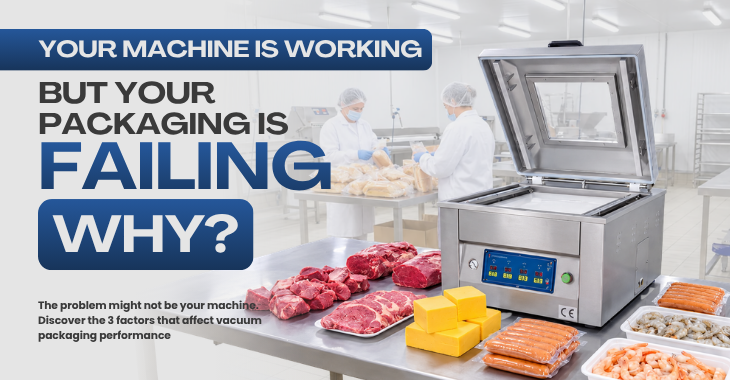
A commercial vacuum packaging machine can complete its cycle, remove air from a bag, and move on to the next package without showing any obvious signs of trouble. Yet the finished package may still have trapped air, a weak seal, wrinkles, leaks, or inconsistent packaging results.
For businesses that depend on vacuum packaging every day, these problems can become expensive. A single poorly sealed package might seem insignificant, but repeated packaging failures can lead to wasted bags, additional labor, product damage, customer complaints, and interruptions in production.
The frustrating part is that the machine may not actually be broken.
In many cases, the problem comes from a combination of factors rather than one defective component. Machine settings, vacuum bag compatibility, product characteristics, sealing conditions, and equipment maintenance all influence the quality of the finished package. A commercial vacuum sealer needs to work with the correct packaging material and operating conditions to deliver consistent results.
This applies to more than food packaging. Meat processors, seafood businesses, dairy manufacturers, restaurants, electronics manufacturers, medical suppliers, textile companies, and industrial manufacturers all depend on packaging that meets the requirements of their products.
So, why does packaging fail even when the machine appears to be working normally?
Let’s examine the most common causes, how to identify them, and what businesses can do to improve their vacuum packaging results.
Why a Working Vacuum Packaging Machine Can Still Produce Poor Results
Vacuum packaging involves more than simply removing air from a plastic bag. The machine must create the required vacuum conditions, handle the selected packaging material correctly, and produce a reliable seal that remains intact during storage, handling, and transportation.
Consider a meat processing facility packaging fresh beef. The vacuum chamber machine completes its cycle, but several packages develop small leaks after leaving the production area. The operator may initially suspect the vacuum pump. However, the actual cause could be moisture or fat contaminating the sealing area, a damaged bag, or an incorrect sealing setting.
A similar situation can occur in an electronics manufacturing facility. The vacuum machine may operate normally, but the packaging may not provide the moisture protection required for sensitive components. In that situation, the problem may involve the selected barrier material rather than the machine’s vacuum performance.
These examples demonstrate an important point: successful packaging depends on the entire packaging process.
Before replacing equipment or assuming that a vacuum pump has failed, businesses should examine the machine settings, packaging bags, sealing components, product preparation, and finished package.
1. Incorrect Vacuum Packaging Machine Settings
Machine settings are among the first things operators should investigate when packaging results become inconsistent.
Commercial vacuum packaging machines use different operating parameters to control the packaging cycle. Depending on the machine configuration, these may include vacuum time or target vacuum level, sealing temperature, sealing duration, cooling time, and optional gas-flushing settings.
If these parameters are not appropriate for the product and packaging material, the finished package may not meet expectations.
For example, a vacuum cycle that is too short for a particular application may leave more residual air than desired. On the other hand, an incorrectly configured sealing cycle may produce a weak seal or damage the packaging material.
Sealing temperature and duration are particularly important because different packaging structures respond differently to heat. A setting that works well with one material may not deliver the same result with another.
Operators should also avoid assuming that the highest possible vacuum setting is always the best choice. Certain products are delicate, irregularly shaped, or sensitive to compression. Their packaging requirements may be different from those of solid meat cuts or industrial components.
How to improve machine settings
Start by reviewing the manufacturer’s operating instructions and the specifications of the packaging material. Test the selected settings using representative products rather than relying on a setting developed for an unrelated application.
Record successful operating parameters so that operators can maintain consistency between production runs. If a problem appears after changing the bag material, product size, or packaging configuration, review the settings again.
For Promarks equipment, businesses can refer to the official machine manuals for model-specific operating and maintenance information.
2. Using the Wrong Vacuum Packaging Bags
A commercial vacuum packaging machine cannot deliver consistent results if the selected bag is unsuitable for the equipment or the product.
Vacuum bags are available in different materials, thicknesses, barrier properties, dimensions, and constructions. Each specification serves a particular packaging requirement.
One common mistake is purchasing bags based only on price or appearance. Two transparent vacuum bags may look almost identical, but their material construction and performance characteristics can be different.
For example, chamber vacuum packaging machines commonly use smooth vacuum bags. External suction-type vacuum sealers generally require embossed or textured bags because their operating systems need channels through which air can be removed.
Using a bag that is incompatible with the machine can result in poor vacuum performance or unsuccessful packaging.
Thickness also deserves attention. A thin bag may be unsuitable for products with sharp edges, heavy components, or demanding transportation conditions. However, simply selecting the thickest available bag does not guarantee better packaging. The material must also provide appropriate sealing characteristics and barrier performance.
Food manufacturers may need bags that provide suitable oxygen and moisture barrier properties. Industrial manufacturers may prioritize puncture resistance, chemical compatibility, or protection from environmental exposure.
How to choose the right vacuum bag
Start with the machine type. Determine whether the equipment is a chamber vacuum sealer, external suction sealer, or another type of packaging system.
Next, consider the product’s dimensions, weight, shape, moisture content, sharp edges, storage requirements, and distribution conditions.
Finally, check the bag’s material structure, thickness, barrier characteristics, and compatibility with the machine’s sealing system.
Businesses looking for more information can read our guide to commercial vacuum sealer bags for food and industrial packaging.
3. Moisture, Grease, or Product Residue on the Sealing Area
A vacuum bag can be compatible with the machine, and the machine settings can be correct, but the package may still develop a weak or incomplete seal.
One common reason is contamination around the sealing area.
When packaging meat, poultry, seafood, prepared foods, sauces, or other products containing liquids, small amounts of moisture, oil, grease, or food residue can reach the open end of the bag.
If these substances remain between the sealing surfaces, they may interfere with the formation of a continuous seal.
This is particularly important in meat and seafood processing. Products can release moisture during handling, while marinades, natural fats, and processing liquids can move toward the bag opening during vacuuming.
The same general principle applies to non-food packaging. Industrial oils, powders, lubricants, and other product residues can contaminate the sealing area if the package is not prepared properly.
A contaminated seal may initially appear acceptable but fail during handling, storage, or transportation.
How to prevent sealing contamination
Operators should ensure that the sealing area remains clean and free from product residue before the sealing cycle begins. The open end of the bag should be positioned correctly, with sufficient clean material available for sealing.
For liquid-containing products, the packaging process should be configured to manage product movement and prevent liquid from reaching the sealing area.
If contamination occurs repeatedly, review product loading methods, bag dimensions, filling levels, and vacuum settings.
Do not attempt to compensate for a contaminated sealing surface simply by increasing the sealing temperature or duration. The source of contamination must be addressed first.
4. Wrinkles, Folds, and Incorrect Bag Positioning
Wrinkles around the sealing area are another frequent reason for inconsistent vacuum packaging results.
A vacuum bag needs to be positioned correctly so that the sealing system can create a continuous seal across the intended area. If the bag opening is folded, twisted, or unevenly positioned, the finished seal may contain channels or incomplete sections.
This problem can occur when operators load products too close to the bag opening, use bags that are too small, or position multiple bags incorrectly on a sealing bar.
In high-volume production environments, these mistakes can become more common when operators prioritize speed over proper package positioning.
Product shape also matters. Large cuts of meat, irregular seafood portions, metal components, and products with sharp corners can make it difficult to position the bag evenly.
How to improve bag positioning
Select a bag that provides sufficient space around the product. Leave an appropriate clean section at the opening for sealing, and make sure the bag lies flat across the sealing area.
Operators should check for folds, creases, trapped product, and overlapping material before starting the cycle.
For production facilities handling several products or bag sizes, standardized loading procedures can help reduce operator-related packaging inconsistencies.
A short visual inspection before each cycle can prevent a significant number of avoidable packaging failures.
5. Worn or Damaged Sealing Components
Sometimes the machine settings and packaging bags are correct, but the sealing components themselves are no longer in suitable condition.
Commercial vacuum sealers operate under repeated cycles. Over time, sealing elements, Teflon covers, pressure bars, silicone rubber, chamber gaskets, and other components can experience normal wear.
A damaged or worn Teflon cover may affect the sealing surface. A deteriorated pressure bar can prevent proper contact during sealing. A worn chamber lid gasket may also affect the machine’s ability to maintain the required vacuum conditions.
These problems do not always cause the machine to stop operating. Instead, operators may notice that packaging quality becomes inconsistent over time.
For example, a machine may seal properly during the first few cycles but produce occasional weak seals later. Another warning sign may be a gradual change in vacuum performance or an increase in cycle time.
What should operators inspect?
Inspect the sealing bar and Teflon covering for visible burns, cuts, tears, or other damage. Check the pressure bar rubber for excessive wear and inspect chamber lid gaskets for cracks, deformation, or loss of flexibility.
The vacuum pump should also be maintained according to the manufacturer’s recommendations. Oil condition, oil level, exhaust filters, and unusual operating sounds deserve attention where applicable.
Maintenance requirements differ by machine model, so operators should follow the appropriate service instructions rather than applying one maintenance schedule to every machine.
For additional guidance, read our article on chamber vacuum sealer maintenance, cleaning, and preventive maintenance.
6. Product Characteristics Are Not Being Considered
Not every product behaves the same way during vacuum packaging.
This is an important consideration because businesses sometimes use the same bag dimensions, vacuum settings, and loading procedures for products with very different characteristics.
Fresh meat, seafood, cheese, prepared meals, electronics, textiles, and industrial components all present different packaging requirements.
A bone-in meat cut may have sharp edges that increase the risk of puncturing the bag. Seafood may contain moisture that moves toward the seal during the vacuum cycle. Prepared foods may contain sauces or liquids that require careful handling.
In non-food industries, a heavy metal component may require stronger puncture resistance than a lightweight textile product. Electronic components may require specialized moisture-barrier packaging rather than an ordinary vacuum bag.
Even when the vacuum machine removes air successfully, the selected packaging structure must still provide the protection required by the application.
How to match packaging to the product
Evaluate the product before selecting the bag and operating parameters.
Consider its size, shape, weight, surface characteristics, moisture content, temperature, storage conditions, and transportation requirements.
For food products, businesses should also consider applicable food-contact packaging requirements, hygiene procedures, and the intended storage conditions.
For electronics and industrial components, evaluate moisture exposure, corrosion risks, static sensitivity, and any special material requirements.
Vacuum packaging should be selected as part of an overall product protection strategy, not treated as a universal solution for every application.
7. Insufficient Maintenance and Poor Operator Practices
A commercial vacuum packaging machine may continue running even when its performance is gradually declining.
This is why preventive maintenance matters.
Vacuum pumps, valves, sealing bars, gaskets, filters, and other components all contribute to machine performance. When routine inspections are ignored, small problems can eventually affect production quality.
For example, deteriorating vacuum pump oil or a restricted exhaust filter may affect pump performance. A worn lid gasket can interfere with chamber evacuation. Damaged sealing components can result in inconsistent seals.
Operator practices are equally important.
Incorrect product loading, poorly positioned bags, overfilled packages, inconsistent machine settings, and inadequate cleaning can create problems even when the equipment itself is functioning correctly.
A facility that operates multiple machines or runs several production shifts should establish clear operating and maintenance procedures. Operators should know what to inspect before production, which problems require attention, and when maintenance personnel should be involved.
How to establish a better maintenance routine
Create a machine-specific maintenance checklist based on the manufacturer’s manual. Include daily visual inspections, cleaning requirements, vacuum pump checks, sealing component inspections, and scheduled service activities.
Keep a record of recurring packaging problems. If the same machine repeatedly produces weak seals or incomplete vacuum cycles, maintenance personnel should investigate the underlying cause rather than repeatedly adjusting the operating settings.
Promarks provides machine manuals and technical documentation to help equipment owners understand the operation and maintenance requirements of their machines.
How Packaging Problems Differ Between Food and Non-Food Industries
Although the basic principles of vacuum packaging remain similar, the challenges can vary considerably depending on the product being packaged.
Food manufacturers generally focus on product freshness, packaging integrity, storage conditions, hygiene, and protection during distribution. Meat processors need to consider bones, moisture, fats, and product dimensions. Seafood processors must account for liquids, shells, and delicate product structures. Dairy manufacturers may require packaging with appropriate barrier properties to support their storage and distribution requirements.
Prepared food manufacturers have additional considerations, including sauces, portion sizes, and packaging consistency across different recipes.
Non-food manufacturers have a different set of priorities.
Electronics manufacturers may need specialized moisture-barrier packaging to protect sensitive components. Industrial businesses packaging metal parts may require materials that help manage moisture exposure and corrosion risks. Textile manufacturers may use vacuum packaging to reduce package volume and improve storage efficiency.
Medical and healthcare packaging requires particular attention to application-specific materials, validated sealing processes, and applicable regulatory requirements. Vacuum packaging alone does not establish sterility.
These differences explain why machine selection and packaging material selection should begin with the product itself.
Promarks provides commercial vacuum packaging equipment for a range of food and non-food applications. The appropriate machine configuration depends on the product, packaging material, production volume, and required packaging process.
Chamber Vacuum Sealer vs. External Vacuum Sealer: Why Machine Compatibility Matters
One of the most important decisions in vacuum packaging is choosing equipment that matches the intended bag construction and production requirements.
A chamber vacuum sealer operates by placing the entire product-filled bag inside the chamber. The machine removes air from the chamber, allowing the pressure conditions inside and outside the bag to change together. The bag is then sealed before the chamber returns to normal atmospheric pressure.
This operating principle makes chamber machines suitable for many commercial applications, including products containing liquids when the process is properly configured.
External suction-type vacuum sealers work differently. They remove air through the open end of the bag, generally using specially designed embossed or textured bags to create air channels.
Using the wrong bag construction can interfere with the operation of either type of machine.
Businesses should also consider production requirements. A tabletop chamber machine may be suitable for lower-volume commercial operations, while a single-chamber or double-chamber machine may be more appropriate for facilities with higher packaging demands.
For a detailed comparison, read our guide to chamber vacuum sealer vs. external vacuum sealers.
A Practical Troubleshooting Checklist for Better Vacuum Packaging Results
When a packaging problem occurs, replacing the machine should not be the first response. A structured inspection can help identify whether the issue involves the bag, operating settings, product preparation, sealing components, or maintenance.
Before starting production, operators should check the following:
1. Inspect the vacuum bag. Confirm that the selected bag is compatible with the machine and appropriate for the product. Check for punctures, tears, manufacturing defects, or unsuitable dimensions.
2. Check the product loading process. Make sure the bag is not overfilled and that the open end has enough clean material for sealing.
3. Review the machine settings. Verify the vacuum level or time, sealing temperature, and sealing duration against the approved settings for the application.
4. Inspect the sealing area. Check for moisture, grease, product residue, folds, and wrinkles that could interfere with seal formation.
5. Examine the sealing components. Inspect the Teflon cover, sealing element, pressure bar rubber, and other relevant components for wear or damage.
6. Check the vacuum system. Review pump oil, filters, gaskets, valves, and other components according to the machine’s maintenance instructions.
7. Inspect the finished package. Examine the seal for continuity and visible defects. Where required, use an appropriate seal-integrity or leak-testing procedure rather than relying only on appearance.
If the problem continues after these checks, consult the machine manual or contact qualified technical support. Avoid changing several machine parameters simultaneously because doing so can make the original cause more difficult to identify.
Choosing the Right Commercial Vacuum Packaging Machine for Your Business
Sometimes, repeated packaging problems are not caused by an operating mistake. The equipment may simply not be suited to the business’s production requirements.
A company packaging a few dozen products per day has different equipment requirements from a meat processing facility packaging hundreds of products per hour.
The size and type of product, bag dimensions, packaging cycle, number of operators, available floor space, and production volume should all be considered when selecting a commercial vacuum packaging machine.
Promarks offers several equipment configurations for different commercial applications.
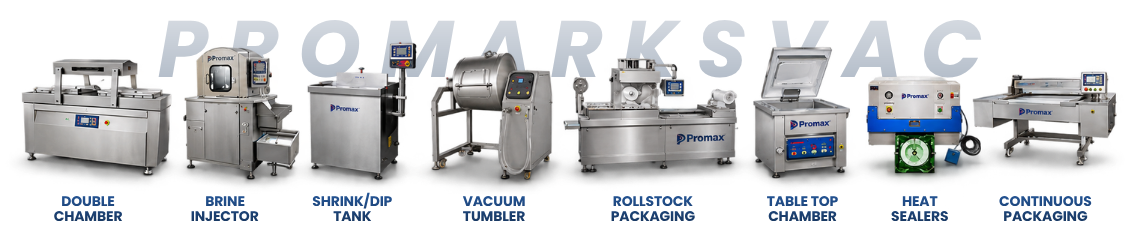
Tabletop chamber vacuum sealers can be suitable for smaller commercial operations and businesses requiring a compact packaging solution. Single-chamber and double-chamber vacuum packaging machines provide different chamber arrangements and production workflows for commercial and industrial users.
Belted chamber vacuum sealers may be considered for higher-throughput packaging applications, while nozzle-type systems serve specialized applications requiring external evacuation methods.
The right choice depends on actual production requirements rather than machine size alone.
Before purchasing equipment, businesses should evaluate representative products, packaging materials, desired production rates, and the operating conditions under which the machine will be used.
Promarks also offers processing and packaging equipment for food manufacturers, including brine injectors, vacuum tumblers, and other machinery used in commercial food production.
Explore our commercial vacuum packaging machines and processing equipment to learn more about available equipment options.
Frequently Asked Questions
Why is my vacuum packaging machine working but not sealing properly?
A vacuum packaging machine may complete its cycle without producing a reliable seal if the sealing temperature or duration is incorrect, the bag material is incompatible, or the sealing area is contaminated. Worn sealing components and incorrect bag positioning can also cause problems. Inspect the bag, settings, sealing area, and machine components before assuming that the vacuum pump has failed.
Why do my vacuum bags lose vacuum after sealing?
Vacuum bags can lose their vacuum because of incomplete seals, punctures, pinholes, damaged bag material, or contamination around the sealing area. A package may initially appear sealed but develop a leak during handling or storage. Inspect the complete seal and check the bag for damage to identify the source.
Can the wrong vacuum bag affect machine performance?
Yes. Bag construction and machine compatibility are important. Chamber vacuum sealers commonly use smooth vacuum bags, while external suction machines generally require embossed bags. An unsuitable bag may prevent proper air evacuation or produce inconsistent sealing results.
What causes weak seals on commercial vacuum packaging machines?
Weak seals can result from incorrect sealing temperature, insufficient sealing duration, contaminated bag openings, wrinkles, damaged Teflon covers, worn sealing elements, or pressure bar problems. The exact cause depends on the machine and packaging material.
Why is air still present inside my vacuum-sealed package?
Residual air may indicate insufficient evacuation, incorrect cycle settings, bag positioning problems, a damaged bag, or an application that requires a different packaging method. Check the machine’s vacuum performance and verify that the selected bag is compatible with the equipment.
Do different products require different vacuum packaging bags?
Yes. Meat, seafood, cheese, electronics, textiles, and industrial components have different packaging requirements. The appropriate bag depends on the product’s size, shape, weight, moisture content, storage conditions, and required barrier properties. Some products also require specialized materials for puncture resistance, moisture protection, or other performance characteristics.
How often should commercial vacuum packaging machines be maintained?
Maintenance frequency depends on the machine model, operating hours, production conditions, and manufacturer’s recommendations. Operators should perform routine inspections and follow the recommended service intervals for vacuum pump oil, filters, sealing elements, gaskets, and other components.
Is a chamber vacuum sealer suitable for both food and non-food products?
Chamber vacuum sealers can serve many food and non-food packaging applications when the machine, bag material, and packaging process are appropriate. However, product-specific requirements such as moisture protection, puncture resistance, food-contact compliance, and specialized barrier properties must be evaluated before selecting a packaging solution.
Better Packaging Starts With the Right Machine, Bag, and Settings
A commercial vacuum packaging machine can be working properly and still produce disappointing packaging results when other parts of the process are overlooked.
Incorrect operating settings, incompatible bags, moisture around the sealing area, poor bag positioning, worn sealing components, and insufficient maintenance can all contribute to packaging failures.
The most effective approach is to examine the complete packaging process rather than immediately assuming that the machine needs replacement.
For food manufacturers, this means considering product characteristics, hygiene requirements, bag construction, and storage conditions. For non-food manufacturers, it means evaluating material compatibility, moisture protection, product dimensions, and transportation requirements.
Since 1989, Promarks has manufactured commercial vacuum packaging machines and food processing equipment for businesses across different industries. With a range of tabletop, single-chamber, double-chamber, belted, and nozzle-type systems, Promarks helps businesses evaluate equipment options according to their packaging and production requirements.
Whether you package meat, seafood, dairy products, prepared foods, electronics, industrial components, or other commercial products, selecting the right equipment and compatible packaging material is an important step toward consistent packaging performance.
Looking for a commercial vacuum packaging machine for your business?
Contact Promarks to discuss your product, packaging requirements, and production needs.
Visit https://promarksvac.com/ or contact the Promarks team to explore the right packaging equipment for your operation.