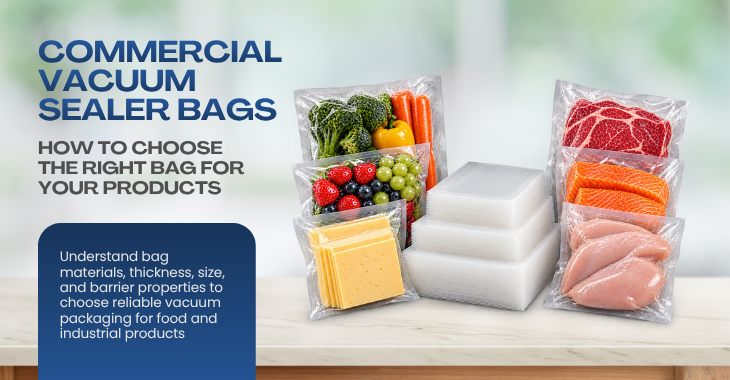
Choosing a vacuum sealer bag for a commercial operation is not as simple as finding a bag that fits inside a chamber vacuum sealer.
A restaurant packaging prepared meals has different requirements from a meat processor packaging bone-in beef. A seafood processor may need to deal with shells, moisture, and frozen storage, while a manufacturer packaging machined components may be more concerned about sharp edges, oils, handling, and protection during transportation. That is why commercial vacuum sealer bags should be selected according to the product, packaging process, storage conditions, equipment, and intended use.
For businesses using a chamber vacuum sealer every day, the bag becomes an important part of the entire packaging system. The right bag can help create consistent packages, support efficient production, protect products during normal handling, and provide a clean finished appearance. The wrong bag can lead to punctures, poor seals, wasted material, and unnecessary repackaging.
This guide looks at how businesses across food processing, foodservice, retail, manufacturing, and industrial packaging can evaluate commercial vacuum bags and choose a suitable option for their application.
What Are Commercial Vacuum Sealer Bags?
Commercial vacuum sealer bags are flexible packaging bags designed for use with professional vacuum packaging equipment.
Unlike ordinary storage bags, commercial vacuum bags are manufactured for vacuum packaging applications where air is removed from around a product before the bag is sealed. Many professional operations use chamber vacuum sealers because chamber machines can efficiently package a wide range of products, including products containing moisture or liquids when the equipment and packaging process are properly configured.
Commercial vacuum bags are available in different sizes, thicknesses, materials, constructions, and configurations. The appropriate specification depends on what is being packaged. For example, a bag used for sliced deli meat may not require the same characteristics as one used for bone-in beef, seafood with shells, or a heavy industrial component. The goal is not simply to find the thickest or strongest bag. The goal is to find the right vacuum packaging bag for the application.
Why Bag Selection Matters in Commercial Vacuum Packaging
A commercial packaging operation may process dozens, hundreds, or thousands of products every day. Small packaging problems can therefore become expensive when repeated across an entire production line. Consider what happens when a bag is poorly matched to a product.
A sharp bone may puncture the package. A contaminated sealing area may produce a weak seal. An incorrectly sized bag may increase material waste. A bag that is difficult to load can slow down production. A packaging material that is not suitable for the intended storage or temperature conditions can create problems later in the supply chain.
For a high-volume business, these issues affect more than packaging costs.
They can also affect:
- Labor efficiency
- Production speed
- Product handling
- Storage
- Transportation
- Package appearance
- Material consumption
- Rework
- Product protection
This is why commercial buyers should evaluate the entire packaging application before ordering vacuum bags in bulk.
How to Choose Commercial Vacuum Sealer Bags
Before choosing a vacuum bag, start with the product.
Ask a few basic questions:
What are you packaging?
How large and heavy is the product?
Does it contain liquid or moisture?
Does it have bones, shells, corners, or sharp edges?
Will it be refrigerated or frozen?
Will the package be transported long distances?
Will the bag be used for food, industrial, retail, or another application?
What type of chamber vacuum sealer will be used?
These questions can narrow down the appropriate bag construction much more effectively than selecting packaging based only on thickness or price.
Commercial Vacuum Bags for Meat Processing
Meat processing is one of the largest applications for vacuum packaging. But even within the meat industry, packaging requirements can vary significantly. A processor handling boneless steaks has a different challenge from a company packaging bone-in beef. A poultry processor may have different requirements from a sausage manufacturer or a business producing portioned ground beef.
Beef and Red Meat
Commercial vacuum packaging can be used for steaks, roasts, ground beef, beef cuts, and other meat products. For boneless products, the primary concerns may include package size, seal quality, product presentation, storage, and handling. Bone-in products introduce another consideration: puncture risk. Bones can create concentrated pressure against flexible packaging material, particularly when products are moved, stacked, or transported. Businesses packaging bone-in meat should therefore evaluate the actual product and test the selected vacuum bag under normal handling conditions.
Ground Beef
Ground beef is commonly packaged into portions, bricks, bulk packs, or other standardized formats. For commercial ground meat operations, consistency can be just as important as bag strength. A standardized bag size can make it easier for employees to load products quickly, maintain consistent package dimensions, organize inventory, and stack finished packages efficiently. For businesses producing large volumes of ground beef, small improvements in packaging workflow can add up over time.
Poultry
Chicken and other poultry products can contain moisture and may have irregular shapes or protruding bones. The bag needs to provide enough room for the product while leaving an appropriate sealing area. Operators should also make sure that meat, juices, fat, or other product residue does not contaminate the seal area. A good vacuum packaging process combines suitable packaging material with proper product positioning and machine settings.
Vacuum Sealer Bags for Seafood
Seafood creates some of the most interesting challenges in commercial vacuum packaging.
Fish, shrimp, scallops, squid, lobster, crab, and other seafood products can contain significant moisture. Shells, bones, fins, and irregular surfaces can also place additional stress on flexible packaging.
Fish and Fish Fillets
Fish fillets need to be packaged carefully because they can be delicate and irregularly shaped. The bag should be large enough to accommodate the product without excessive material around it. For processors selling fresh or frozen fish, the packaging operation should also account for the product’s expected storage and transportation conditions. A package that looks perfect immediately after sealing should still be evaluated after refrigeration, freezing, stacking, and normal handling.
Shrimp and Shellfish
Shrimp and shellfish can present additional puncture challenges because of shells and other hard surfaces. Seafood businesses should evaluate how the finished package behaves during:
- Vacuuming
- Sealing
- Chilling
- Freezing
- Stacking
- Transportation
- Loading and unloading
A suitable commercial vacuum bag should be selected based on the complete process rather than simply its appearance or price.
Seafood Distribution
Seafood distributors may handle packages multiple times before they reach the final customer. The product can move from processing facilities to cold storage, transportation, wholesalers, restaurants, retailers, or other foodservice operations. Consistent packaging can make these handling stages easier while providing a controlled package format for storage and distribution.
Vacuum Packaging Bags for Ready-to-Eat and Prepared Foods
Prepared foods are an increasingly important commercial vacuum packaging application. Food manufacturers, restaurants, catering businesses, commissary kitchens, and meal-prep companies may package:
- Ready-to-eat meals
- Cooked meat
- Cooked chicken
- Pasta
- Rice dishes
- Lasagna
- Soups
- Sauces
- Prepared vegetables
- Portion-controlled meals
- Meal-prep products
- Sous vide products
Many of these products contain moisture, sauces, or other ingredients that make chamber vacuum packaging particularly useful.
Ready-to-Eat Meals
A manufacturer producing hundreds or thousands of meals needs packaging that fits its production process. The bag should accommodate the portion while providing enough space for proper sealing. Production teams also need to consider how quickly packages can be loaded, evacuated, sealed, inspected, labeled, chilled, frozen, and stored. This is where commercial vacuum packaging becomes more than a food-preservation technique. It becomes part of the manufacturing workflow.
Soups and Sauces
Liquid-rich foods require particular attention during vacuum packaging. Chamber vacuum technology can be useful for products containing liquids because the pressure inside the chamber is controlled during the vacuum cycle. However, businesses should use packaging and machine settings appropriate for the specific product and process. The sealing area should remain as clean as possible. Liquid or food particles in the seal zone can compromise seal quality.
Commercial Vacuum Bags for Restaurants and Foodservice
Vacuum packaging is not limited to large food factories. Restaurants, hotels, catering companies, meal-preparation businesses, and commissary kitchens can also use chamber vacuum sealers for professional food preparation and packaging.
A restaurant might use vacuum bags for:
- Portioning
- Prepared ingredients
- Meat cuts
- Seafood
- Sauces
- Prepared vegetables
- Meal components
- Selected sous vide applications
- Refrigerated storage
- Freezer storage
The requirements of a restaurant can be different from those of a large processor.
A restaurant may value flexibility, convenient bag sizes, easy storage, and fast packaging. A large processor may place greater emphasis on automated workflow, standardized dimensions, bulk purchasing, and production volume.
The right commercial vacuum bag should match the operation.
Vacuum Bags for Sous Vide Applications
Sous vide cooking has created another important application for vacuum packaging. In professional kitchens, food is placed inside a vacuum bag, air is removed, and the sealed package is used according to the restaurant’s established cooking process. However, businesses should not assume that every vacuum bag is automatically suitable for high-temperature cooking.
Bag thickness by itself does not determine temperature suitability.
Material construction, manufacturer specifications, sealing characteristics, and intended application all matter. Businesses using vacuum bags for sous vide should therefore verify that the selected bag is appropriate for the specific temperature and cooking conditions.
Commercial Vacuum Bags for Cheese and Dairy Products
Cheese and dairy products can also be packaged using commercial vacuum packaging.
Applications can include:
- Cheese blocks
- Cheese portions
- Specialty cheeses
- Foodservice cheese
- Retail cheese
- Selected dairy products
The requirements vary depending on the product. Hard cheese, soft cheese, sliced products, and irregular portions may behave differently during vacuum packaging. For dairy processors, maintaining a clean sealing area is especially important. Product residue or moisture in the seal area can interfere with a reliable seal.
The finished package should also be evaluated according to its intended storage, handling, and distribution environment.
Vacuum Sealer Bags for Frozen Foods
Freezing introduces another set of packaging considerations.
Frozen products may be handled repeatedly as they move from processing to storage, transportation, distribution, retail, or foodservice. Commercial vacuum bags for frozen food should therefore be selected according to the product and the intended temperature conditions.
Common applications include:
- Frozen beef
- Frozen poultry
- Frozen seafood
- Frozen prepared meals
- Frozen vegetables
- Portion-controlled frozen foods
Businesses should verify the manufacturer’s specifications for the selected bag before using it for a particular freezing application. A package that performs well at room temperature should not automatically be assumed to perform identically after freezing.
Commercial Vacuum Packaging for Bakery Products
Vacuum packaging can also be used for selected bakery and food products, although the application needs to be evaluated carefully. Soft or delicate products can be compressed during vacuuming. For products where appearance is important, the packaging process needs to balance air removal with the physical characteristics of the product. Depending on the product, businesses may need to evaluate vacuum levels, packaging sequence, bag dimensions, and handling requirements.
The important lesson is simple:
The product should determine the packaging process, not the other way around.
Industrial Vacuum Packaging Bags
Commercial vacuum packaging is not limited to food. Manufacturers, distributors, and industrial businesses can use flexible vacuum packaging for selected components and products.
Potential applications include:
- Machined metal parts
- Automotive components
- Hardware
- Electrical components
- Small mechanical assemblies
- Manufacturing parts
- Industrial kits
- Tools and selected equipment components
Industrial packaging introduces requirements that are often completely different from food packaging.
The goal may be to provide protection from moisture, contamination, handling, or environmental exposure rather than to package a product for direct consumer consumption.
Packaging Machined Parts
Machined components may have corners, edges, threads, burrs, or other surfaces that can stress flexible packaging. A lightweight smooth component may be relatively easy to package. A heavy metal part with sharp corners is a different matter. Before purchasing industrial vacuum bags in bulk, manufacturers should test representative products under actual packaging and handling conditions. Additional internal protection may also be appropriate for products with significant puncture or abrasion risk.
Automotive and Mechanical Components
Automotive and mechanical parts can vary enormously in shape and weight. Some components may be suitable for flexible vacuum packaging, while others may require a more robust packaging system.
Businesses should consider:
- Part weight
- Sharp edges
- Surface finish
- Oil or lubricant exposure
- Moisture requirements
- Storage conditions
- Transportation
- Handling
The vacuum bag should be considered as one component of the overall packaging system.
Electrical and Electronic Components
Selected electrical and electronic components may require protection from environmental conditions during storage and transportation. Whether a vacuum bag is appropriate depends on the particular component and its sensitivity to moisture, static electricity, pressure, and other factors. For specialized industrial applications, businesses should verify material compatibility and packaging requirements rather than assuming a general-purpose food vacuum bag is suitable.
Vacuum Packaging Bags for Retail and E-Commerce
Small manufacturers and online businesses are also becoming commercial users of vacuum packaging. Specialty food companies, subscription businesses, butcher shops, seafood sellers, and other product businesses may use vacuum packaging to create consistent retail-ready packages. For e-commerce businesses, packaging can become particularly important because the product may travel through several transportation and handling stages before reaching the customer.
The packaging needs to match the product, shipping environment, storage requirements, and expected handling. For retail products, appearance matters too. A clean, consistent vacuum package can create a more organized presentation than irregular packaging, particularly when multiple products are displayed together.
How to Select the Right Vacuum Bag Thickness
Thickness is an important consideration, but it should not be the only consideration. Vacuum bags are available in different thicknesses and constructions for different applications. A thinner bag may be appropriate for a relatively smooth product with low puncture risk. A heavier construction may be appropriate where the product is more demanding.
However, thicker does not automatically mean better. The correct specification depends on:
- Product characteristics
- Puncture risk
- Bag material
- Film construction
- Seal requirements
- Temperature
- Storage
- Transportation
- Machine compatibility
- Application requirements
For businesses considering 3 mil bags, Promarks also provides a detailed guide to help determine whether 3 mil vacuum seal bags are strong enough for a particular product and application.
Choosing the Right Bag Size
Bag dimensions are just as important as material selection. A bag that is too small can make loading difficult and interfere with sealing. A bag that is unnecessarily large increases material usage and can make the packaging process less efficient. Commercial operations should establish standard bag sizes for their most common products wherever practical. For example, a meat processor may use different sizes for steaks, ground beef, roasts, and bulk products. A prepared-food manufacturer may have separate bag dimensions for individual meals and family-size portions. Standardization can simplify inventory management and make employee training easier.
Chamber Vacuum Sealer Compatibility
The bag should be compatible with the chamber vacuum machine used by the business. Commercial chamber vacuum sealers vary in chamber dimensions, sealing-bar configuration, vacuum capacity, and operating characteristics. Before purchasing vacuum bags in bulk, businesses should confirm:
- Bag dimensions
- Chamber size
- Sealing-bar length
- Bag opening position
- Product dimensions
- Machine specifications
- Intended packaging cycle
The objective is to create a repeatable process in which operators can load, vacuum, seal, remove, and inspect packages efficiently.
Common Commercial Vacuum Packaging Problems
Even the right vacuum bag can produce poor results if the packaging process is inconsistent.
Bag Punctures
Sharp bones, shells, corners, or industrial components can puncture flexible packaging. If punctures occur repeatedly, examine the product and packaging process rather than simply increasing bag thickness.
Weak Seals
Food, grease, liquid, or debris in the sealing area can prevent a proper seal. Operators should keep the sealing zone clean and follow the equipment manufacturer’s recommended settings.
Incorrect Bag Size
A bag that is too small can be difficult to load. An oversized bag can increase material consumption. Choosing standardized dimensions based on actual products can improve efficiency.
Inconsistent Vacuum
Machine settings, product positioning, bag placement, and product characteristics can all affect the vacuum cycle. Commercial operations should establish repeatable procedures for frequently packaged products.
Buying Commercial Vacuum Sealer Bags in Bulk
High-volume businesses often purchase vacuum bags in bulk. Before placing a large order, conduct a practical packaging test. Use the actual product and the actual vacuum machine whenever possible.
Test:
- Bag size
- Product loading
- Vacuum cycle
- Seal quality
- Package appearance
- Handling
- Refrigeration or freezing
- Transportation
- Storage
- Final package condition
This provides a much more reliable evaluation than comparing prices alone. The cheapest bag per unit is not necessarily the lowest-cost packaging solution if it creates more punctures, failed seals, labor, or product rework.
What Should Commercial Buyers Look for in a Vacuum Bag Supplier?
A commercial buyer should consider more than the bag itself. Look for a supplier that can help answer practical questions about:
- Available sizes
- Bag thickness
- Material construction
- Chamber compatibility
- Food applications
- Industrial applications
- Storage conditions
- Bulk quantities
- Packaging requirements
- Custom requirements where available
For high-volume operations, consistent supply is also important. A packaging process depends on having the right bags available when production needs them.
Commercial Vacuum Packaging Starts With the Product
There is no universal vacuum bag that is perfect for every application. The right packaging choice depends on what you are packaging and what happens to the package after it leaves the vacuum chamber. A meat processor needs to think about bones, moisture, product shape, storage, and distribution. A seafood processor needs to consider shells, moisture, freezing, and handling. A prepared-food manufacturer needs to think about liquids, portion sizes, production speed, and storage. A restaurant may prioritize flexibility and fast packaging. An industrial manufacturer may need to consider heavy components, sharp edges, oils, moisture, and transportation. That is why selecting commercial vacuum sealer bags should be treated as a packaging decision rather than simply a purchasing decision.
Find Commercial Vacuum Packaging Solutions From Promarks
Promarks provides commercial vacuum packaging equipment and solutions for businesses across food processing, foodservice, manufacturing, and other professional applications.
From meat and seafood to prepared foods and selected industrial products, the right combination of commercial vacuum bags and chamber vacuum packaging equipment can help businesses build a more consistent packaging workflow. If you are unsure which vacuum bag size, thickness, or construction is appropriate for your product, start with the application. Consider the product’s size, shape, moisture, sharp edges, storage temperature, handling requirements, and packaging volume. Then test the packaging under the conditions in which your business actually operates.
Looking for commercial vacuum sealer bags for your operation? Contact Promarks to discuss your packaging requirements and find a vacuum packaging solution suited to your application.
Frequently Asked Questions
What are commercial vacuum sealer bags used for?
Commercial vacuum sealer bags are used to package a wide range of food and selected industrial products. Common applications include meat, poultry, seafood, cheese, prepared foods, frozen foods, restaurant ingredients, meal-prep products, and certain industrial components.
Are chamber vacuum bags suitable for commercial food packaging?
Yes. Chamber vacuum bags are commonly used with professional chamber vacuum sealers for commercial food packaging. The appropriate bag depends on the food product, machine, storage conditions, and intended application.
What vacuum bags are best for meat?
The appropriate bag for meat depends on the product. Boneless cuts, ground meat, poultry, and bone-in products can have different packaging requirements. Businesses should consider product size, moisture, puncture risk, storage temperature, and handling.
Can commercial vacuum bags be used for seafood?
Yes, vacuum packaging bags can be used for many seafood products. Fish, shrimp, shellfish, and other seafood may require careful consideration of moisture, shells, bones, product shape, freezing, and transportation.
What vacuum bags are used for prepared foods?
Prepared foods can be packaged using suitable chamber vacuum bags. Applications can include prepared meals, cooked meat, pasta, rice dishes, sauces, soups, vegetables, and meal-prep portions. The selected bag should be compatible with the product and intended storage or cooking conditions.
Can vacuum bags be used for industrial parts?
Selected industrial parts can be packaged using vacuum bags. However, manufacturers should evaluate the product’s weight, shape, sharp edges, oils, chemicals, moisture requirements, and transportation conditions before selecting packaging material.
Does a thicker vacuum bag always provide better protection?
No. Thickness is only one factor. Material construction, film properties, product characteristics, seal quality, temperature, and handling conditions can all affect packaging performance.
How do I choose the right size commercial vacuum bag?
Measure the product and consider how it will be positioned inside the chamber. The bag should provide sufficient room for loading and sealing without being unnecessarily oversized.
Can the same vacuum bag be used for food and industrial products?
Not automatically. Food and industrial applications can have very different material, regulatory, compatibility, and performance requirements. The bag should be selected according to its intended application and manufacturer specifications.
How can I reduce vacuum bag waste?
Use standardized bag sizes where practical, select bags that closely match your products, avoid unnecessarily large bags, and train operators to position products consistently before vacuuming and sealing.
Should I test vacuum bags before buying in bulk?
Yes. Commercial buyers should test the actual bag with representative products and the equipment used in production. Evaluate sealing, puncture resistance, handling, storage, and transportation before committing to a large purchase.
Final Takeaway
The best commercial vacuum sealer bag is not necessarily the thickest, largest, or cheapest option. It is the bag that matches the product and the packaging process. For meat processors, seafood companies, restaurants, prepared-food manufacturers, retailers, meal-prep businesses, and industrial manufacturers, the right choice begins with understanding the product and its journey from packaging to final use. Evaluate the product. Check the machine. Consider storage and handling. Test the package under real conditions. Then choose the vacuum bag specification that fits the application. That approach can help businesses build a more reliable and efficient commercial vacuum packaging operation.