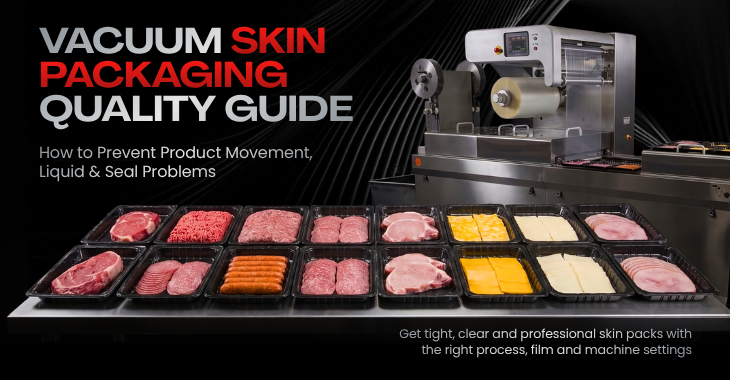
Vacuum skin packaging (VSP) is one of the most attractive and secure package formats available for fresh meat, seafood, dairy products, ready-to-eat foods, and other items that benefit from a tight, high-clarity presentation. When the process is dialed in, the result is easy to recognize: the top film follows the contours of the product, there’s little to no visible air space, the product stays firmly in position, and the seal stays clean and secure around the package.
When something’s off, the signs are just as easy to spot the product may shift inside the package, liquid or meat purge may collect near the seal, air pockets can linger around the product, or the film may wrinkle instead of forming tightly. Sometimes a package looks perfect leaving the machine but develops a leak later. Left unaddressed, these inconsistencies can lead to product waste, rework, customer complaints, and unnecessary downtime.
The good news is that these issues are rarely caused by a single factor, which means there’s usually more than one lever available to fix them. Film selection, product preparation, positioning, forming temperature, vacuum performance, sealing conditions, tooling, and operator practices all shape the final package. VSP works by heating a flexible barrier film and drawing it tightly around the product, letting the product itself act as the forming shape the result is a close-fitting “second skin.” This guide walks through the most common VSP quality issues and practical, proven ways to prevent them.
What Is Vacuum Skin Packaging?
Vacuum skin packaging uses a heat-softened top film that’s drawn under vacuum over a product and sealed to a compatible base material or tray. Unlike a conventional vacuum pouch, the film doesn’t just collapse around the product it conforms closely to its shape, creating a tight package with minimal headspace and a highly visible presentation. That close fit also helps limit product movement, which is why VSP is a popular choice for steaks, poultry, seafood, sliced meats, cheese, prepared foods, and other items where appearance and package integrity matter.
Research and technical literature consistently point to real advantages here: reduced visible air space, an attractive product presentation, and in many applications, lower purge compared with other vacuum-packaging formats. Realizing those benefits, though, depends on properly matching the process to the product, film, tooling, and machine which is exactly what this guide will help you do.
Why Does Product Move Inside a Vacuum Skin Pack?
One of the biggest advantages of skin packaging is that the film should hold the product closely in place, so any movement after packaging is worth investigating. It typically happens when the film doesn’t conform tightly enough, when residual air remains between the film and product, when the product is positioned incorrectly, or when the film and forming conditions aren’t well matched to the product’s geometry.
Common contributing factors include incomplete vacuum drawdown, excessive residual air, incorrect film temperature, poor film-forming characteristics, incorrect product positioning, difficult product geometry, insufficient film conformity, inadequate sealing around the product, improper tooling or mold configuration, and excessive liquid between the product and film.
It’s worth emphasizing: the fix isn’t simply to “turn up the vacuum.” Vacuum level is only one part of the equation the film also needs to soften and stretch correctly so it can follow the product’s surface without excessive thinning, tearing, or trapping air. A well-designed skin pack uses the product itself as the forming shape, letting the heated film conform closely to its contours. That close fit is exactly why skin packaging can outperform looser formats when it comes to keeping product immobilized.
How to Prevent Product Movement in Vacuum Skin Packaging
Start with product placement. The product should sit consistently within the intended packaging area and stay clear of the sealing zone when operators position the same product differently from cycle to cycle, the amount of film needed to form around it changes too.
Product height and shape matter just as much. A tall product with sharp edges calls for different forming conditions than a relatively flat steak or fillet, and irregular products can create areas where the film stretches more aggressively than elsewhere. The film needs to be capable of handling that geometry.
If movement persists, work through this list: product position, product height, product shape, film type and thickness, film heating, vacuum drawdown, tooling, seal location, product temperature, and machine cycle consistency. Resist the urge to compensate for every problem by simply increasing temperature or vacuum a setting that fixes one product can introduce film thinning, wrinkles, or new problems on another.
Why Is There Liquid Inside My Vacuum Skin Package?
Liquid is another common concern, especially with fresh meat, poultry, seafood, marinated products, and other foods that naturally release moisture during processing or storage think meat purge, water, marinade, brine, sauce, or fat.
It’s important to draw a clear distinction here: some purge is simply a product characteristic, not a machine failure. Liquid only becomes a packaging problem when it reaches the sealing area or interferes with contact between the film and product. Liquid inside the package is not automatically the same thing as a seal failure the real question is whether it’s affecting appearance, product quality, or seal integrity. Research on meat packaging identifies purge as an important visual and quality factor, and studies comparing packaging methods have found real differences in purge levels across formats.
How Does Liquid Cause Vacuum Skin Packaging Seal Problems?
The sealing area needs clean, consistent contact between the sealing surfaces. If meat juice, marinade, grease, fat, sauce, or small product particles get between the films at the sealing flange, the films may not bond correctly. That can produce a seal that looks fine at first but has a weak section one that can later open during handling, transport, refrigeration, or distribution.
A recent Promarksvac troubleshooting guide points to contaminated seal areas, film damage, and mismatched sealing or vacuum settings as leading causes of post-thermoforming leaks. Keep an eye out for these warning signs: liquid consistently appearing near one side of the seal, leaks concentrated around corners, food particles trapped in the seal, product extending into the sealing flange, grease or fat visible between the films, packages losing vacuum after several hours or days, and seals that peel apart more easily than expected.
If the same corner keeps developing leaks, don’t jump straight to raising the sealing temperature first figure out why contamination or product interference is reaching that spot.
How to Prevent Liquid From Causing Seal Problems
1. Keep the sealing area clean. This is often the simplest and most impactful step. The area where the top and bottom materials meet must stay free of product, liquid, grease, and debris. Make it a habit to inspect failed packages directly rather than judging only by finished-product appearance cut or peel open a failed package and pinpoint exactly where the seal gave way.
2. Avoid overfilling the package. The product needs adequate clearance from the sealing area. If it’s too large for the cavity or positioned too close to the edge, liquid and product particles are more likely to reach the seal. Correct pocket dimensions and consistent loading go a long way here.
3. Control product preparation. Product temperature, surface moisture, trimming, marination, and handling all shape how the process behaves. A product with excess surface liquid will behave differently from a relatively dry one the goal isn’t to force the product bone-dry, but to design the packaging process around its actual condition.
4. Use the right film. The film needs to deliver the forming, sealing, barrier, and mechanical properties the application demands. High-barrier materials are the standard choice for vacuum applications, since maintaining a low-oxygen environment depends on both strong material properties and solid seal integrity.
How to Get a Tight, Clear, Professional Vacuum Skin Pack
A great skin package does more than hold the product in place it makes the product look its best. For retail food packaging, the package is part of the product itself. A steak, chicken breast, fish fillet, cheese product, or prepared meal that’s clearly visible through a tight, transparent film makes a very different impression than one surrounded by wrinkles and air pockets.
The hallmarks of an ideal skin pack: tight film conformity, minimal residual air, clear product visibility, consistent sealing, minimal wrinkles, no film punctures, correct product positioning, clean package edges, and consistent package dimensions. VSP is purpose-built to conform closely to the product and showcase its natural shape and appearance getting there consistently is simply a matter of dialing in the right conditions.
Why Does Skin Packaging Film Wrinkle?
Wrinkles usually trace back to one of a few causes: the film wasn’t heated correctly, the forming process wasn’t consistent, the film’s characteristics don’t suit the application, or the product’s geometry is creating difficult forming conditions.
Film heating deserves special attention. Under-softened film won’t conform properly to the product, while overheated film can stretch excessively or develop other problems. Technical guidance for skin packaging also notes that heat can accumulate in the heating system over repeated cycles meaning a setting that worked perfectly at the start of a production run may behave differently later on.
That’s why pattern recognition matters more than any single fix. Ask: Do wrinkles show up on every package, or just certain products? Do they appear only after the machine has been running a while? Are they concentrated around corners? Tied to a particular film? Did the issue start right after a film or tooling change? These questions point you toward the real root cause instead of treating every wrinkle as a simple temperature fix.
How to Prevent Air Pockets in Vacuum Skin Packaging
The whole point of skin packaging is bringing the film in close against the product, so trapped air works directly against that goal. Air pockets typically stem from inadequate evacuation, poor airflow around the product, product geometry, incorrect film heating, film that isn’t conforming correctly, improper tooling, blocked or restricted vacuum paths, or product-loading issues. In meat packaging especially, these gaps deserve attention since residual spaces can allow purge to accumulate and detract from appearance and quality.
A practical troubleshooting approach: When an air pocket shows up, pinpoint exactly where it is. If it recurs in the same spot every time, look at product shape, tooling, and airflow. If it appears randomly, investigate machine consistency, film heating, vacuum performance, and loading. If it’s limited to one product type, geometry is likely the bigger factor. This targeted approach gets you to the answer faster than adjusting several machine settings at once.
Why Do Vacuum Skin Packages Leak After Sealing?
One of the more frustrating scenarios: a package that looks properly sealed and passes a basic visual check, only to develop a leak later. A few things typically explain this:
Contaminated sealing area food particles, liquid, grease, or residue preventing proper bonding. Incorrect sealing conditions temperature, pressure, and dwell time not matched to the film and system. Damaged film punctures from forming or sharp product edges. Excessive film stretching which can thin the top film in certain spots; Campden BRI notes this makes checking barrier properties after packing especially worthwhile. Product interfering with the seal an oversized or poorly positioned product entering the sealing area. Inconsistent forming uneven film formation putting excess stress on certain areas.
How to Improve Seal Integrity
Good seal integrity is built well before the sealing station it depends on the film, product, tray or base material, machine, and process parameters all working in sync.
Start with the packaging material: the film should be compatible with the machine and application, the sealing layer suited to the base material, and the overall construction should deliver the mechanical and barrier performance you need. Then look at the sealing area itself it should stay clean and flat enough for consistent contact. Finally, verify the process: visual inspection is useful but shouldn’t be your only check, since a package can look fine while the bond underneath is inadequate. Technical guidance recommends physical seal testing for this reason.
A strong quality-control program for commercial operations typically includes visual inspection, seal inspection, leak testing, peel or seal-strength testing where appropriate, periodic film inspection, product-weight verification, package appearance checks, and ongoing monitoring of machine parameters. The right testing methods will depend on your packaging material, product, process, and applicable food-safety requirements.
How Product Shape Affects Vacuum Skin Packaging
Not every product behaves the same way in a skin-packaging system. A flat chicken breast, a bone-in steak, a fish fillet, a block of cheese, and a prepared meal all call for different forming conditions.
Sharp-edged products (like bone-in meat) carry a higher puncture risk. Deep or irregular contours typically require more film stretching and careful forming. Uneven product heights across the same package can make consistent film distribution trickier. Moist products add another variable, since liquid can migrate during vacuum evacuation and potentially reach the sealing area. For all these reasons, it’s well worth running packaging trials with the actual commercial product rather than an empty tray or a sample with different geometry.
Choosing the Right Film for Vacuum Skin Packaging
Film selection is one of the most overlooked levers for consistent VSP quality and there’s no single film that’s automatically right for every product. Worth weighing: product type, weight, and geometry; bone or sharp-edge risk; desired shelf life; refrigerated versus frozen distribution; required oxygen and moisture barrier; forming characteristics; seal compatibility; puncture resistance; machine capabilities; and package appearance.
Vacuum packaging materials commonly use multilayer or coextruded constructions to deliver the right combination of barrier, strength, and heat-sealing performance. The film should be selected as part of the complete packaging system machine, product, and film together rather than in isolation.
How Machine Design Affects Skin Packaging Quality
Consistent skin packaging takes more than pulling a vacuum it requires controlled forming, reliable evacuation, accurate sealing, consistent indexing, and repeatable operation. In commercial production, this matters enormously, since even a small inconsistency repeated thousands of times can become a significant source of waste.
The Promarksvac PRSK-420M-240 Skin Pack Rollstock Machine is built for exactly this kind of demand commercial VSP applications where forming accuracy, sealing consistency, and production efficiency all matter. It features a 240 mm indexing system and a three-station loading area to keep product loading and production flow organized, along with Promax QK forming technology for controlled thermoforming and an integrated vacuum system operating across the top, bottom, and side of the package. Hinged flip-up forming and sealing upper molds give operators fast, easy access to tooling for quicker die changes.
Other standout features include a stainless steel frame and loading area, a 7-inch color HMI, motor-driven scrap material take-up, a chain lubrication system, an air-drying system, a rounded-corner cutting knife for rigid films, 240 mm advanced indexing, and a three-station loading area. For operations juggling frequent product changes, the quick-access mold design is a real efficiency win, since changeover time is such a big piece of overall line performance.
7 Practical Ways to Improve Vacuum Skin Packaging Quality
If your line is producing inconsistent packages, work through these areas systematically:
- Check product positioning, make sure operators load products consistently and keep them clear of the sealing area.
- Inspect the seal for contamination, look for liquid, meat particles, fat, or marinade trapped in failed seals.
- Evaluate the film, confirm it suits the product, forming depth, sealing system, and distribution conditions.
- Look for recurring air pockets, their location can reveal a lot about airflow, tooling, geometry, or forming.
- Monitor film heating, don’t assume one setting works equally well across every film and product.
- Inspect failed packages, not just good ones, a failed package often reveals more about the process than a successful one.
- Change one variable at a time, adjusting vacuum, temperature, dwell time, film, tooling, and position all at once makes it impossible to know what actually fixed the problem. A controlled approach delivers better long-term results.
Vacuum Skin Packaging Troubleshooting Checklist
| Problem | Possible Causes | What to Check |
|---|---|---|
| Product moves | Poor conformity, residual air, product position | Vacuum, film forming, loading |
| Air pockets | Poor evacuation, product geometry, restricted airflow | Vacuum path, tooling, product shape |
| Film wrinkles | Incorrect heating, forming conditions, film characteristics | Film temperature and forming |
| Liquid near seal | Product purge, marinade, poor loading | Product position and sealing flange |
| Weak seal | Contamination, incorrect sealing conditions | Seal area and process parameters |
| Package leaks | Seal contamination, puncture, poor bonding | Failed package location |
| Film tears | Sharp product edges, excessive stretching | Product geometry and film |
| Poor appearance | Wrinkles, air, inconsistent forming | Film, heat, vacuum, tooling |
| Excessive waste | Poor indexing, scrap handling, film setup | Machine settings and material handling |
| Inconsistent results | Operator variation or unstable process | Standard operating procedure |
Why Package Quality Matters Beyond Appearance
A good skin package isn’t just about looking attractive it directly shapes production efficiency, product protection, distribution success, waste levels, and how customers perceive the product. A poor seal can mean a rejected product. A punctured film can cause vacuum loss. An air pocket can undercut visual quality. Product movement can make packages harder to stack, transport, or display. And liquid near the seal can create both an appearance issue and a genuine seal-integrity risk. When these issues recur, the cost adds up fast across a production run which is exactly why it pays to treat skin packaging as one complete process rather than a single machine setting to tweak.
Frequently Asked Questions About Vacuum Skin Packaging
Why does my product move inside a vacuum skin package?
Product movement can result from insufficient film conformity, residual air, product positioning, unsuitable film characteristics, or forming conditions that don’t match the product’s geometry. Check product position, film, vacuum process, and forming conditions before adjusting machine settings.
Why is my vacuum skin packaging film wrinkling?
Wrinkles can stem from film heating, forming conditions, product geometry, vacuum drawdown, or film characteristics. If wrinkles only appear after the machine has been running a while, check whether heating conditions are shifting during continuous production.
How do I prevent liquid from entering the seal area?
Keep the sealing flange clear of product and liquid, ensure correct product positioning, avoid overfilling the cavity, and check whether excess purge or marinade is reaching the sealing area.
Why does my vacuum skin package leak after sealing?
Common causes include contaminated seals, incorrect sealing conditions, film punctures, excessive film stretching, or product interference with the sealing area. Inspect the failed package to find exactly where the leak began.
How do I get a tight vacuum skin package?
You’ll need the right film, correct forming conditions, effective vacuum evacuation, suitable tooling, consistent product positioning, and a clean sealing area. Increasing vacuum alone won’t solve every skin-packaging challenge.
How do I prevent air pockets in vacuum skin packaging?
Check vacuum evacuation, airflow, film heating, product geometry, tooling, and film compatibility. If air pockets consistently show up in the same spot, that location is a strong clue to the underlying cause.
Does vacuum skin packaging reduce product movement?
Yes, one of VSP’s defining traits is how closely the top film conforms to the product, which immobilizes it far more effectively than packaging formats with more internal space.
Is vacuum skin packaging suitable for fresh meat?
Absolutely. VSP is widely used for meat applications, including individual portions and retail cuts, and research has examined its positive effects on purge and color stability compared with other packaging formats.
What causes weak vacuum packaging seals?
Seal contamination, film incompatibility, incorrect temperature or dwell conditions, inadequate pressure, and product intrusion into the seal area can all play a role. Controlled testing rather than trial-and-error adjustments is the best way to pin down the exact cause.
How can I improve the appearance of my skin-packed products?
Focus on consistent product positioning, the right film, proper forming, effective vacuum evacuation, minimal residual air, clean seals, and well-tuned machine settings. The goal is a film that follows the product closely without excessive wrinkles or air pockets.
Final Thoughts: Better Skin Packaging Starts With Process Control
Vacuum skin packaging can deliver a tight, clear, professional package but the machine is only one part of the equation. When a product moves, liquid reaches the seal, air pockets appear, or packages start leaking, the answer is almost always found by looking at the complete process: start with the product, examine the film, check positioning and geometry, evaluate vacuum evacuation and forming, inspect the sealing area for contamination, and confirm the machine’s tooling and settings are matched to the application.
For commercial processors, consistency is the real goal. A skin package that looks excellent once isn’t enough the process needs to deliver that same result reliably across hundreds or thousands of cycles.
The Promarksvac PRSK-420M-240 Skin Pack Thermoform Packaging Machine is built exactly for this: a commercial thermoform skin packaging system with controlled forming, integrated vacuum sealing, efficient indexing, quick-access molds, and production-oriented features throughout. When the machine, film, product, tooling, and operating process all work together, vacuum skin packaging delivers what processors are really after secure product positioning, strong package integrity, attractive presentation, and consistent production performance.
If your current skin packaging line is dealing with product movement, liquid-related seal problems, air pockets, wrinkles, leaks, or inconsistent quality, the first step isn’t necessarily a new machine. Start by pinpointing where the problem occurs, when it occurs, and how consistently it happens that diagnosis will lead you straight to the real solution.