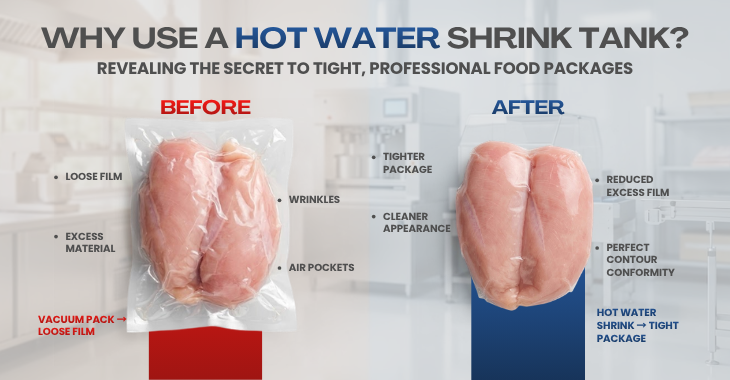
Vacuum packaging is widely used to remove air from around a product and create a sealed package. But removing air is only part of the packaging process. When a product is packaged in vacuum shrink film, the package may still have loose, wrinkled, or excess film around the product after vacuum sealing.
This is where a hot water shrink tank can make a difference.
By exposing a vacuum-packed product to controlled hot water, compatible shrink film contracts around the product. The result is a tighter, more form-fitting package with less excess film and a cleaner overall appearance.
The basic process is:
Vacuum Pack → Loose Film → Hot Water Shrink → Tight Package
For meat, seafood, prepared foods, frozen foods and other vacuum-packaged products, hot water shrinking can be an important step in achieving a consistent finished package.
What Happens After Vacuum Packaging?
During vacuum packaging, air is removed from the package before the bag is sealed.
The process helps:
- Reduce air surrounding the product
- Create a sealed package
- Protect the packaged product from exposure to the surrounding environment
- Produce a compact package
- Improve storage and handling
However, vacuum sealing does not necessarily mean that the packaging film will perfectly conform to every part of the product.
Depending on the product shape and the film being used, you may see:
- Loose film
- Wrinkles
- Excess material around the product
- Air pockets or uneven-looking areas
- Film that does not closely follow the product contours
For applications where package appearance and film conformity are important, a vacuum shrink film and hot-water shrinking process can provide an additional step after vacuum sealing.
What Is a Hot Water Shrink Tank?
A hot water shrink tank is a packaging machine that uses controlled hot water to shrink compatible vacuum shrink film around a packaged product.
It is also commonly referred to as a hot water dip tank or shrink tank machine.
The vacuum-packed product is placed into the hot water area for a controlled period. Heat causes the shrink film to contract, allowing it to conform more closely to the product.
The purpose is not to vacuum the product again. Instead, the shrink tank is used to shrink the packaging film after vacuum sealing.
This creates a two-stage packaging process:
Stage 1: Vacuum packaging removes air and seals the package.
Stage 2: Hot-water shrinking tightens the compatible film around the product.
Quick Specs at a Glance
- Recommended product weight: below 8 kg
- Maximum water temperature: not to exceed 100°C
- Approximate machine weight: 100 kg (220 lbs)
- Cleaning: by hand daily, mild detergent never hose down directly
- Film requirement: vacuum shrink film only (standard vacuum pouches are not designed for this process)
Why Use a Hot Water Shrink Tank After Vacuum Packaging?
There are several reasons processors may add hot-water shrinking to their vacuum packaging process.
1. Creates a Tighter Package
One of the primary purposes of hot-water shrinking is to make the film conform more closely to the product.
Instead of leaving excess film loosely around the product, compatible shrink film contracts when exposed to heat.
The finished package can therefore have a more compact, form-fitting appearance.
2. Reduces Loose and Excess Film
After vacuum sealing, some products may have areas of film that extend away from the product surface.
Hot-water shrinking can reduce this excess by allowing the film to contract around the product.
This is particularly useful when the finished package needs to have a clean and consistent appearance.
3. Improves Package Appearance
Packaging appearance matters in food processing.
A package with loose, wrinkled film can look different from one where the film closely follows the product.
Hot-water shrinking can help create:
Loose Film → Tight Film
This can provide a cleaner and more consistent presentation across packaged products.
4. Helps Film Conform to Product Shape
Not every product has a simple rectangular shape.
Meat cuts, seafood and prepared foods can have irregular surfaces and contours.
Compatible vacuum shrink film is designed to contract when exposed to the appropriate heat. A hot water shrink tank provides a controlled environment for that shrinking process.
The result is film that follows the product shape more closely.
5. Creates More Consistent Finished Packages
Consistency is particularly important in commercial food processing.
A controlled shrinking process can help processors achieve a more uniform appearance from package to package.
The exact result depends on several factors, including:
- Product shape
- Product size
- Film type
- Film thickness
- Film shrink characteristics
- Water temperature
- Shrink time
- Machine settings
For this reason, the shrink process should be matched to the packaging material and product application.
How Does Hot Water Shrinking Work?
The basic process is simple.
Step 1: Prepare the Product The product is prepared according to the normal production process.
Step 2: Vacuum Package the Product The product is placed inside compatible vacuum shrink film. The vacuum packaging machine removes air and seals the package.
Step 3: Transfer the Package to the Shrink Tank The sealed package is transferred to the hot water shrink tank.
Step 4: Apply Controlled Heat The package is exposed to hot water at the selected operating conditions. The heat causes the compatible shrink film to contract.
Step 5: Film Conforms to the Product As the film shrinks, it moves closer to the product surface.
Step 6: Remove the Finished Package The product exits the shrink tank with the film more tightly formed around it.
The overall process can be visualized as:
Product → Vacuum Package → Hot Water Shrink → Tight Package
Why Is Vacuum Shrink Film Important?
Not every vacuum bag is designed for hot-water shrinking.
This is an important distinction.
A standard vacuum pouch and a vacuum shrink pouch/film may be designed for different packaging processes. For a hot water shrink tank, the packaging material needs to have appropriate shrink characteristics for the intended process.
The Promarks ST-68 manual specifically states that vacuum shrink film must be used for the machine’s application.
Therefore, the film should be selected based on:
- Product type
- Product dimensions
- Required shrink temperature
- Required shrink time
- Film specifications
- Packaging equipment
- Final package requirements
Always follow the film manufacturer’s processing recommendations as well as the equipment manufacturer’s instructions.
Hot Water Shrink Tank Applications
Hot water shrinking is particularly relevant to food processing operations that use vacuum shrink packaging.
Meat Packaging Meat products are a common application for vacuum packaging and shrink film. Hot-water shrinking can help the film conform more closely to products such as beef, pork, poultry, processed meat, and other vacuum-packaged meat products. A tighter package can provide a cleaner and more consistent finished appearance.
Seafood Packaging Seafood products can have irregular shapes that make film conformity important. Hot-water shrinking can be used as part of the vacuum packaging process for compatible seafood products, including fish, seafood, frozen seafood, and prepared seafood products.
Prepared Foods Prepared foods can also be packaged using vacuum shrink film. Depending on the product and packaging material, hot-water shrinking can provide a more compact and consistent package.
Frozen Foods The Promarks ST-68 is designed for applications including frozen food. For these applications, processors should ensure that the selected film and complete packaging process are appropriate for the product.
Hot Water Shrink Tank vs. Vacuum Packaging Machine
A hot water shrink tank does not replace a vacuum packaging machine. The two machines perform different functions.
| Equipment | Primary Function |
|---|---|
| Vacuum Packaging Machine | Removes air and seals the package |
| Hot Water Shrink Tank | Shrinks compatible film around the sealed package |
A typical process may therefore use both:
Vacuum Packaging Machine → Vacuum Shrink Film Package → Hot Water Shrink Tank → Tighter Finished Package
The shrink tank is an additional stage in the packaging process.
Hot Water Shrink Tank vs. Hot Water Dip Tank
You may see both terms used when researching packaging equipment: Hot Water Shrink Tank and Hot Water Dip Tank.
In many packaging applications, these terms describe the same basic process: immersing a vacuum-packaged product in controlled hot water to shrink compatible film.
The term shrink tank emphasizes the result the film shrinks around the product. The term dip tank emphasizes the process the package is dipped into hot water.
What Factors Affect the Shrink Result?
A hot water shrink tank does not automatically produce the same result for every product. Several variables affect the finished package.
Film Type – Different shrink films have different shrink characteristics.
Product Shape – Irregular products may require different processing conditions from products with uniform shapes.
Product Size – Larger packages may require different handling and process conditions.
Water Temperature – The temperature needs to be appropriate for the selected shrink film and application.
Shrink Time – The amount of time the package is exposed to hot water affects the shrinking process.
Package Orientation – How the product enters and moves through the shrink tank can also affect the result.
For these reasons, processors should establish appropriate operating parameters through testing and follow the recommendations of their packaging-film supplier and equipment manufacturer.
Promarks ST-68 Hot Water Shrink Tank
The Promarks ST-68 Hot Water Shrink Tank is designed for vacuum shrink film applications in food processing and packaging operations.
According to the ST-68 operating manual, applications include:
- Frozen food
- Seafood
- Prepared food
- Meat
- Soaked foods
The manual recommends a product weight below 8 kg and specifies the use of vacuum shrink film.
The ST-68 provides controls for important operating functions, including:
- Working temperature
- Heating (with selectable heating modes – see below)
- Water supply
- Conveyor operation
- Dipping operation
- Product movement
- Ventilation
- Manual operation
- Programmable feeding, dipping, drop, and waiting times per production program
The machine also monitors operating conditions such as water level, temperature, motor operation, conveyor operation and air pressure.
For processors looking to add a controlled shrinking stage after vacuum packaging, the ST-68 can be incorporated into the overall packaging workflow.
ST-68 Temperature and Water-Level Control
Consistent operating conditions are important for a hot water shrink tank.
The ST-68 allows operators to set the working temperature and includes a maximum temperature parameter. The manual specifies that the maximum temperature setting should not exceed 100°C.
The machine also monitors water level. If the water level falls below the required lower level, the system can automatically supply water until the appropriate level is reached.
These controls help maintain the operating conditions required for the shrinking process.
ST-68 Heating Modes
The ST-68 includes two heater operating modes, each using the machine’s five heating-element banks.
HEATER HIGH All five heating banks run together until the water reaches the selected set temperature, then heating stops.
HEATER LOW All five heating banks run initially to bring the water up to the set temperature. Once that temperature is reached, two banks shut off automatically, and the remaining three continue cycling to hold the set temperature. This gives operators a lower-output mode for maintaining temperature rather than running at full heating capacity continuously.
The correct setting should be selected according to the machine’s operating instructions and production requirements.
Cleaning and Maintenance of a Hot Water Shrink Tank
Regular cleaning is important for food packaging equipment.
The ST-68 manual recommends daily cleaning and specifies cleaning by hand using a mild detergent.
The manual also warns operators not to directly hose down the machine.
Operators should follow the manufacturer’s cleaning procedure and ensure that the machine is properly maintained.
Regular cleaning can help maintain equipment condition and support hygienic packaging operations.
Common ST-68 Operating Alerts
The ST-68 control system includes alerts for several operating conditions. Examples include:
- Water Lower Level
- Temperature Over
- Heater Error
- Motor Over
- Conveyor Over
- Blower Over
- Air Pressure Error
- Circuit Breaker Over
- NFB Over
These alerts help operators identify conditions that may require attention.
Operators should follow the ST-68 manual when responding to an alert. Electrical repairs, adjustments and service work should be handled by qualified maintenance personnel.
When Should You Consider a Hot Water Shrink Tank?
A hot water shrink tank may be worth considering if your vacuum packaging process requires:
- Tighter-fitting packages
- Better film conformity
- Reduced excess film
- More consistent package appearance
- A controlled shrinking step after vacuum sealing
- High-volume or commercial food packaging
It may be particularly relevant for processors packaging meat, seafood, frozen foods and prepared foods using compatible vacuum shrink film.
The right equipment depends on your product, film, production volume and required packaging result.
Final Thoughts
Vacuum packaging and hot-water shrinking serve two different purposes.
Vacuum packaging removes air and seals the product. Hot-water shrinking helps compatible shrink film conform tightly around the sealed product.
When these processes are combined, processors can achieve a tighter, cleaner and more consistent finished package.
The basic workflow is simple:
Vacuum Pack → Loose Film → Hot Water Shrink → Tight Package
For food processors using vacuum shrink film, a hot water shrink tank can therefore be an important part of the overall packaging process.
If you are evaluating a hot water shrink tank for meat, seafood, frozen food or prepared-food packaging, contact Promarks to discuss your product, film, production requirements and equipment needs.