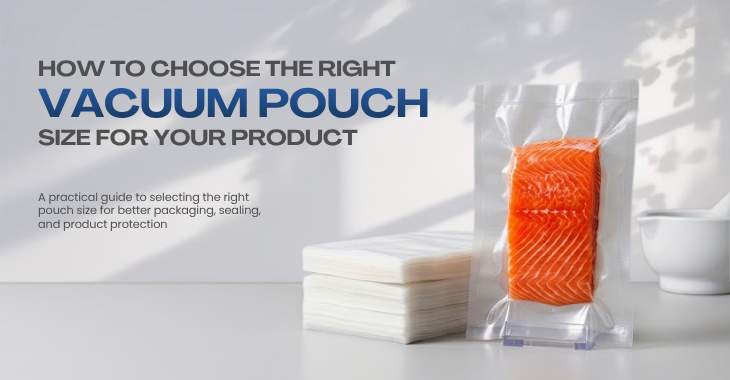
Choosing the right vacuum pouch size is an important part of an effective vacuum packaging operation. Whether you are packaging fresh meat, seafood, cheese, vegetables, prepared meals, medical supplies, or industrial components, the size of your vacuum pouch directly affects packaging quality, product presentation, storage efficiency, and operating costs.
A pouch that is too small can make product loading difficult, create wrinkles around the sealing area, or prevent the package from sealing correctly. On the other hand, an oversized pouch can increase packaging material costs, occupy unnecessary storage space, and make your finished products look less professional. Selecting the correct pouch size helps maintain consistent packaging results while reducing material waste and improving production efficiency.
For businesses using commercial vacuum packaging machines, pouch selection involves more than measuring the product’s length and width. You must also consider product thickness, shape, weight, sharp edges, moisture content, required barrier protection, sealing margins, and machine compatibility.
For example, a meat processor packaging individual pork chops has different packaging requirements from a seafood processor packaging whole fish fillets or a food manufacturer packaging bulk quantities of shredded cheese. Each application requires a pouch that accommodates the product comfortably while providing enough material for reliable vacuum sealing.
This guide explains how to measure your products, calculate suitable vacuum pouch dimensions, select the right pouch construction and thickness, and test packaging materials before purchasing them in bulk.
Why Choosing the Correct Vacuum Pouch Size Matters
Vacuum packaging removes air from a pouch before sealing it, helping protect the packaged product from exposure to oxygen and external contaminants. However, the effectiveness and consistency of the packaging process depend on selecting the appropriate pouch.
The right pouch size provides several operational and packaging benefits.
1. Reliable and Consistent Sealing
A vacuum pouch must have enough space to accommodate the product without interfering with the sealing area. When a pouch is too small, the product may extend too close to the opening, making it difficult to position the bag correctly.
Food particles, grease, moisture, and product residue can also reach the sealing area when there is insufficient clearance. These contaminants may interfere with the heat-sealing process and result in weak or incomplete seals.
Choosing an appropriately sized pouch gives operators enough room to position the product and keep the sealing area clean.
2. Better Product Protection
A properly sized pouch helps the packaging material fit around the product without unnecessary tension or excessive folds.
This is particularly important when packaging products with irregular shapes, bones, sharp edges, or delicate surfaces. If the pouch is too tight, sharp corners may stretch or puncture the material. If it is excessively large, additional folds and wrinkles may develop during vacuuming.
The goal is to achieve a close-fitting package without putting unnecessary stress on the pouch.
3. Reduced Packaging Costs
Packaging materials represent an ongoing expense for food processing facilities and manufacturing businesses.
Using oversized vacuum pouches increases material consumption with every packaged unit. Even a small difference in pouch dimensions can become expensive when a company packages hundreds or thousands of products daily.
For example, if a business packages 5,000 products each month, reducing unnecessary pouch material by even a small amount per package can generate meaningful savings over time.
Selecting the correct pouch dimensions helps businesses control packaging costs without compromising product protection.
4. Improved Storage and Transportation
Properly sized vacuum packages are generally easier to arrange in cartons, storage racks, refrigerated areas, and transportation containers.
When products are packaged consistently, businesses can improve carton utilization and make inventory handling more organized.
For meat, seafood, and prepared food manufacturers, consistent package dimensions can also help standardize product presentation for retail distribution.
5. Professional Product Presentation
Packaging influences how customers perceive a product.
An appropriately sized vacuum pouch provides a cleaner and more consistent appearance. This is particularly important for retail meat cuts, seafood portions, cheese products, and prepared foods displayed in refrigerated sections.
A properly fitted pouch can help showcase the product while reducing unnecessary material around it.
Step 1: Measure Your Product Before Selecting a Vacuum Pouch
The first step in choosing the correct vacuum pouch size is measuring the product accurately.
Do not select a pouch based only on the product’s length and width. Its thickness, shape, and overall dimensions also influence the amount of packaging material required.
For the most accurate results, measure the product in the same position in which it will be placed inside the pouch.
Measure Length
Measure the product from its longest point.
For example, if you are packaging a fish fillet measuring 10 inches from one end to the other, use that measurement as the product length.
For irregular products, measure from the farthest point rather than estimating based on the average dimensions.
Measure Width
Measure the widest part of the product.
This is especially important when packaging products such as whole fish portions, bone-in meat cuts, chicken breasts, and irregularly shaped food items.
A product may be relatively narrow at one end but considerably wider in the middle. Always use its maximum width when determining pouch requirements.
Measure Thickness or Height
Product thickness is one of the most frequently overlooked factors when selecting vacuum pouch dimensions.
A flat product, such as a thin cheese slice, requires less material than a thick steak, bone-in pork chop, or packaged portion of prepared food.
Measure the product at its thickest point. If several products will be packaged together, measure the combined stack rather than calculating dimensions for individual pieces.
Consider Product Shape
Not every product fits neatly into a rectangular package.
Consider the following examples:
- Boneless meat: Generally has a relatively consistent shape, making pouch sizing easier.
- Bone-in meat: Requires additional clearance and puncture-resistant packaging considerations.
- Fish fillets: May be long, flat, and delicate, requiring careful positioning.
- Whole seafood: May have irregular contours, fins, shells, or pointed edges.
- Cheese blocks: Often have predictable dimensions but may have sharp corners.
- Prepared meals: Can vary significantly in height and shape depending on the food and container.
For irregular products, measure the widest and thickest points and conduct a practical packaging test before finalizing the pouch size.
Step 2: Calculate the Required Vacuum Pouch Dimensions
Once you have measured the product, the next step is determining the pouch width and length.
The pouch must accommodate the product while leaving enough material around its edges and at the opening for proper sealing.
There is no single sizing formula that works perfectly for every product because product geometry, pouch construction, loading orientation, and packaging equipment can vary. However, the following method provides a useful starting point for conventional flat vacuum pouches.
Calculating Pouch Width
For a product positioned flat inside a pouch, consider:
Pouch Width = Product Width + Product Thickness Allowance + Side Clearance
A practical starting estimate is to allow approximately twice the product thickness across the pouch width, plus some additional clearance for positioning.
For example:
- Product width: 8 inches
- Product thickness: 2 inches
- Additional clearance: 1 inch
Estimated pouch width:
8 + (2 × 2) + 1 = 13 inches.
A pouch approximately 13 inches wide would be a starting point for testing.
This is not a universal specification. The actual requirement depends on the product’s shape, how it sits inside the pouch, and how tightly the packaging material needs to conform.
Calculating Pouch Length
Pouch length must accommodate the product’s longest dimension, its thickness, and the sealing area.
A useful starting estimate is:
Pouch Length = Product Length + Product Thickness Allowance + Sealing Margin
For example:
- Product length: 10 inches
- Product thickness allowance: 2 inches
- Sealing margin: 3 inches
Estimated pouch length:
10 + 2 + 3 = 15 inches.
This provides a starting pouch size of approximately 13 × 15 inches.
The sealing margin should be sufficient to keep the product away from the seal area and allow the operator to position the pouch properly. The required margin varies with the equipment and packaging application.
Example: Selecting a Vacuum Pouch for a Meat Cut
Imagine a meat processing company packaging individual boneless pork cuts.
The product measurements are:
| Measurement | Dimension |
|---|---|
| Length | 10 inches |
| Width | 8 inches |
| Thickness | 2 inches |
Using the starting estimates:
- Pouch width: 8 + 4 + 1 = 13 inches.
- Pouch length: 10 + 2 + 3 = 15 inches.
The initial pouch specification would be approximately 13 × 15 inches.
Before placing a large order, the processor should test this size using actual production products. The test should confirm that the product loads comfortably, the pouch does not stretch excessively, the seal remains clean, and the finished package has an acceptable appearance.
Step 3: Understand Different Types of Vacuum Pouches
Vacuum packaging materials are available in different constructions and formats. Selecting the correct pouch type is just as important as selecting its dimensions.
The appropriate option depends on the product, packaging machine, production volume, storage conditions, and desired finished-package appearance.
1. Flat Vacuum Pouches
Flat vacuum pouches are among the most commonly used packaging formats for commercial vacuum packaging.
They have a simple rectangular construction and are suitable for many food and non-food products.
Common applications include:
- Fresh and frozen meat
- Chicken portions
- Fish fillets
- Seafood
- Cheese blocks
- Vegetables
- Prepared food ingredients
- Industrial components
Flat pouches are available in different widths, lengths, material structures, and thicknesses.
They are particularly useful when businesses need consistent packaging dimensions for individual products or standardized portions.
However, the pouch must be compatible with the vacuum packaging machine. Many commercial chamber vacuum sealers use smooth, non-embossed pouches, while external suction machines commonly require specially textured bags.
2. Gusseted Vacuum Pouches
Gusseted pouches have additional material incorporated into their construction, allowing them to accommodate products with greater depth or volume.
They can be useful for products that are difficult to package in conventional flat pouches.
Applications may include bulk food products, larger portions, and products with three-dimensional shapes.
However, gusseted construction is not automatically suitable for every vacuum packaging machine. Businesses should confirm the pouch design and sealing requirements with their packaging supplier and equipment manufacturer.
3. Retort Pouches
Retort pouches are specialized multilayer packaging materials designed for specific heat-processing applications.
They are commonly used for shelf-stable prepared foods and products that undergo validated thermal processing.
Unlike ordinary vacuum pouches, retort packaging must be selected according to the required processing temperature, pressure, barrier performance, and food safety specifications.
A standard vacuum pouch should never be assumed to be suitable for retort processing.
4. Zipper Vacuum Pouches
Some packaging formats incorporate zipper closures for products that need to be opened and resealed.
However, a zipper pouch is not necessarily a vacuum-compatible pouch.
If the product requires vacuum packaging, the material and closure design must be specifically intended for that application. The zipper alone does not replace the heat seal required for a reliable vacuum package.
Always verify the manufacturer’s specifications before using these bags with a vacuum packaging machine.
Step 4: Select the Appropriate Pouch Material
Pouch dimensions are only one part of the packaging decision. Material construction determines how effectively the package protects the product during storage, transportation, and handling.
Most commercial vacuum pouches use multilayer materials that combine different properties.
Nylon and Polyethylene (PA/PE)
One common construction for commercial vacuum pouches combines polyamide (PA), commonly known as nylon, with polyethylene (PE).
These materials perform different functions:
- Polyamide (PA): Provides mechanical strength and contributes to resistance against punctures and oxygen transmission.
- Polyethylene (PE): Commonly provides the heat-sealing layer and moisture resistance.
The combination creates a flexible packaging structure suitable for many food applications.
However, the exact performance depends on the material grades, layer thicknesses, manufacturing process, and overall pouch construction.
Consider Oxygen Barrier Requirements
Oxygen exposure can contribute to oxidation, color changes, and quality deterioration in many food products.
Meat, seafood, cheese, and other perishable products may require packaging materials with appropriate oxygen barrier properties.
When comparing suppliers, ask for the oxygen transmission rate (OTR) of the material rather than relying only on general descriptions such as high barrier or premium quality.
Consider Moisture Resistance
Products with high moisture content require packaging that can withstand contact with liquids and maintain its sealing performance.
This is particularly important for fresh meat, poultry, seafood, and marinated products.
The packaging material should be selected according to the product’s moisture content, storage conditions, and handling requirements.
Consider Temperature Requirements
The intended storage and processing temperatures should also influence material selection.
For example, packaging for frozen products must maintain flexibility and sealing integrity at the expected freezing and storage temperatures.
Products that will be cooked in their packaging require materials specifically approved for the intended cooking conditions.
Do not assume that every vacuum pouch is suitable for freezing, boiling, sous vide cooking, or high-temperature processing.
Step 5: Choose the Right Vacuum Pouch Thickness
Vacuum pouch thickness is another important consideration when selecting packaging materials.
Pouch thickness is commonly specified in mil or microns.
One mil equals 0.001 inch, while one mil is approximately 25.4 microns.
The correct thickness depends on product weight, surface characteristics, handling conditions, and the required level of mechanical protection.
Lightweight Products
Lightweight products with smooth surfaces may work well with thinner vacuum pouch constructions, provided the material meets the required barrier and sealing specifications.
Examples include certain cheese portions, vegetables, and dry food ingredients.
Medium-Weight Products
Products such as boneless meat cuts, chicken portions, and seafood fillets may require a more robust pouch construction depending on their dimensions and handling requirements.
The pouch must maintain its integrity during loading, vacuuming, sealing, storage, and transportation.
Heavy or Sharp Products
Bone-in meat, seafood with sharp edges, frozen products, and industrial components can create additional stress on packaging materials.
In these applications, businesses should consider stronger or more puncture-resistant material constructions.
Simply increasing thickness does not guarantee better performance. Material structure, toughness, puncture resistance, and seal integrity must all be evaluated.
Compare Specifications, Not Just Thickness
When purchasing vacuum pouches, ask suppliers about:
- Total material thickness.
- Layer construction.
- Oxygen transmission rate.
- Water vapor transmission rate.
- Puncture and tear resistance.
- Heat-sealing temperature requirements.
- Compatibility with the intended packaging machine.
This information provides a better basis for selecting packaging materials than thickness alone.
Step 6: Check Compatibility with Your Vacuum Packaging Machine
A pouch that fits your product may still be unsuitable for your packaging machine.
Machine compatibility is an essential part of pouch selection, particularly for commercial packaging operations.
Different vacuum packaging systems have different chamber dimensions, sealing bar configurations, operating methods, and material requirements.
Chamber Vacuum Packaging Machines
Chamber vacuum sealers remove air from the entire chamber before sealing the pouch.
The vacuum pouch is placed inside the chamber, and the machine creates the required vacuum environment before completing the heat-sealing process.
These machines are widely used in commercial food packaging applications, including meat, poultry, seafood, cheese, and prepared foods.
When selecting pouches for a chamber machine, consider:
- Maximum chamber dimensions.
- Sealing bar length.
- Number and position of sealing bars.
- Pouch width and length.
- Required seal width.
- Product height and positioning.
The pouch must fit comfortably within the chamber, and its opening must align properly with the sealing bar.
External Suction Vacuum Sealers
External suction machines remove air through an opening in the pouch rather than evacuating an entire chamber.
Many of these machines require textured or embossed vacuum bags to create the appropriate airflow path during vacuuming.
Standard smooth chamber pouches may not work correctly with these systems.
Before purchasing packaging materials, check the machine manufacturer’s recommendations.
Consider Production Volume
Production requirements also influence pouch selection.
A small restaurant packaging a limited number of products daily may have different requirements from a meat processing facility packaging thousands of units per shift.
For higher-volume operations, standardized pouch dimensions can improve loading consistency, reduce material handling variations, and simplify inventory management.
It is also important to confirm that the selected pouch size can be handled efficiently by operators and automated packaging equipment.
Step 7: Match the Pouch Size to Your Product Category
Different products require different packaging approaches. A pouch that works well for a boneless steak may not be suitable for a whole fish or a bulk package of shredded cheese.
Here are some important considerations for common commercial applications.
Vacuum Pouches for Meat Packaging
Meat processing is one of the major applications for commercial vacuum packaging.
Products such as steaks, pork chops, ground beef, chicken breasts, ribs, and larger meat cuts require pouches that accommodate their dimensions without creating unnecessary tension.
For boneless meat, standard flat pouches are often suitable.
Bone-in products require additional attention because sharp bone edges can damage the packaging material during handling and vacuuming.
Processors should consider:
- Product dimensions and weight.
- Bone and sharp-edge protection.
- Puncture resistance.
- Required oxygen barrier.
- Refrigerated or frozen storage.
- Consistent retail package dimensions.
For bulk meat packaging, the pouch should accommodate the total product volume without interfering with the sealing area.
Vacuum Pouches for Seafood and Fish
Seafood products present different packaging challenges because of their moisture content, delicate structure, and irregular shapes.
Fish fillets, shrimp, scallops, crab meat, and whole seafood products may require different pouch dimensions and material specifications.
For example, a long fish fillet requires sufficient pouch length, while a package containing multiple seafood portions requires enough width and depth to accommodate the combined product.
Important considerations include:
- Product length and thickness.
- Moisture and liquid management.
- Sharp fins, shells, or edges.
- Oxygen barrier requirements.
- Refrigerated or frozen storage.
- Product presentation.
Seafood processors should also consider the amount of liquid released during handling and packaging. Excess moisture around the pouch opening can interfere with heat sealing.
Vacuum Pouches for Cheese and Dairy Products
Cheese packaging requires careful consideration of product dimensions, surface characteristics, and storage conditions.
Hard cheese blocks can generally be measured using their length, width, and thickness.
Soft cheeses may require more careful handling because excessive vacuum pressure can deform the product.
A properly sized pouch helps reduce unnecessary folds while providing enough material for secure sealing.
Vacuum Pouches for Prepared Foods
Prepared foods come in many different shapes and sizes.
Some products are flat and compact, while others contain multiple ingredients, sauces, or irregular portions.
The pouch should accommodate the complete product without allowing food particles or liquids to contaminate the sealing area.
For liquid-rich foods, businesses should evaluate whether their packaging machine and pouch are suitable for the intended application. Special liquid-management procedures or equipment may be necessary.
Vacuum Pouches for Industrial Products
Vacuum packaging is not limited to the food industry.
Manufacturers also use vacuum packaging to protect certain components, materials, and products from environmental exposure during storage and transportation.
For these applications, pouch selection should be based on the product’s dimensions, weight, surface characteristics, moisture sensitivity, and required barrier properties.
Food-grade packaging should not automatically be assumed to meet specialized industrial protection requirements.
Step 8: Leave Enough Space for a Proper Seal
One of the most important factors in vacuum pouch sizing is the sealing margin.
The sealing area is the section of the pouch opening where the machine applies heat and pressure to create a closed package.
If the product is positioned too close to the opening, food particles, grease, moisture, or product edges may interfere with the seal.
A sufficient margin makes pouch loading easier and helps operators maintain a clean sealing area.
What Is a Sealing Margin?
The sealing margin is the unused portion of the pouch between the product and the opening.
The required amount depends on:
- Product dimensions.
- Product shape.
- Pouch construction.
- Machine sealing bar configuration.
- Required seal width.
- Operator loading method.
For many applications, leaving approximately 2–3 inches of usable space near the opening can be a practical starting point. However, this is not a universal requirement, and the equipment manufacturer’s recommendations should take priority.
Common Sealing Problems Caused by Incorrect Pouch Sizing
Product too close to the opening: Food particles and moisture may reach the seal area.
Insufficient pouch length: The operator may struggle to position the pouch correctly.
Excessive pouch material: Extra folds can create inconsistent packaging and increase material consumption.
Product pressing against the seal area: Product movement during vacuuming can compromise sealing consistency.
Testing the actual product in the selected pouch is the most reliable way to identify these issues before full-scale production.
Step 9: Test Vacuum Pouch Samples Before Ordering in Bulk
Even when pouch dimensions appear correct on paper, actual packaging performance should be verified.
Product shape, operator handling, machine settings, and material behavior can influence the finished package.
Before committing to a large order, request samples from your packaging supplier.
A practical packaging trial should evaluate the following areas.
Product Loading
Check whether the product fits comfortably inside the pouch.
Operators should be able to insert the product without stretching, pulling, or damaging the packaging material.
Vacuum Performance
Observe how the pouch behaves during the vacuum cycle.
The packaging material should conform appropriately to the product without excessive tension, undesirable deformation, or damage.
Seal Quality
Inspect the finished seal for consistency.
Look for wrinkles, contamination, incomplete sealing, and other defects that may affect package integrity.
Where necessary, conduct appropriate seal-strength and package-integrity testing.
Product Protection
Check the pouch after packaging and during handling.
For meat and seafood, pay particular attention to sharp edges and potential puncture points.
For frozen products, verify that the material maintains its integrity under the expected storage conditions.
Finished Package Appearance
Evaluate how the package looks after vacuum sealing.
Consider whether the pouch provides the desired product presentation, fits the intended carton, and supports efficient storage.
Repeat the Test
Do not rely on a single successful package.
Test multiple samples using actual production conditions. This helps identify variations in product dimensions, material performance, and operator handling.
Once the packaging trial meets the required specifications, document the approved pouch size and material construction for future purchasing.
Step 10: Work with a Reliable Vacuum Packaging Supplier
Choosing a vacuum pouch is not simply a matter of purchasing a bag with the correct dimensions.
A reliable packaging supplier should be able to provide technical information about the material and help determine whether it is appropriate for your product and packaging equipment.
When discussing your requirements, provide the supplier with:
- Product name and application.
- Product length, width, and thickness.
- Average product weight.
- Product shape and surface characteristics.
- Refrigerated, frozen, or other storage requirements.
- Required pouch dimensions.
- Packaging machine model.
- Expected daily or monthly packaging volume.
- Desired material thickness and barrier performance.
If possible, provide actual product samples or photographs with measurements.
This information helps the supplier recommend a suitable packaging construction rather than relying on generic pouch-size suggestions.
Businesses should also request material specifications, food-contact compliance documentation where applicable, and samples for machine testing.
Common Mistakes to Avoid When Selecting Vacuum Pouch Sizes
Even experienced packaging operators can make mistakes when choosing packaging materials.
Understanding these common problems can help prevent unnecessary material costs and packaging inconsistencies.
1. Selecting a Pouch Based Only on Length and Width
Ignoring product thickness can result in a pouch that is too tight.
Always consider all three product dimensions.
2. Choosing Oversized Pouches
Larger pouches are not automatically better.
Excessive packaging material increases costs and may create unnecessary folds during vacuum sealing.
3. Ignoring Sharp Edges
Bone-in meat, seafood shells, and industrial components can damage unsuitable pouch materials.
Evaluate puncture resistance and consider protective packaging solutions where necessary.
4. Using the Wrong Pouch for the Machine
A smooth pouch designed for a chamber vacuum sealer may not work with an external suction machine.
Always confirm equipment compatibility before purchasing.
5. Ignoring Material Barrier Requirements
A pouch may have suitable dimensions but insufficient oxygen or moisture barrier properties for the intended application.
Select materials based on actual storage and product protection requirements.
6. Assuming Thicker Always Means Better
Higher thickness can increase material consumption without necessarily solving every packaging problem.
Material structure, seal performance, puncture resistance, and barrier properties should be considered together.
7. Ordering Large Quantities Without Testing
A pouch that appears suitable in a product specification sheet may behave differently during actual packaging.
Always conduct packaging trials before standardizing a pouch size.
Vacuum Pouch Size Selection Checklist
Before finalizing your vacuum pouch specifications, review the following points:
- Product length has been measured accurately.
- Product width has been measured at its widest point.
- Product thickness has been measured.
- Irregular shapes and sharp edges have been considered.
- Suitable pouch width and length have been calculated.
- Sufficient sealing margin has been included.
- Pouch material is suitable for the product.
- Barrier properties meet storage requirements.
- Pouch thickness is appropriate for product handling.
- Packaging material is compatible with the vacuum machine.
- Sample pouches have been tested.
- Finished package quality has been inspected.
- Supplier specifications and compliance documentation have been reviewed.
Frequently Asked Questions About Vacuum Pouch Sizes
1. How do I know what size vacuum pouch I need?
Measure your product’s length, width, and thickness. Then account for the additional material needed around the product and at the pouch opening for sealing. The final dimensions should be confirmed through a practical packaging test.
2. How much extra space should I leave in a vacuum pouch?
The required clearance depends on product shape, thickness, and machine configuration. As a starting point, allow enough space around the product to prevent excessive tension and approximately 2–3 inches near the opening for positioning and sealing. Always verify the requirements with your machine manufacturer and pouch supplier.
3. Can I use a larger vacuum pouch for a smaller product?
Yes, provided the pouch is compatible with the machine and the excess material does not interfere with vacuuming or sealing. However, oversized pouches increase material consumption and can produce unnecessary folds.
4. What thickness is best for commercial vacuum pouches?
There is no single thickness suitable for every commercial application. Lightweight products may work with thinner materials, while bone-in meat, sharp seafood, and heavy products may require stronger constructions. Consider material specifications and actual packaging tests rather than thickness alone.
5. Are all vacuum pouches compatible with chamber vacuum sealers?
No. Chamber vacuum sealers commonly use smooth vacuum pouches, while many external suction machines require embossed or textured bags. Always check the equipment manufacturer’s specifications before selecting packaging materials.
6. What vacuum pouch size is best for meat packaging?
The ideal size depends on the cut of meat, its dimensions, weight, and whether it contains bones. Individual steaks, pork chops, chicken portions, and bulk meat packages all have different requirements. Measure the actual product and test the selected pouch before ordering in volume.
7. Can vacuum pouches be used for frozen food?
Many vacuum pouch constructions are designed for frozen food applications. However, the material must be suitable for the intended freezing temperature and handling conditions. Check the supplier’s specifications before use.
8. What is the difference between mil and micron in vacuum pouch thickness?
Mil and micron are two units used to describe material thickness. One mil equals 0.001 inch and is approximately 25.4 microns. Always check whether a supplier specifies total pouch thickness or the thickness of an individual layer.
9. Do thicker vacuum pouches provide better protection?
Not necessarily. Thickness can contribute to mechanical strength, but barrier performance, material structure, puncture resistance, and seal integrity are equally important. The right material should be selected according to the product and application.
10. Can I use the same pouch size for different products?
You can use the same pouch size for different products if their dimensions, shapes, and packaging requirements are compatible. However, products with sharp edges, high moisture content, or different barrier requirements may need different pouch specifications.
Final Thoughts: Choose Vacuum Pouch Sizes That Match Your Product and Machine
Selecting the perfect vacuum pouch size requires more than measuring the product and choosing the closest available bag dimension.
Businesses must consider product length, width, thickness, shape, material requirements, sealing clearance, storage conditions, and vacuum packaging machine compatibility.
The correct pouch should accommodate the product comfortably, provide sufficient material for reliable sealing, and deliver the protection required throughout storage and distribution.
For commercial food processors, meat manufacturers, seafood businesses, and industrial packaging operations, testing actual products with sample pouches is one of the most effective ways to avoid costly packaging mistakes.
At Promarksvac, we understand that packaging performance depends on the right combination of equipment, packaging materials, and production requirements. Selecting suitable vacuum pouches and matching them with the appropriate vacuum packaging system helps businesses maintain consistent packaging quality and efficient operations.
If you are evaluating vacuum packaging equipment for your production facility, explore the commercial vacuum packaging solutions available from Promarksvac.
Need help selecting the right vacuum packaging machine for your operation? Contact the Promarksvac team to discuss your product, packaging requirements, and production needs.