Pork chops are among the most widely processed pork products in the meat industry. From retail supermarket packages and restaurant supplies to foodservice distribution and further-processed meat products, pork chops require careful handling and consistent processing to meet product quality expectations. However, achieving consistent results across different pork chop cuts is not always straightforward. Factors such as meat thickness, muscle structure, bone placement, brine formulation, injection pressure, and processing conditions can influence the final product.
For commercial meat processors, maintaining consistency across every production batch is an important part of delivering reliable products. This is where precision brine injection becomes an important processing consideration.
Brine injection is a meat-processing technique used to introduce a formulated solution into muscle tissue. Depending on the product specification and formulation, the brine may contain water, salt, phosphates, flavoring ingredients, and other permitted functional ingredients. When properly controlled, the process helps processors achieve more consistent brine distribution, manage product pickup, and maintain repeatable processing results.
However, processing bone-in pork chops is different from processing boneless pork chops. The presence of bone, variations in muscle thickness, and differences in cut geometry all influence injection planning.
For processors looking to improve their pork processing operations, understanding these differences is essential. The right injection equipment, properly configured for the product and production requirements, can help establish a more controlled and efficient processing workflow.
In this guide, we explore how precision brine injection works, the differences between bone-in and boneless pork chop processing, important equipment considerations, and how industrial meat injection solutions support modern pork processing operations.
Understanding Pork Chop Processing in Commercial Meat Production
Pork chop processing involves several steps, beginning with the preparation of pork loin sections and continuing through cutting, trimming, optional brine injection, further processing, packaging, and refrigerated distribution.
The exact workflow depends on the final product. Some processors produce fresh, unseasoned pork chops, while others manufacture enhanced, seasoned, marinated, or value-added products designed for retail and foodservice markets.
In enhanced pork products, brine injection can play an important role in achieving the required formulation and product characteristics. Instead of relying entirely on surface application, processors introduce the brine directly into the meat using specialized injection equipment.
This approach allows the processing team to control the amount of solution introduced into the product and work toward a more consistent distribution throughout the muscle.
For large-scale meat-processing facilities, consistency is particularly important. When hundreds or thousands of pork chops move through a production line, differences in product thickness, muscle structure, and injection conditions can affect the results.
A well-planned injection process considers the characteristics of the incoming meat, the target pickup percentage, brine formulation, needle configuration, and equipment operating parameters.
These factors work together. Simply increasing injection pressure or brine volume does not automatically produce a better result. The objective is to establish processing conditions that suit the specific pork chop product.
Why Precision Injection Matters When Processing Pork Chops
Precision is important because pork chops are individual cuts with natural variations. Even when products come from the same loin section, they may differ in thickness, dimensions, muscle structure, and fat distribution.
These differences can influence how brine enters and moves through the meat.
An inconsistent injection process may result in some portions receiving more solution than intended while others receive less. This can create variation between individual pieces and production batches.
For processors manufacturing enhanced pork chops, such variation can affect formulation control, product consistency, processing yield, and the ability to meet established specifications.
Precision brine injection helps address these challenges by providing a controlled method of introducing brine into the meat.
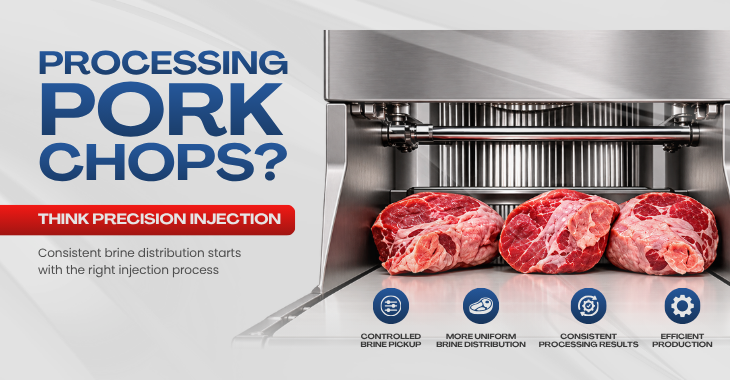
A commercial meat injector uses multiple injection needles to distribute the solution at selected locations throughout the product. Depending on the equipment configuration, needle arrangement, operating settings, and product dimensions, processors can develop an injection pattern suitable for their application.
The goal is not simply to inject more brine. It is to introduce the required quantity in a controlled and repeatable manner.
A consistent process also makes it easier for production teams to monitor pickup levels, evaluate finished products, and identify areas where adjustments may be necessary.
For pork chop processors, this means having greater control over one of the important stages in enhanced meat production.
Processing Bone-In Pork Chops: Why Injection Planning Matters
Bone-in pork chops present particular considerations during brine injection because the bone changes the structure and geometry of the cut.
Unlike boneless portions, bone-in chops contain both muscle tissue and a solid bone structure. The size, position, and shape of the bone can vary depending on the cut and how the pork loin has been prepared.
These characteristics influence how the product should be presented to the injector and how injection points are distributed.
Understanding the Structure of Bone-In Pork Chops
Bone-in pork chops generally contain a section of the backbone or rib structure, depending on the specific cut. The surrounding muscle tissue varies in thickness, and the distance between the bone and the outer surface is not always uniform.
During injection, the needles must operate within the intended meat areas. Contact with bone can interfere with needle penetration, potentially affecting the injection pattern and equipment operation.
This is why product dimensions and bone placement should be considered when selecting injection equipment and establishing processing parameters.
Processors should evaluate the typical thickness and size of their bone-in chops before deciding on needle configuration, product handling, and operating conditions.
Achieving More Consistent Brine Distribution
The objective when processing bone-in pork chops is to distribute the formulated brine throughout the intended muscle tissue while accounting for the presence of bone.
A properly configured injector can help introduce brine at multiple locations rather than relying on a single injection point.
The effectiveness of the process depends on several variables, including needle spacing, needle penetration depth, brine pressure, product thickness, and the characteristics of the brine formulation.
Processors should conduct product trials to determine whether the selected settings provide the required distribution without creating excessive surface leakage or localized accumulation.
Maintaining Product Integrity
Bone-in pork chops require careful handling throughout the processing operation. Excessive mechanical pressure, inappropriate needle placement, or unsuitable operating conditions may damage the product or affect its appearance.
Maintaining the visual quality of the finished chop is important, particularly for retail products where consumers can clearly see the bone and muscle structure.
Injection settings should therefore be established with both processing performance and product presentation in mind.
Processing Boneless Pork Chops: Achieving Uniformity Across Every Cut
Boneless pork chops offer a different processing challenge. Without a bone structure, the meat presents a more continuous surface for injection. However, this does not mean that every boneless chop will respond identically to the same processing settings.
Variations in thickness, muscle structure, and cut dimensions remain important considerations.
Understanding Boneless Pork Chop Characteristics
Boneless pork chops are typically prepared from pork loin sections after the bone has been removed. They are widely used in retail packages, restaurant operations, ready-to-cook products, and further-processed meat applications.
Their relatively uniform shape can make them suitable for automated injection operations. However, differences between individual pieces can still influence brine distribution.
For example, a thick-cut pork chop may require a different injection approach from a thinner retail portion. If the injection pattern is not suited to the product dimensions, distribution may become inconsistent.
Supporting Consistent Brine Pickup
One of the main objectives in boneless pork chop injection is achieving the required brine pickup across the production batch.
Pickup percentage represents the increase in product weight resulting from the addition of the injection solution.
For example, if a processor starts with 100 kg of pork and introduces 10 kg of retained brine, the theoretical pickup is 10% based on the original meat weight.
However, actual retained pickup must be evaluated after the relevant processing steps because some injected solution may be lost through handling, tumbling, resting, or other operations.
A properly controlled injection process helps processors work toward their specified pickup target while monitoring the consistency of individual products.
Maintaining Consistency Between Production Batches
Retail and foodservice customers expect products to meet established specifications. Differences in product weight, formulation, and appearance can create challenges for processors.
By establishing repeatable injection settings and monitoring product pickup, processors can improve control over their production process.
The equipment should be configured according to the characteristics of the boneless pork chops being processed, rather than relying on identical settings for every product size and formulation.
How Does a Commercial Meat Brine Injection Machine Work?
A commercial meat brine injection machine introduces a formulated solution into meat through specialized needles. The equipment is designed to handle production requirements that are difficult to manage consistently through manual application.
Although machine configurations differ, industrial brine injectors generally include several important components that work together during the injection process.
1. Brine Preparation and Supply
The process begins with preparing the brine according to the product formulation.
Ingredients must be measured and mixed according to established specifications. The solution should have the required concentration and consistency before entering the injection system.
Proper brine preparation is important because formulation differences can influence product characteristics and equipment performance.
Processors should also ensure that the solution is maintained under appropriate temperature and food-safety conditions throughout production.
2. Brine Filtration and Circulation
Before reaching the injection needles, the brine must be suitable for the equipment’s pumping and filtration system.
Filtration helps remove particles that could interfere with needle operation or restrict solution flow.
Brine circulation also helps maintain a consistent supply of solution during production.
The filtration requirements depend on the machine design and brine formulation. Solutions containing larger particles or certain seasoning ingredients may require special consideration.
3. Needle Injection System
The injection needle assembly is one of the most important parts of a commercial meat injector.
Multiple needles introduce brine into the meat at selected points. Their arrangement, diameter, spacing, and operating configuration influence the injection pattern.
For pork chops, needle selection should consider the thickness and dimensions of the product, along with the desired brine distribution.
Bone-in products require particular attention to bone placement, while boneless products may allow a different injection pattern.
4. Conveyor and Product Movement
Industrial injection machines commonly use conveyor systems to move products through the injection area.
The movement of the meat must be coordinated with the injection operation to achieve the intended pattern.
Product positioning and consistent feeding are important because irregular presentation can affect the relationship between the needles and the meat.
For processors handling different pork chop sizes, conveyor settings and product placement should be evaluated during machine setup.
5. Injection Pressure and Operating Parameters
Injection pressure, pump operation, needle configuration, and conveyor movement all contribute to the final result.
There is no single pressure setting that works for every pork chop application.
The appropriate operating conditions depend on the meat characteristics, brine formulation, target pickup, and machine configuration.
Processors should use product trials and manufacturer guidance to establish suitable settings.
Important Factors That Influence Pork Chop Brine Injection Results
A commercial brine injector is only one part of the overall processing system. Several additional factors influence whether the finished product meets the required specifications.
Brine Formulation
The composition of the brine directly influences the finished product.
Salt, water, phosphates where permitted, flavoring ingredients, and other formulation components must be selected according to the product requirements and applicable food regulations.
The concentration of each ingredient should be controlled carefully. Changes in formulation can affect solution characteristics, processing behavior, and the final product.
A formulation designed for boneless pork chops may not automatically be appropriate for every bone-in application.
Meat Temperature
Meat temperature is another important variable during injection.
Processors must maintain appropriate refrigerated conditions throughout the operation to protect product safety and quality.
Temperature can also influence the physical behavior of the meat and the processing solution.
The processing team should establish suitable temperature controls for receiving, preparation, injection, further processing, and storage.
Product Thickness and Dimensions
Not every pork chop has the same thickness.
Thicker cuts may require different needle penetration settings and injection patterns compared with thinner cuts.
Processors should evaluate the typical product dimensions and account for variations within the production batch.
Consistent product presentation helps the injector operate under more predictable conditions.
Target Pickup Percentage
Pickup percentage determines how much injection solution is introduced relative to the original meat weight.
A processor must establish the target according to the product formulation, customer requirements, and applicable regulations.
The machine should then be configured and monitored to achieve the intended target.
Importantly, higher pickup is not automatically better. Excessive or poorly controlled injection can create product-quality problems and increase the amount of free solution.
Equipment Maintenance and Needle Condition
Needles, filters, pumps, and other injection components must remain in suitable operating condition.
Damaged or obstructed needles may affect solution delivery and injection consistency.
Regular inspection, cleaning, and preventive maintenance help support reliable equipment operation.
Common Challenges in Pork Chop Brine Injection and How to Address Them
Even well-designed processing operations can experience injection-related challenges. Understanding their causes helps processors identify practical solutions.
Uneven Brine Distribution
Uneven distribution may occur when injection pressure, needle spacing, product positioning, or conveyor movement is not properly matched to the application.
Inconsistent product thickness can also contribute to variation.
The first step is to evaluate the injection pattern and compare product samples from different positions in the production batch.
Reviewing needle condition, equipment settings, and product presentation can help identify the source of the problem.
Excessive Brine Leakage
Brine leakage can occur when the injection quantity exceeds the meat’s ability to retain the solution or when the injection conditions are unsuitable.
The brine formulation, product temperature, injection pattern, and downstream handling process should all be reviewed.
Processors should avoid treating increased injection volume as the only way to improve product performance.
Inconsistent Product Weight
Variation in product weight may result from differences in the incoming meat, injection pickup, or solution retention.
Regular weight checks before and after injection help production teams understand how the process is performing.
Monitoring samples throughout the production run provides a clearer picture than relying on a single measurement.
Needle Blockage
Needle blockage can interrupt production and affect injection consistency.
This may occur when the brine contains particles that are unsuitable for the equipment’s filtration and needle configuration.
Proper brine preparation, filtration, and cleaning procedures help reduce the risk of blockage.
The processing team should follow the machine manufacturer’s instructions for inspecting and maintaining the injection assembly.
Bone-In vs. Boneless Pork Chop Processing: What Should Processors Consider?
Although both products can be processed using industrial brine injection equipment, their physical differences require attention during machine selection and setup.
Bone-in pork chops require injection planning that accounts for bone location and the surrounding muscle tissue. Boneless pork chops offer a different product geometry but still require appropriate control over needle penetration and brine distribution.
The following comparison highlights the main considerations.
| Processing Factor | Bone-In Pork Chops | Boneless Pork Chops |
|---|---|---|
| Product structure | Muscle with bone | Muscle without bone |
| Injection planning | Must account for bone position | Based on meat thickness and dimensions |
| Needle placement | Requires careful positioning around bone | Focuses on uniform coverage of muscle |
| Product variation | Bone size and muscle thickness | Cut thickness and muscle structure |
| Quality considerations | Product integrity and appearance | Uniformity and product presentation |
| Processing objective | Controlled brine distribution | Controlled brine distribution |
The best equipment configuration depends on the products being manufactured, expected production volumes, brine formulation, and required pickup levels.
Processors handling both types of pork chops should evaluate whether the same machine can accommodate their different product requirements and what adjustments are necessary when changing between applications.
Choosing the Right Industrial Brine Injection Machine for Pork Processing
Selecting an industrial brine injection machine involves more than comparing equipment prices or maximum production speeds.
The machine must suit the actual products, processing requirements, and operating conditions of the facility.
Consider Your Production Capacity
Production volume is one of the first factors to evaluate.
A facility processing a limited number of pork chops per hour may have different equipment requirements from a large commercial operation running multiple production shifts.
Processors should consider the expected number of products, available labor, line layout, and future production requirements.
The selected equipment should support the required production capacity without creating unnecessary bottlenecks elsewhere in the facility.
Evaluate Needle Configuration
Needle configuration directly influences how the brine is introduced into the product.
Processors should discuss the dimensions of their pork chops, the presence or absence of bone, and their desired injection pattern with the equipment manufacturer.
A suitable configuration should be established through product evaluation and machine trials.
Review Pickup Requirements
Different enhanced pork products may require different pickup percentages.
Before purchasing equipment, processors should identify their target pickup range and confirm that the proposed machine configuration can accommodate the intended application.
It is also important to understand how pickup will be measured and monitored during production.
Consider Cleaning and Sanitation
Food-processing equipment must support effective cleaning and sanitation procedures.
Brine injection systems contain multiple components that come into contact with food and must be maintained according to appropriate hygiene requirements.
When comparing equipment, evaluate access to the needle assembly, filtration components, product-contact surfaces, and other areas that require regular cleaning.
Sanitation procedures should follow the equipment manufacturer’s instructions and the facility’s food-safety program.
Look Beyond Initial Equipment Cost
The purchase price is only one part of the total cost of owning industrial processing equipment.
Processors should also evaluate maintenance requirements, replacement parts, technical support, operator training, utility requirements, and the availability of service assistance.
A machine that fits the production process and can be maintained properly may offer better long-term operational value than equipment selected solely on its initial price.
How Precision Injection Fits Into a Complete Pork Processing Workflow
Brine injection should not be treated as an isolated operation. It is part of a larger production workflow that begins with raw material preparation and continues through final packaging.
A well-organized pork processing operation considers how each stage affects the next.
The process generally starts with receiving pork loin sections under appropriate refrigerated conditions. The meat is then inspected, prepared, and cut into the required pork chop dimensions.
Depending on the product specification, the chops may undergo trimming and other preparation before entering the injection stage.
The brine solution is prepared separately according to the established formulation. Once the injector and product-handling system are ready, the pork chops move through the injection process.
Following injection, processors may use additional steps such as controlled resting, tumbling, or other application-specific operations. These steps depend on the product formulation and manufacturing requirements.
The finished product is then inspected and evaluated for weight, appearance, formulation compliance, and other quality parameters.
Finally, pork chops are packaged using a suitable packaging system and transferred to refrigerated storage or distribution.
Throughout the workflow, temperature control, sanitation, traceability, and quality assurance remain essential.
When injection equipment is properly integrated into the production line, it can help establish a more controlled approach to enhanced pork processing.
Why Meat Processors Are Investing in Better Injection Technology
The meat-processing industry continues to place importance on consistency, operational control, and production efficiency.
For processors manufacturing enhanced pork products, injection technology provides a practical way to introduce brine into meat at a commercial scale.
Manual application methods may be suitable for certain small-scale operations, but they can become difficult to manage when production volumes increase and product specifications become more demanding.
Industrial meat injection equipment provides a more structured approach through controlled solution delivery, multiple injection points, and automated product handling.
However, the value of injection technology is not limited to automation.
The ability to establish repeatable operating parameters, monitor pickup, and evaluate product quality helps production teams manage their processes more systematically.
As pork processors expand their product ranges and serve different retail and foodservice requirements, equipment flexibility also becomes important.
A facility may need to process different pork cuts, product thicknesses, and formulations. Having access to an appropriately configured injection solution can help accommodate these changing requirements.
The important consideration is selecting equipment that matches the actual application rather than purchasing a machine based on general production claims.
Promarksvac Brine Injection Solutions for Commercial Meat Processing
For commercial meat processors, selecting the right injection equipment is an important decision that can influence daily production operations.
Promarksvac provides industrial food-processing equipment designed to support commercial meat-processing applications, including brine injection.
Its MSK brine injector range is designed for processing applications where controlled solution delivery and consistent injection operations are important.
Depending on the selected model and configuration, the MSK injector range supports pickup capabilities of approximately 8% to 40% and operating rates of 1 to 50 strokes per minute. Actual operating performance depends on the machine configuration, product characteristics, and processing conditions.
For pork chop manufacturers, equipment selection should consider whether the intended application involves bone-in cuts, boneless portions, or a combination of both.
Needle configuration, product dimensions, target pickup, brine formulation, and required production capacity should all be discussed when evaluating a suitable injection solution.
Promarksvac works with commercial food processors looking for equipment that fits their specific production requirements.
Whether your operation handles pork chops or other meat products, understanding the application is the first step toward selecting the right processing equipment.
Explore the available solutions at https://promarksvac.com/ or contact the Promarksvac team to discuss your meat-processing requirements.
Frequently Asked Questions About Pork Chop Brine Injection
1. What is brine injection in pork processing?
Brine injection is a meat-processing technique in which a formulated solution is introduced directly into pork using specialized injection needles. It is commonly used in enhanced pork products to control solution pickup and support more consistent brine distribution throughout the meat.
2. Can bone-in pork chops be processed using a brine injection machine?
Yes. Bone-in pork chops can be processed using suitable industrial brine injection equipment. However, injection planning must account for bone location, muscle thickness, needle positioning, and product dimensions to achieve the intended distribution.
3. Is brine injection suitable for boneless pork chops?
Yes. Boneless pork chops are suitable for industrial brine injection. Their dimensions and muscle structure should be evaluated to establish the appropriate needle configuration, injection pattern, and operating parameters.
4. What is the difference between bone-in and boneless pork chop injection?
The main difference is the product structure. Bone-in pork chops contain bone that must be considered when planning needle placement and penetration. Boneless pork chops provide a continuous muscle structure, but their thickness and dimensions still influence the injection process.
5. What ingredients are commonly used in pork brine?
Pork brine formulations commonly include water and salt, with other ingredients such as phosphates, flavorings, and approved functional ingredients depending on the intended product. The exact formulation must follow applicable food regulations and product specifications.
6. What is pickup percentage in meat injection?
Pickup percentage refers to the amount of injection solution introduced relative to the original meat weight.
For example, adding 10 kg of retained solution to 100 kg of original meat represents a theoretical pickup of 10%. Actual retained pickup should be verified through product weighing and subsequent processing checks.
7. Why is brine distribution important when processing pork chops?
Consistent brine distribution helps processors achieve more uniform product formulation and repeatable processing results. Uneven distribution can contribute to differences in product characteristics between individual chops and production batches.
8. Can one injection machine process both bone-in and boneless pork chops?
Depending on the machine design and configuration, one industrial brine injector may be suitable for both applications. However, needle arrangements, penetration settings, product handling, and operating parameters may need to be adjusted. Processors should confirm compatibility with the equipment manufacturer.
9. What causes uneven brine injection in pork chops?
Uneven injection can result from unsuitable pressure settings, obstructed needles, inconsistent product thickness, improper needle positioning, irregular conveyor movement, or unsuitable brine characteristics. Evaluating these variables can help identify and correct the problem.
10. How do processors maintain consistency during pork chop injection?
Processors can improve consistency by maintaining controlled brine formulation, monitoring product temperature, selecting suitable needle configurations, checking injection pickup, inspecting equipment regularly, and establishing repeatable operating procedures.
11. What should I consider when purchasing a commercial meat injector?
Important considerations include production capacity, injection requirements, needle configuration, pickup range, cleaning and sanitation, maintenance requirements, spare parts availability, and technical support. The machine should be selected according to the products and processing conditions of the facility.
12. Is brine injection used only for pork chops?
No. Industrial brine injection is used in a variety of meat-processing applications, including pork, poultry, beef, and other products, depending on the machine configuration and processing requirements.
Final Thoughts: Better Pork Processing Starts With the Right Injection Process
Processing pork chops at a commercial scale requires attention to product characteristics, brine formulation, equipment configuration, and production consistency.
Bone-in and boneless pork chops may share similar processing objectives, but their structural differences require different considerations when establishing an injection process.
For bone-in cuts, needle positioning and bone placement are important. For boneless cuts, thickness, dimensions, and injection coverage influence the final results.
In both applications, the objective is to introduce the required brine in a controlled and repeatable manner while maintaining product integrity and meeting established processing specifications.
Choosing the right industrial brine injection equipment is therefore an important part of developing an effective pork processing operation.
Processing Pork Chops? Think Precision Injection.
Explore Promarksvac industrial brine injection solutions and find equipment designed around your commercial meat-processing requirements.
Visit https://promarksvac.com/ to learn more or request a quote.