Choosing the best food vacuum sealer is not simply a matter of finding the machine with the strongest vacuum or the lowest price. The right vacuum packaging machine depends on what you are packaging, how much you package each day, the type and size of bags you use, the amount of liquid in the product, and how frequently the machine will operate.
A restaurant packaging prepared meals has different requirements from a butcher shop packaging steaks. A seafood processor may need a different vacuum packaging system than a cheese manufacturer, meal-prep company, or food manufacturer handling hundreds of packages per hour.
For this reason, it is important to evaluate the application first and the machine second.
This guide explains the major types of food vacuum sealers, the features that matter, and the factors you should consider before investing in a vacuum packaging machine.
What Is a Food Vacuum Sealer?
A food vacuum sealer removes air from a package and seals the bag to help protect the product from exposure to oxygen and external contaminants.
Vacuum packaging can help reduce oxidation, moisture loss, freezer burn, and exposure to the surrounding environment. It is commonly used for meat, poultry, seafood, cheese, prepared foods, vegetables, sauces, and many other food products.
However, a vacuum sealer does not make every food product shelf-stable, and vacuum packaging should always be used together with appropriate food-safety, refrigeration, freezing, and storage practices.
The performance of a vacuum packaging machine depends on more than the vacuum level. Pump capacity, sealing temperature, bag material, product characteristics, package size, and machine cycle all affect the final package.
Why Choosing the Right Vacuum Sealer Matters
Buying a vacuum sealer that is too small for your operation can create production bottlenecks, inconsistent packaging, excessive downtime, and premature equipment wear.
On the other hand, purchasing a machine significantly larger than your actual requirements can increase your initial investment without providing a meaningful operational benefit.
Before comparing models, answer these questions:
- What type of food are you packaging?
- What are the dimensions and weight of each package?
- Are the products dry, moist, or liquid?
- How many packages do you need to seal per hour or per day?
- What type and thickness of vacuum bags will you use?
- What is the maximum bag size?
- Do you need to package products with bones or sharp edges?
- Will the machine operate continuously or only occasionally?
- How much floor or counter space is available?
- What level of automation do you need?
- What electrical power is available at the installation location?
These answers will narrow down the type and size of machine you actually need.
Types of Food Vacuum Sealers
Food vacuum sealers can be broadly divided into several categories. The two most important categories for many operations are external/nozzle-style vacuum sealers and chamber vacuum sealers.
1. External or Nozzle-Type Vacuum Sealers
External vacuum sealers remove air from a bag using a nozzle or external suction system before sealing the opening of the bag.
These machines can be useful for certain lower-volume applications where portability, compact size, or a relatively simple operating process is important.
Some external vacuum systems use specially designed channel or textured bags. The texture creates air channels that allow air to move toward the suction area during the vacuum cycle.
These systems can be suitable for selected applications, but they are not necessarily the best choice for every commercial food operation.
Advantages of External Vacuum Sealers
Depending on the machine and application, benefits can include:
- Compact equipment design
- Relatively simple operation
- Lower initial investment for some applications
- Convenient operation for lower production volumes
- Compatibility with specific channel-style bags
Limitations
External systems can be less suitable when an operation requires high production volume, consistent packaging of products with significant moisture, or greater control over the vacuum and sealing cycle.
For commercial food packaging, a chamber vacuum machine is often the more versatile option.
2. Chamber Vacuum Sealers
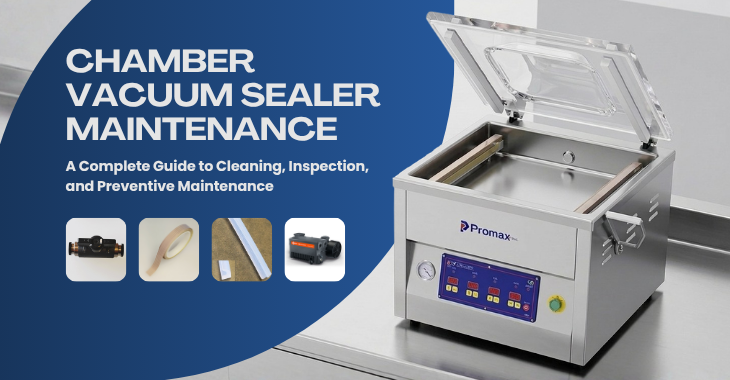
Chamber vacuum sealers place the entire bag inside a vacuum chamber. The machine removes air from the chamber and the bag simultaneously before sealing the package.
Because the pressure inside and outside the bag is equalized during the vacuum cycle, chamber machines are particularly useful for packaging products containing moisture or liquids.
Chamber vacuum sealers are available in different configurations, from compact tabletop machines to larger commercial and industrial systems.
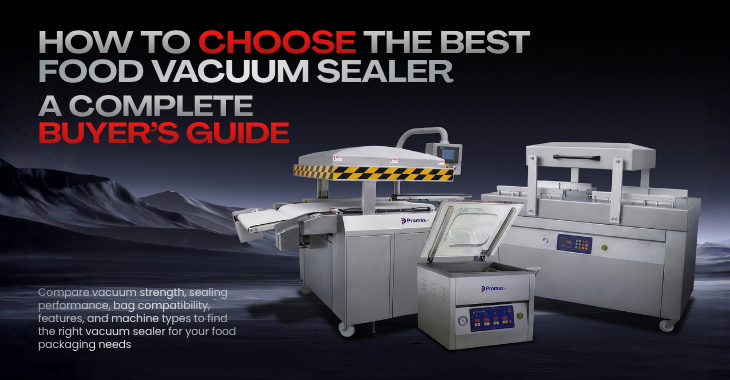
For example, the Promarksvac TC-280F is a tabletop chamber vacuum packaging machine designed for applications that require a compact commercial vacuum packaging solution.
Advantages of Chamber Vacuum Sealers
Chamber machines can offer several advantages for food businesses:
- Suitable for a wide range of food products
- Effective handling of moist products
- Suitable for liquid-containing products within the machine’s application limits
- Consistent vacuum and sealing cycles
- Ability to use smooth vacuum bags
- Good repeatability for commercial packaging
- Different chamber sizes are available for different products and production requirements
Common applications include:
- Meat
- Poultry
- Seafood
- Cheese
- Prepared foods
- Vegetables
- Sauces
- Marinated products
- Frozen foods
- Restaurant and foodservice products
Tabletop vs. Commercial Vacuum Packaging Machines
One of the most important purchasing decisions is determining how large a machine you actually need.
Tabletop Vacuum Sealers
Tabletop chamber machines are suitable when space is limited and production requirements are moderate.
They can be a practical choice for:
- Restaurants
- Butcher shops
- Small food processors
- Catering businesses
- Meal-prep companies
- Specialty food manufacturers
- Retail food operations
The important consideration is not simply the physical size of the machine. You should evaluate the usable chamber dimensions, seal bar length, pump capacity, cycle time, and expected workload.
Larger Commercial Vacuum Packaging Machines
Higher-volume food processors may require larger chamber machines with greater production capacity.
These machines can provide:
- Larger chamber dimensions
- Longer sealing bars
- Higher production capacity
- Larger vacuum pumps
- Multiple packages per cycle
- More robust construction
- Better suitability for continuous commercial production
The correct machine should be selected according to actual production requirements rather than simply choosing the largest available model.
10 Important Features to Look for in a Food Vacuum Sealer
Once you have identified the appropriate machine category, the next step is comparing specifications and features.
1. Vacuum Pump Capacity
The vacuum pump is one of the most important components of a chamber vacuum machine.
Pump capacity influences how quickly the machine can achieve the required vacuum level and complete its cycle.
However, a larger pump does not automatically mean a better machine for every application. Pump capacity should be considered alongside chamber volume, product size, package configuration, and production requirements.
2. Vacuum Control
A good commercial vacuum sealer should provide appropriate control over the vacuum cycle.
Different products may require different vacuum settings. Fragile products may require a different approach from dense or robust products.
Adjustable vacuum controls allow operators to establish repeatable packaging parameters rather than relying on a single fixed cycle.
3. Sealing Bar Length
The seal bar determines the maximum width of the bag that can be sealed.
Before purchasing a machine, measure the bags you currently use—or plan to use—and compare their dimensions with the machine’s sealing capacity.
A machine with a seal bar that is too short can limit your packaging options even if its vacuum pump is adequate.
4. Chamber Dimensions
The chamber must accommodate the product and bag without excessive crowding.
Consider:
- Product dimensions
- Bag dimensions
- Product height
- Number of bags per cycle
- Required clearance around the product
If you routinely package large cuts of meat, bulk products, or multiple packages simultaneously, chamber size becomes especially important.
5. Adjustable Sealing Time
Different bag materials and thicknesses can require different sealing parameters.
Adjustable sealing time allows operators to optimize the seal for the specific packaging material being used.
A strong vacuum is of little value if the finished package does not have a reliable, consistent seal.
6. Manual and Programmable Controls
Commercial operators often benefit from controls that allow them to establish repeatable vacuum and sealing cycles.
Depending on the machine, useful controls may include:
- Vacuum time or level
- Sealing time
- Cooling time
- Multiple programs
- Manual vacuum control
- Emergency stop or cycle interruption
Programmable controls can also make training easier because operators can use established settings rather than manually adjusting every package.
7. Soft-Air or Controlled-Air Functions
Some products can be damaged by an abrupt return of atmospheric pressure after vacuuming.
A controlled-air or soft-air function can help manage the chamber’s pressure equalization and reduce the risk of certain delicate products being crushed or distorted.
Whether this feature is necessary depends on the products being packaged.
8. Moisture Handling
If you package meat, seafood, marinated foods, sauces, or other moisture-rich products, moisture handling should be a major consideration.
A chamber vacuum sealer is generally more suitable for these applications than many external vacuum systems because the vacuum process occurs inside the chamber.
However, operators should still select the correct machine and operating parameters for the specific product.
9. Construction and Sanitation
Food packaging equipment should be designed with the operating environment in mind.
Look for construction and design features that make the machine practical to clean and maintain.
Important considerations include:
- Stainless-steel construction where appropriate
- Accessible sealing components
- Easy-to-clean surfaces
- Durable chamber components
- Replaceable wear parts
- Appropriate protection around the vacuum system
For commercial food environments, sanitation and maintenance should be considered alongside machine performance.
10. Service, Parts and Support
A vacuum packaging machine is production equipment, not simply a countertop appliance.
Before purchasing, find out:
- Who provides technical support?
- Are replacement parts available?
- How easy is it to obtain sealing components?
- Is the vacuum pump serviceable?
- What does the warranty cover?
- Where can replacement gaskets and other wear parts be purchased?
- Is operator training available?
A lower purchase price does not necessarily represent a lower total cost if parts and service are difficult to obtain.
Choosing a Vacuum Sealer Based on the Food You Package
The product itself should influence your machine selection.
Meat and Poultry
Meat processors, butcher shops, and foodservice operations commonly use vacuum packaging for beef, pork, poultry, lamb, and other products.
When packaging meat, consider:
- Product size
- Bone and sharp-edge exposure
- Moisture content
- Bag thickness
- Package dimensions
- Daily production volume
Bone-in products may require stronger packaging materials and appropriate bag handling to reduce the risk of puncturing the package.
Seafood
Seafood can contain significant moisture and may have irregular shapes or sharp components.
For seafood packaging, consider a chamber machine with appropriate vacuum controls, chamber dimensions, and sealing capability.
Cheese and Dairy Products
Cheese products can vary significantly in shape, size, and moisture content.
The packaging process should provide a reliable seal without unnecessarily compressing products that are sensitive to pressure.
Prepared and Ready-to-Eat Foods
Prepared meals, cooked meats, pasta dishes, vegetables, sauces, and meal-prep products can benefit from vacuum packaging when the packaging process and storage conditions are appropriate.
Because these products may contain moisture or sauces, chamber vacuum packaging machines can be particularly useful.
Dry Foods
Some dry products can also be vacuum packaged, including selected spices, ingredients, and other food products.
For dry products, the primary considerations may be package size, production volume, sealing quality, and required vacuum level rather than liquid handling.
What Type of Vacuum Bag Should You Use?
The vacuum machine and bag work together as a packaging system.
Before buying a machine, determine what bags you intend to use.
Important bag specifications include:
- Bag dimensions
- Bag thickness
- Material structure
- Smooth vs. textured surface
- Temperature resistance
- Product characteristics
- Required storage conditions
External/channel vacuum machines typically require compatible textured bags that allow air to travel through the bag during evacuation.
Chamber vacuum machines commonly use smooth vacuum pouches, giving commercial operators a broad range of packaging options.
Do not choose a machine first and assume every vacuum bag will work with it.
How Much Vacuum Do You Actually Need?
A common purchasing mistake is assuming that maximum vacuum is always the objective.
It is not.
The appropriate vacuum level depends on the product and packaging application.
Some dense products can tolerate aggressive vacuuming, while delicate products may become compressed or damaged.
For example, a soft prepared food product may require different vacuum parameters from a solid piece of frozen meat.
The goal should be the correct vacuum for the product, not simply the highest possible vacuum.
How Many Packages Do You Need to Produce?
Production volume is one of the strongest factors in machine selection.
A business packaging 20 bags per day does not necessarily need the same equipment as a processor packaging hundreds or thousands of packages.
Estimate:
Packages per hour × operating hours per day = approximate daily packaging requirement
Then consider peak production rather than average production.
If your business normally packages 300 bags per day but occasionally needs to package 600 bags, selecting equipment based only on the 300-bag average could create a bottleneck during busy periods.
Common Vacuum Sealer Buying Mistakes
Buying Based Only on Price
The cheapest machine may not be the most economical machine over its operating life.
Consider the total cost of ownership, including:
- Purchase price
- Bags
- Maintenance
- Replacement parts
- Pump servicing
- Downtime
- Labor
- Expected operating life
Buying the Largest Machine Available
The opposite mistake is purchasing equipment that is significantly larger than necessary.
A larger chamber, bigger pump, or higher-capacity machine can increase cost, space requirements, and operating requirements.
Choose capacity based on actual production requirements and expected growth.
Ignoring Bag Size
A machine may have sufficient vacuum power but still be unsuitable if the chamber or seal bar cannot accommodate the required bag size.
Always compare the machine’s usable dimensions with your actual packaging requirements.
Ignoring Product Moisture
If your product contains significant moisture or liquid, the machine’s suitability for that application should be considered before purchase.
Do not assume that every vacuum sealer performs the same way with dry and wet products.
Choosing a Machine Without Considering Future Growth
If your business is expanding, selecting a machine based only on today’s production volume can result in another equipment investment sooner than expected.
Consider realistic growth over the next several years when deciding between machine sizes.
A Simple Vacuum Sealer Buying Checklist
Before purchasing a food vacuum packaging machine, review the following:
Product
- What food products will be packaged?
- Are they dry, moist, or liquid?
- Are there bones or sharp edges?
- Are products delicate or robust?
Packaging
- What bag material will you use?
- What are the maximum bag dimensions?
- What bag thickness is required?
- Do you need smooth or textured bags?
Production
- How many packages are produced per day?
- How many packages must be produced per hour?
- How many packages should fit in each cycle?
- Will production increase in the future?
Machine
- What chamber size do you need?
- What seal bar length is required?
- What vacuum pump capacity is appropriate?
- What vacuum controls are available?
- Is the sealing time adjustable?
- Are programmable cycles available?
- Is the machine designed for commercial use?
Maintenance
- What parts require regular replacement?
- Is pump service available?
- Are replacement parts readily available?
- What warranty is included?
- Who provides technical support?
Food Vacuum Sealer vs. Vacuum Packaging Machine
The term “food vacuum sealer” is often used to describe everything from small household appliances to commercial vacuum packaging equipment.
These machines are not necessarily designed for the same workload.
A small countertop appliance may be adequate for occasional household use, while a restaurant, butcher shop, food processor, or manufacturer may need commercial equipment designed for repeated production cycles.
When purchasing equipment for a business, focus on commercial duty, production capacity, serviceability, and long-term reliability rather than comparing machines solely by their consumer-style specifications.
When Should You Upgrade Your Vacuum Sealer?
You may need to consider upgrading when:
- Your current machine creates a production bottleneck
- You are packaging more products than before
- Your existing chamber is too small
- You need larger bags
- Your sealing capacity is limiting production
- Vacuum cycles are taking too long
- You experience inconsistent seals
- Maintenance downtime is increasing
- You need multiple packages per cycle
- You are expanding into commercial production
An upgrade should solve a specific production limitation rather than simply provide a newer machine.
Choosing the Best Food Vacuum Sealer for Your Business
There is no single “best” food vacuum sealer for every business.
The best machine is the one that matches your product, packaging material, package dimensions, production volume, available space, operating environment, and budget.
For occasional low-volume applications, a compact vacuum sealer may be sufficient. For restaurants, butcher shops, caterers, and small food processors, a tabletop chamber vacuum sealer can provide a more commercial solution. Higher-volume processors may require larger chamber machines with greater pump capacity, larger chambers, longer sealing bars, and higher production capability.
If you are unsure which machine is appropriate, start by documenting your current packaging requirements and expected production volume. From there, compare chamber dimensions, seal bar length, pump capacity, vacuum controls, cycle times, construction, and available service support.
Frequently Asked Questions About Food Vacuum Sealers
What is the best type of vacuum sealer for commercial food packaging?
For many commercial food applications, a chamber vacuum sealer is a versatile option because it can handle a broad range of products and is well suited to moist foods. The appropriate machine size depends on production volume, bag dimensions, and product characteristics.
Are chamber vacuum sealers better than external vacuum sealers?
Not in every situation. Chamber machines are generally more versatile for commercial food packaging, particularly for moist products and higher-volume applications. External systems can be suitable for specific lower-volume applications and compatible bag types.
Can vacuum sealers package liquids?
Chamber vacuum packaging machines are generally better suited to products containing liquids than external vacuum systems because the vacuum process takes place within the chamber. The specific machine and operating parameters should still be matched to the product.
What size vacuum sealer should I buy?
Choose a machine based on the maximum product and bag dimensions, required production rate, and number of packages you want to process per cycle. The largest machine is not automatically the best choice.
What vacuum bags should I use?
The correct bag depends on the type of vacuum machine and the product. External/channel machines generally require compatible textured bags, while chamber vacuum machines commonly use smooth vacuum pouches.
Does a stronger vacuum always mean better packaging?
No. The correct vacuum level depends on the product. Excessive vacuum can compress or damage delicate products, while insufficient vacuum may leave too much air in the package.
How long should a commercial vacuum sealer last?
Service life depends on construction, operating frequency, maintenance, pump usage, sealing components, and the operating environment. A commercial machine should be evaluated based on its intended duty cycle and availability of replacement parts and service.
Can I use a commercial vacuum sealer for different types of food?
Yes, many commercial chamber vacuum machines can package different food products, but the appropriate vacuum and sealing settings may vary between applications.
Need Help Choosing a Commercial Vacuum Sealer?
Selecting a vacuum packaging machine should begin with your application rather than a particular machine model.
Promarksvac offers commercial vacuum packaging equipment for food processing, foodservice, meat, seafood, dairy, prepared foods, and other packaging applications. If you know your product type, bag dimensions, production volume, and packaging requirements, these details can be used to determine the appropriate machine configuration.
Need help selecting the right vacuum packaging machine? Contact Promarksvac to discuss your application and packaging requirements.