If you are researching how much a vacuum packaging machine costs, it is tempting to look for a single price range and compare machines based on the number attached to the price tag. In commercial food processing, however, that approach can be misleading.
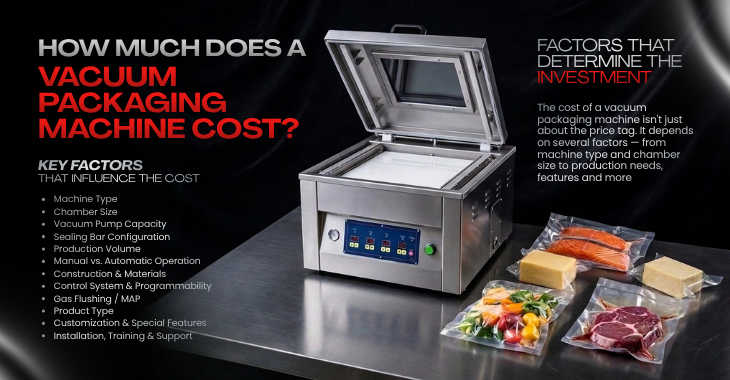
A vacuum packaging machine is not a one-size-fits-all piece of equipment. The cost can vary significantly depending on the type of machine, chamber size, vacuum pump capacity, sealing configuration, production volume, automation level, construction, and the specific products being packaged.
A small operation packaging a limited number of products each day may have very different requirements from a meat processor running continuous production. Similarly, a company packaging large cuts of meat may need a different configuration from a manufacturer packaging smaller food products or non-food items.
That is why the better question is not simply “How much does a vacuum packaging machine cost?” It is:
“What factors determine the cost of a vacuum packaging machine, and what configuration does my operation actually need?”
Understanding these factors can help you compare equipment more accurately and avoid paying for capabilities you do not need—or choosing a machine that cannot keep up with your production requirements.
What Determines the Cost of a Vacuum Packaging Machine?
The investment in a commercial vacuum packaging machine is influenced by several interconnected factors. Two machines may both be described as chamber vacuum sealers but have very different capabilities, production capacities, and component specifications.
The most important factors include machine type, chamber dimensions, vacuum pump capacity, sealing configuration, production requirements, construction, controls, automation, gas flushing capabilities, and application-specific features.
Let’s look at each factor in more detail.
1. Type of Vacuum Packaging Machine
The first factor is the type of machine.
Commercial vacuum packaging equipment ranges from compact tabletop chamber machines to large industrial systems designed for high-volume production. The machine type directly affects the size, components, production capacity, and ultimately the overall investment.
A tabletop chamber vacuum sealer may be suitable for restaurants, butcher shops, small food processors, catering operations, and businesses with moderate packaging requirements. These machines generally occupy less floor space and are designed for applications where operators manually load products into the chamber.
A single-chamber commercial vacuum sealer provides more capacity while maintaining a relatively straightforward operating process. Depending on the chamber dimensions and sealing configuration, operators can package one or multiple bags during a cycle.
A double-chamber vacuum packaging machine can improve workflow because one chamber can be unloaded and loaded while the other chamber is operating. This can make a significant difference in a busy production environment where machine utilization and operator efficiency are important.
For higher-volume operations, larger industrial floor-standing vacuum packaging machines may be more appropriate. These machines are designed around heavier production requirements and may incorporate larger chambers, higher-capacity vacuum pumps, multiple sealing bars, and other features intended for demanding environments.
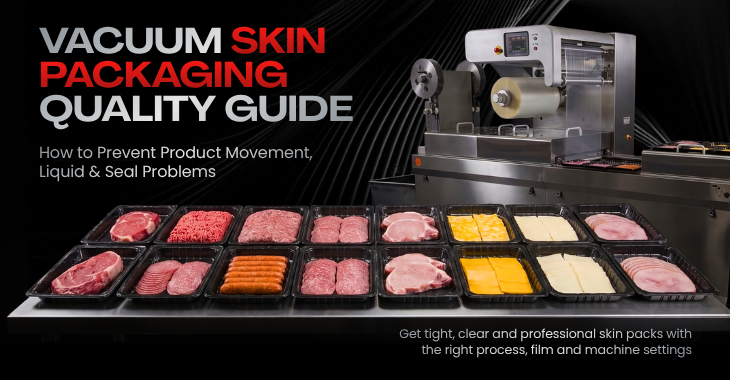
There are also specialized vacuum packaging systems designed for applications such as vacuum skin packaging, tray packaging, or integration with automated production lines.
Therefore, the first step in understanding machine cost is identifying the machine category that matches the application.
2. Chamber Size
Chamber size is another major factor.
The chamber determines the physical size of the products or bags that can be placed inside the machine. A larger chamber can accommodate larger products, larger bags, or multiple packages during a single cycle.
For example, a small butcher shop packaging individual portions may not need the same chamber dimensions as a meat processor packaging large cuts or multiple bags simultaneously.
A larger chamber generally requires more material, a larger lid, stronger construction, and potentially a higher-capacity vacuum system. These factors can increase the equipment investment.
However, choosing the largest chamber available is not necessarily the right approach.
A chamber that is significantly larger than your actual packaging requirements can take up unnecessary floor space and may not provide a meaningful production advantage. The better approach is to determine the largest product and bag dimensions you regularly expect to package and select equipment around those requirements.
When evaluating a vacuum packaging machine, consider:
- Maximum product dimensions
- Bag dimensions
- Number of bags per cycle
- Product height
- Available floor space
- Future production requirements
The chamber should be large enough for the intended application without unnecessarily increasing the size and complexity of the machine.
3. Vacuum Pump Capacity
The vacuum pump is one of the most important components in a chamber vacuum packaging machine.
Its job is to remove air from the chamber and, depending on the packaging process, from the package itself. Pump capacity can influence how quickly the machine reaches the required vacuum level and how efficiently it performs repeated cycles.
For a small-volume operation, a smaller pump may be sufficient. A high-volume production environment may require a larger pump to support faster cycle times and repeated operation.
Pump specifications should therefore be evaluated in relation to the chamber size and production requirements rather than viewed independently.
A larger pump can be an important investment when the operation requires high throughput. However, installing a pump substantially beyond the actual requirements may not provide a proportional benefit.
The pump also affects long-term operating considerations. Businesses should look at pump quality, maintenance requirements, availability of replacement parts, and the manufacturer’s recommended service procedures.
This is particularly important for commercial operations where the vacuum packaging machine may run for several hours each day.
4. Sealing Bar Configuration
The sealing system is another factor that influences equipment cost.
Vacuum packaging machines can have different sealing configurations depending on the model. The sealing length determines the maximum width of the bag that can be sealed, while the number and arrangement of sealing bars can influence how many packages can be processed during a cycle.
A single sealing bar may be adequate for a smaller operation. Businesses processing several bags simultaneously may benefit from multiple sealing bars or a configuration that allows better use of the chamber.
The sealing system also needs to match the packaging material and application.
Important considerations include sealing length, sealing width, seal consistency, bag material, and expected production volume.
For example, a company packaging large commercial bags may need a different sealing configuration than a business packaging smaller retail portions.
The goal is not simply to select the machine with the greatest sealing capacity. It is to choose a sealing configuration that supports the actual package dimensions and production workflow.
5. Production Volume and Required Throughput
Production volume is one of the most important factors when selecting commercial vacuum packaging equipment.
Consider two businesses.
The first packages several dozen products during a typical working day. The second processes hundreds or thousands of packages as part of a continuous production operation.
Both businesses need vacuum packaging, but their equipment requirements are very different.
For lower-volume applications, a manually operated chamber machine may provide sufficient capacity. For higher-volume production, businesses may need larger chambers, faster vacuum pumps, multiple sealing stations, double chambers, or more automated equipment.
Cycle time also becomes important.
If a machine requires several minutes to complete a cycle and the business needs to package hundreds of products per day, the available production time can quickly become a limiting factor.
This is why machine cost should be evaluated alongside production requirements.
A machine that costs less initially may not necessarily be the more economical choice if it creates a bottleneck in production. Conversely, investing in a much larger machine than necessary can increase capital expenditure without providing a useful return.
The right question is:
How many packages do we need to produce per hour, shift, or day?
Once that number is known, the machine configuration can be evaluated more realistically.
6. Manual, Semi-Automatic, or Automatic Operation
Automation can have a significant impact on the cost of vacuum packaging equipment.
A basic chamber machine requires an operator to place the product and bag into the chamber, position the bag, close the lid, start the cycle, and remove the finished package.
This can work well when production volumes are manageable and labor is readily available.
As production increases, businesses may look for equipment that reduces manual handling. Depending on the application, this could include double-chamber systems, automated loading and unloading, conveyors, or integration with upstream and downstream equipment.
Automation generally increases the initial investment because the machine requires additional mechanical, electrical, and control components.
However, the additional investment should be evaluated against the potential operational benefits.
For a high-volume processor, reducing handling time by even a small amount per package can have a significant effect over an entire production shift.
The important point is that automation should solve a real production problem. It should not simply be added because a machine has more features.
7. Machine Construction and Materials
The construction of the machine also contributes to its cost.
Commercial vacuum packaging machines used in food processing environments are commonly built with stainless-steel components because the equipment needs to withstand frequent cleaning, moisture, and demanding operating conditions.
The chamber, lid, frame, sealing system, controls, hinges, and other components all contribute to the overall construction quality.
A machine intended for occasional use in a small operation has different requirements from equipment operating every day in a commercial processing facility.
When comparing machines, buyers should look beyond the external appearance and consider the engineering behind the equipment.
Important questions include:
How is the chamber constructed?
What materials are used?
What type of vacuum pump is installed?
What components are used in the control system?
Are replacement parts readily available?
Is the machine designed for the expected production environment?
These questions can be more useful than simply comparing the initial purchase price.
8. Control System and Programmability
Modern commercial vacuum packaging machines may offer programmable controls that allow operators to set and repeat specific vacuum and sealing parameters.
A basic machine may provide straightforward controls for vacuum time and sealing time. More advanced systems can provide programmable cycles and additional controls for different products or packaging requirements.
This can be particularly useful for processors handling multiple products.
For example, a business may package fresh meat, processed meat, cheese, or prepared foods. Each product may have different packaging characteristics and may require different vacuum and sealing settings.
Programmable controls can make it easier to maintain consistency between production runs.
The control system can therefore affect both the equipment cost and the operational value of the machine.
9. Gas Flushing and Modified Atmosphere Packaging
Some vacuum packaging applications require more than simply removing air.
Gas flushing can be incorporated into certain packaging systems to replace some of the air in the package with a selected gas mixture before sealing. This is commonly associated with modified atmosphere packaging applications.
A machine equipped for gas flushing requires additional components and controls compared with a standard vacuum-only system.
Therefore, if gas flushing is required, it should be considered when determining the machine configuration from the beginning.
Businesses should not assume that every vacuum packaging machine can automatically perform the same gas-flushing functions. The required system should be matched to the packaging application and production process.
10. The Product Being Packaged
The product itself can influence equipment requirements.
A machine packaging dry products may have different requirements from one used for fresh meat, seafood, cheese, sauces, prepared foods, or other products containing moisture.
Product dimensions also matter.
Large cuts of meat require more chamber space than small portions. Products with sharp edges may require appropriate packaging materials and sealing considerations. Products containing liquids may require careful control of the vacuum cycle to prevent excessive product movement or liquid being drawn toward the sealing area.
This means the question of machine cost cannot be separated from the question of what you are packaging.
Before selecting equipment, businesses should consider:
- Product dimensions
- Product weight
- Moisture content
- Package dimensions
- Packaging material
- Required shelf-life objectives
- Daily production volume
- Handling requirements
These details help determine the appropriate machine configuration.
11. Number of Packages Per Cycle
Another factor that is often overlooked is how many packages the machine can process during a cycle.
Suppose an operation needs to package 500 bags per day.
If the machine can process only one bag per cycle, the operator may spend significant time loading and unloading the equipment. If the chamber can accommodate multiple appropriately sized bags, production efficiency may improve.
The machine investment should therefore be considered in terms of packages per cycle and cycles per hour, not simply machine size.
A basic calculation can help:
Packages per hour = Packages per cycle × Cycles per hour
This does not account for every production variable, but it provides a useful starting point when comparing equipment capacity.
12. Customization and Special Requirements
Some businesses require a standard machine configuration. Others have specific requirements that call for customization.
Examples may include special chamber dimensions, unusual sealing arrangements, custom controls, gas flushing, conveyor integration, or compatibility with other packaging equipment.
Customization can increase the cost because additional engineering, components, fabrication, and testing may be required.
However, customization can also make sense when it solves a specific production problem.
A company should therefore distinguish between features that are genuinely required and features that are simply convenient.
13. Installation, Training, Service and Support
The initial machine purchase is only one part of the total investment.
Businesses should also consider what happens after the machine arrives.
Installation requirements, operator training, preventive maintenance, replacement parts, technical support, and warranty coverage can all affect the long-term cost of ownership.
A machine used in a commercial production environment needs to remain operational. Unexpected downtime can disrupt production schedules and create additional labor costs.
For this reason, buyers should ask about service support and parts availability before purchasing equipment.
A lower initial purchase cost does not automatically mean a lower total cost of ownership.
14. Future Production Growth
Another important consideration is where the business expects to be in the next few years.
Buying equipment strictly around today’s production volume can create limitations if production increases significantly.
For example, a processor currently packaging 200 packages per day may grow to 500 or more. If the original machine has little additional capacity, the business may eventually need another machine or a replacement.
On the other hand, buying equipment designed for several times the current production volume can result in unnecessary capital expenditure.
The practical approach is to consider realistic growth rather than hypothetical maximum growth.
Ask:
What will our packaging requirements realistically look like over the next three to five years?
That answer can help determine whether the machine should be selected around today’s requirements or with additional capacity for expected expansion.
Why Machine Price Should Not Be the Only Comparison
When businesses compare vacuum packaging machines, it is easy to focus entirely on the initial purchase price.
That can lead to an incomplete comparison.
Two machines may have similar external dimensions but different pumps, sealing systems, controls, construction, production capacities, and service support.
Similarly, two machines with different purchase prices may have very different operating capabilities.
Instead of comparing only the initial cost, consider the overall value of the equipment over its expected working life.
Factors such as productivity, reliability, maintenance requirements, energy consumption, spare parts availability, labor requirements, and downtime can all influence the actual cost of operating the equipment.
For a commercial processor, a machine that consistently supports production can be more important than simply finding the lowest initial purchase price.
How to Determine the Right Vacuum Packaging Machine for Your Operation
Before requesting a quotation, gather a few basic pieces of information about your operation.
Start with the product.
What are you packaging? What are the maximum product dimensions? Does the product contain liquid or moisture? What type of packaging material will you use?
Next, determine your production volume.
How many packages do you currently produce per day? How many do you expect to produce during your busiest shift? How many operators will be working with the machine?
Then determine the package dimensions.
The bag size is important because it directly influences chamber and sealing requirements.
After that, consider the required production speed.
Do you need to process one package at a time, or would processing several bags per cycle provide a meaningful advantage?
Finally, determine whether you need additional capabilities such as gas flushing, programmable cycles, multiple sealing bars, or integration with other packaging equipment.
Once these requirements are established, it becomes much easier for a packaging equipment manufacturer to recommend an appropriate machine configuration.
Questions to Ask Before Buying a Commercial Vacuum Packaging Machine
Before making a purchase, ask the manufacturer questions that go beyond the initial price.
What products is this machine designed to package?
What are the maximum chamber and sealing dimensions?
What vacuum pump is included?
What is the pump capacity?
How many packages can be processed per cycle?
What cycle time can be expected for my application?
What type of sealing system does the machine use?
Can the machine be configured for gas flushing if required?
What maintenance is required?
Are replacement parts readily available?
What warranty and technical support are provided?
Can the machine accommodate future production requirements?
These questions can reveal important differences between machines that may not be obvious from a basic product listing.
The Cost of a Vacuum Packaging Machine Is Really About the Application
There is no universal answer to the question “How much does a vacuum packaging machine cost?”
The more useful answer is that the cost depends on what the machine needs to do.
A compact machine for moderate packaging requirements will have different specifications from a high-output industrial system. Chamber size, vacuum pump capacity, sealing configuration, automation, controls, construction, gas flushing, product characteristics, and production volume can all influence the final equipment configuration.
For a commercial food processor, the objective should not be to find the cheapest vacuum packaging machine available. The objective should be to identify the equipment configuration that provides the required production capacity, package quality, reliability, and operating efficiency.
That starts with understanding your application.
At PromarksVac, commercial vacuum packaging equipment can be configured around different production requirements and packaging applications. Whether you are packaging meat, seafood, cheese, prepared foods, or other products, the appropriate machine depends on factors such as product dimensions, package size, production volume, chamber requirements, vacuum capacity, and sealing configuration.
If you are evaluating equipment for a new packaging operation or replacing an existing machine, provide your product type, package dimensions, expected production volume, and current packaging process. These details can help determine what type of commercial vacuum packaging equipment is appropriate for your operation.
The right vacuum packaging machine is not necessarily the machine with the lowest price. It is the machine configured for the job you actually need it to perform.