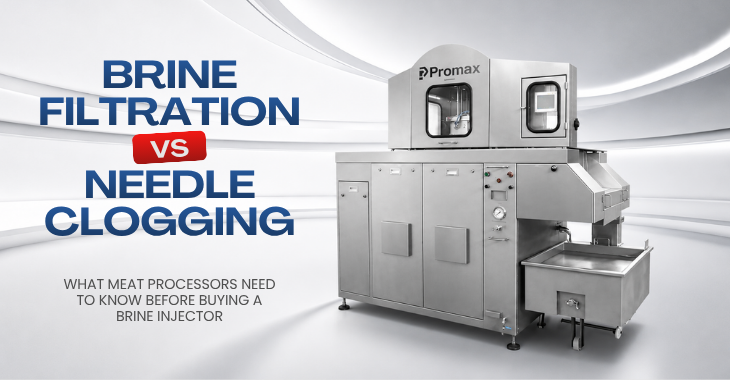
For meat processors, choosing a commercial brine injector is about much more than selecting the number of needles or comparing equipment prices.
A brine injector sits at the center of an important part of the meat-processing operation. It has to move brine consistently through a filtration and pumping system, deliver the solution through multiple injection needles, handle different product characteristics, and maintain reliable performance throughout production.
When something goes wrong, the problem may appear to be a simple clogged needle. But in many cases, needle clogging is actually a symptom of a larger issue involving brine preparation, filtration, agitation, pump performance, product debris, cleaning, or maintenance. This is why brine filtration should be one of the most important considerations when buying a commercial brine injector for meat processing.
The same principle applies when deciding between different injector configurations, such as a 32-needle and 98-needle brine injector. More needles can provide more injection points, but a larger needle system also makes proper brine management and maintenance even more important.
The Promax MSK-32 and MSK-98 manuals provide a useful example. Both machines incorporate adjustable injection frequency, injection pressure, injection rate, and step spacing. Both are designed for bone-in and boneless products and include filtration, brine agitation, and pneumatic needle cleaning systems. The MSK-32 uses 32 needles and a gear-driven step-feed system, while the MSK-98 uses 98 needles and a hydraulic motor-driven step-feed system.
For a processor evaluating new equipment, the important question is therefore not simply “How many needles does the machine have?” It is: “Can the complete injection system consistently deliver the result I need without excessive clogging, downtime, cleaning, or maintenance?”
This guide explains the relationship between brine filtration and needle clogging, what buyers should look for in a commercial brine injector, and how filtration should factor into the decision between a 32-needle and 98-needle machine.
Why Brine Filtration Matters in Meat Processing
Brine injection looks relatively simple from the outside. Brine is prepared, pumped through the machine, and injected into the meat. In reality, the process involves several interconnected components:
Brine tank → agitation → filtration → pump → pressure control → injection manifold → needles → product
If one part of this system is not working correctly, it can affect the others. The injection needles are particularly sensitive because they contain relatively small passages through which the brine must flow.
The Promax MSK-32 and MSK-98 manuals specifically identify filtration as a way to help prevent scrap from clogging the needles and causing jamming. Both machines incorporate a three-stage filtration system, and the brine tank is equipped with an agitator intended to help prevent filter blockage. This is why filtration should not be considered an accessory it is part of the injection process itself.
What Causes Brine Injector Needles to Clog?
Needle clogging can have several causes. The most obvious is foreign material entering the brine system, but the source may be further upstream than the needle itself. According to the MSK manuals, brine should not contain insoluble ingredients, long fibers, minced meat, or hard particles because these materials can cause the needles and brine pump to jam.
Common sources of potential blockage include:
- Meat particles
- Hard particles
- Long fibers
- Insoluble ingredients
- Sediment
- Improperly prepared brine
- Dirty filter screens
- Accumulated residue
- Poor cleaning practices
- Inadequate brine circulation
This leads to an important distinction: a clogged needle is the problem you see, but poor brine management may be the reason it happened. That distinction matters because simply replacing or cleaning the needle does not necessarily solve the underlying problem.
How Brine Filtration Protects the Needle System
The purpose of filtration is straightforward: keep unwanted material away from the pump and injection needles. But an effective filtration system needs to be considered as part of the entire brine-handling system.
A commercial brine injector may have multiple filtration stages designed to progressively remove unwanted material before the brine reaches the injection system. The Promax MSK-32 and MSK-98 manuals identify a three-stage filtration system specifically intended to prevent scrap from clogging needles and causing jamming.
For a buyer, this raises several useful questions:
- How many filtration stages does the injector use?
- Where are the filters located?
- Can operators easily access the filters?
- How frequently should they be cleaned?
- Are replacement screens available?
- What happens when a filter becomes partially blocked?
- Does the machine provide an indication of a filtration problem?
- How does the filtration system protect the pump?
- How does filtration affect needle maintenance?
These questions can reveal important differences between machines that may look similar on a quotation sheet.
Why Brine Agitation Is Also Important
Filtration does not operate in isolation. The condition of the brine entering the filtration system matters as well. The MSK-32 and MSK-98 include a brine tank agitator, and the manuals explain that agitation helps prevent the holes in the filter from becoming clogged.
This is an important concept for buyers. If ingredients or particles settle in the brine tank, they can eventually enter the circulation system. Proper agitation helps maintain more consistent brine movement and works together with filtration.
Therefore, when comparing a commercial meat brine injector, don’t look only at the number of filters. Look at the entire brine-management system: tank + agitation + filtration + pump + pressure + needles.
Dirty Brine Can Turn Into Production Downtime
Needle clogging is more than a maintenance inconvenience a blocked needle can affect the injection process. If multiple needles become restricted, the machine may not deliver the intended injection pattern consistently.
The MSK troubleshooting section identifies problems such as no water coming from the needle tube and insufficient water yield, with potential causes including brine-pump or needle-tube jams. The recommended solutions include clearing obstructions and replacing needles where necessary.
For a production manager, the financial issue is therefore not simply “How much does a replacement needle cost?” The better question is: “What does needle clogging cost my operation?”
Consider:
- Operator time
- Production interruption
- Cleaning time
- Lost throughput
- Product inconsistency
- Maintenance labor
- Replacement parts
- Restart time
- Potential downstream disruption
A machine that costs slightly more but provides better brine management and easier maintenance may deliver a lower total cost of ownership.
32-Needle vs. 98-Needle Brine Injector: Where Filtration Fits Into the Decision
This is where the two purchasing decisions come together. A buyer may start by asking, “Should I buy a 32-needle or 98-needle injector?” But the better decision process is:
- What products do I process?
- What production volume do I need?
- What injection pattern do I require?
- What needle configuration is appropriate?
- How will the brine be filtered?
- How easy is the system to clean?
- How will needles be maintained?
- What downtime can I realistically expect?
- What support and spare parts are available?
The MSK-32 has 32 needles, while the MSK-98 has 98 needles. Both have a listed injection speed of 15–56 times per minute and a listed pressure range of 0.2–0.5 MPa. Both also allow adjustment of injection frequency, pressure, injection rate, and step spacing. Therefore, needle count should not be treated as a standalone measurement of machine performance.
When a 32-Needle Brine Injector May Be the Better Choice
A 32-needle injector may be suitable for operations that have moderate production requirements or need a flexible commercial injection system.
The MSK-32 provides:
- 32 needles
- Adjustable injection frequency
- Adjustable injection pressure
- Adjustable injection rate
- Adjustable step spacing
- Bone-in and boneless product capability
- Three-stage filtration
- Brine tank agitation
- Pneumatic needle cleaning
- Gear-driven step feed
These features mean that a smaller needle configuration does not necessarily mean a basic machine. A 32-needle machine may be worth considering when:
Your production volume is moderate. You may not need the larger needle configuration if your actual production requirements can be met effectively with 32 needles.
You process several different products. Adjustable injection parameters can be useful when production changes between products.
You have limited floor space. A smaller system may be easier to integrate into an existing processing area, subject to the manufacturer’s actual installation requirements.
You want to control equipment investment. Buying a machine that matches your actual requirements rather than over-sizing the equipment can help control capital expenditure.
But even with 32 needles, filtration remains important. A smaller injector still depends on clean brine and properly maintained filters.
When a 98-Needle Brine Injector May Make More Sense
A 98-needle machine becomes more interesting when production requirements justify a larger needle configuration.
The MSK-98 provides:
- 98 needles
- Adjustable injection frequency
- Adjustable injection pressure
- Adjustable injection rate
- Adjustable step spacing
- Bone-in and boneless product capability
- Three-stage filtration
- Brine tank agitation
- Pneumatic needle cleaning
- Hydraulic motor-driven step feed
A 98-needle system may be worth considering when:
You need more injection points. The larger number of needles provides a denser needle configuration than the 32-needle system.
Your production operation is expanding. If production requirements are increasing, the larger configuration may provide additional processing flexibility.
You are integrating the injector into a larger processing line. Larger processing operations may have different requirements for throughput, product handling, and automation.
Consistent injection distribution is important. The number and arrangement of injection points can become important when processing products that require a particular injection pattern.
However, the same warning applies: 98 needles do not automatically mean 98 times better performance. The final result depends on the complete machine and the product.
More Needles Also Make Brine Management More Important
This is one of the most important connections between the two topics. If you have more injection needles, there are more injection points that need to remain clear and operational. That means filtration, brine preparation, cleaning, and preventive maintenance should receive serious attention when evaluating a higher-needle-count system.
This does not mean a 98-needle injector will necessarily clog more frequently. It means that the quality and consistency of the brine system become increasingly important when operating a larger needle configuration. For a production manager, that is why filtration should be evaluated before making a decision based solely on needle count.
How to Evaluate a Brine Injector Filtration System Before Buying
If filtration is important to your operation, do not simply ask “Does the machine have a filter?” Almost every commercial system will have some form of filtration. Instead, ask more detailed questions.
1. How many filtration stages are included? A multi-stage system may provide progressive filtration before brine reaches the injection system. The Promax MSK-32 and MSK-98 manuals identify three-stage filtration.
2. How easy are the filters to access? A filter that takes excessive time to remove, clean, and reinstall can turn routine maintenance into lost production time. Ask the manufacturer to demonstrate the procedure.
3. How often should the filters be cleaned? The MSK manuals emphasize keeping the brine filter screens clean and replacing or repairing them if they become worn. Your maintenance schedule should reflect actual production conditions.
4. What happens when a filter becomes restricted? Ask whether operators can easily identify a restriction. A partially blocked filter may affect brine flow before the problem becomes an obvious needle blockage.
5. What is the cost of replacement filtration components? Filter screens and other wear components are part of the machine’s long-term operating cost. Ask for replacement-part pricing before buying.
Brine Preparation Is the First Line of Defense Against Clogging
Filtration cannot compensate for every brine-preparation problem. The MSK manuals specifically instruct operators to ensure that brine does not contain granules or long fibers and does not contain ingredients that could erode stainless steel or Teflon.
This means your brine preparation process should be considered part of the injector system. Before the brine enters the machine, processors should understand:
- Ingredient solubility
- Particle size
- Fibrous ingredients
- Meat residue
- Sediment
- Brine temperature requirements for their process
- Mixing procedure
- Tank agitation
- Filtration requirements
The machine manufacturer should also be consulted regarding acceptable brine composition.
Why Pump Protection Matters
A clogged needle is not necessarily the only problem caused by contaminated or poorly prepared brine, the brine pump can also be affected. The MSK manuals warn that insoluble ingredients, long fibers, minced meat, and hard particles can cause jamming of both needles and the brine pump. The manuals also specify that the brine level should remain above the pump inlet, because operating the pump with insufficient brine can cause pump failure.
This gives buyers another reason to evaluate the brine system as a complete package. A reliable injector needs more than good needles it needs a properly managed path from the brine tank to the product.
Needle Cleaning Should Be Easy and Repeatable
Even a well-designed filtration system cannot eliminate the need for needle cleaning. Needles need regular inspection and cleaning, particularly in food-processing environments.
The MSK manuals include dedicated pneumatic needle-cleaning procedures. Operators are instructed to safely open the needle head, remove the needles, use the needle cleaner to remove food material, lubricate the needles, reinstall them, and restore the needle-air system. The MSK-32 manual provides a similar procedure, including the use of air to remove material from the needles.
For a buyer, the lesson is simple: don’t evaluate only how well the machine injects evaluate how easily your team can maintain it. Ask for a demonstration of the actual cleaning process.
Cleaning Time Is Part of the Machine’s Cost
Suppose two machines deliver similar injection results. One takes 30 minutes to clean properly; the other takes 60 minutes. That difference happens every production day, and over a year, the additional labor and lost production time can become significant.
The MSK-32 manual specifies that the machine should be washed at the end of each shift and key operating parts should be oiled to prevent excessive wear in the wet environment. The MSK-98 manual provides similar cleaning and maintenance guidance. Therefore, cleaning should be included in your total cost of ownership calculation.
How to Reduce Needle Clogging in a Commercial Brine Injector
A practical needle-clogging prevention strategy should include several steps:
- Prepare clean brine. Follow the equipment manufacturer’s requirements for acceptable ingredients and particle content.
- Maintain proper agitation. Keep the brine mixture moving according to the equipment’s operating requirements.
- Keep filters clean. Do not wait until needles begin clogging before inspecting the filtration system.
- Inspect needles regularly. Look for signs of restriction, wear, or damage.
- Clean the injector after production. Follow the manufacturer’s cleaning procedures.
- Use the correct needle-cleaning procedure. Improper cleaning can damage needles or other components.
- Keep replacement needles available. A production line should not necessarily have to stop for an extended period because a replacement needle is unavailable.
- Train operators. Operators should understand how brine quality, filtration, and needle condition affect the machine.
- Track recurring problems. If the same needles repeatedly clog, investigate why rather than simply replacing them.
- Follow preventive maintenance. Regular inspection can identify problems before they become production failures.
What Should You Look for in a Commercial Brine Injector?
If you are currently comparing suppliers, use the following checklist.
Brine System
- Brine tank design
- Tank capacity appropriate to application
- Agitation system
- Filtration stages
- Filter accessibility
- Pump design
- Brine circulation
- Easy cleaning
Injection System
- Needle quantity
- Needle configuration
- Needle material
- Needle replacement cost
- Injection pressure
- Injection frequency
- Injection rate
- Step spacing
- Bone-in capability
- Boneless capability
Product Handling
- Feed mechanism
- Step-feed accuracy
- Product size compatibility
- Product thickness
- Product loading
- Product unloading
Controls
- PLC controls
- Operator interface
- Adjustable parameters
- Fault indication
- Safety interlocks
- Emergency stop
- Manual operating mode
Maintenance
- Needle cleaning procedure
- Filter cleaning
- Feed-system cleaning
- Lubrication requirements
- Wear parts
- Spare-parts availability
- Technical support
32 Needles or 98 Needles: Which One Should You Buy?
The decision should start with your production requirement, not the machine’s headline specification.
Consider a 32-needle injector if:
- Your production volume is moderate.
- You need commercial injection capability.
- You process multiple products.
- You need adjustable injection parameters.
- Your products do not require a larger needle configuration.
- You want a gear-driven step-feed system.
- Your facility has limited space.
- You want to avoid purchasing more capacity than you currently need.
The MSK-32 offers 32 needles while retaining adjustable injection parameters, filtration, agitation, pneumatic needle cleaning, and bone-in/boneless capability.
Consider a 98-needle injector if:
- You need a larger needle configuration.
- You require more injection points.
- Your production operation is growing.
- Your product and injection pattern justify the larger system.
- You are planning for higher production requirements.
- You prefer a hydraulic motor-driven feed system.
- You are building a larger processing operation.
The MSK-98 provides 98 needles together with adjustable injection parameters, three-stage filtration, brine agitation, pneumatic needle cleaning, and a hydraulic motor-driven step feed.
The Right Way to Compare Two Brine Injectors
When comparing machines, create a side-by-side evaluation rather than comparing only price and needle count.
| Buying Factor | 32-Needle Injector | 98-Needle Injector |
|---|---|---|
| Needle quantity | Lower | Higher |
| Injection points | Fewer | More |
| Injection pressure | Evaluate application | Evaluate application |
| Injection frequency | Adjustable on MSK-32 | Adjustable on MSK-98 |
| Step spacing | Adjustable | Adjustable |
| Feed drive | Gear | Hydraulic motor |
| Filtration | Three-stage | Three-stage |
| Brine agitation | Yes | Yes |
| Needle cleaning | Pneumatic | Pneumatic |
| Bone-in products | Yes | Yes |
| Boneless products | Yes | Yes |
| Best choice depends on | Production/application | Production/application |
The important takeaway is that many of the core process-control features are shared. Therefore, the decision should be based on application fit, needle configuration, production requirements, feed system, maintenance, and total ownership cost rather than assuming the 98-needle machine is automatically superior.
Don’t Forget Total Cost of Ownership
The purchase price is only the beginning. When comparing a commercial meat brine injector, calculate:
Total Cost of Ownership = Purchase Price + Installation + Maintenance + Spare Parts + Cleaning Labor + Downtime + Energy + Operator Training
The exact cost will vary by machine and facility, but the principle remains the same. For example, a machine that costs less initially but requires more frequent maintenance may not be the cheaper machine over several years. Likewise, buying a larger injector than you actually need can tie up capital that could otherwise be invested elsewhere in the production line.
The best equipment purchase balances: capacity + performance + reliability + maintenance + growth.
Test the Machine Before You Buy
If possible, arrange a product trial before committing to a commercial brine injector. This is especially important when choosing between different needle configurations.
Ask the manufacturer to test:
- Your actual meat product
- Your brine formulation
- Your target injection level
- Your product thickness
- Bone-in products, if applicable
- Boneless products, if applicable
Then measure the results:
- Check injection consistency, does the brine reach the product evenly?
- Check product appearance, does the injection produce acceptable visual results?
- Check product integrity, is the product damaged during injection?
- Check yield, does the actual pickup meet your target?
- Check brine flow, does the system maintain consistent flow?
- Check needle performance, do needles remain clear throughout the test?
- Check cleaning, how long does complete cleaning take?
- Check changeover, how quickly can operators move between products?
- Check maintenance access, can operators reach filters, needles, and other service components easily?
This real-world test can tell you more than a specification sheet.
Questions to Ask Your Brine Injector Supplier
Before purchasing, ask the supplier these questions:
About filtration
- How many filtration stages does the machine have?
- How often should the filters be cleaned?
- How quickly can filters be replaced?
- What does a replacement filter cost?
About needles
- How many needles does the machine use?
- What replacement needles are available?
- How much does a complete needle set cost?
- How are needles cleaned?
About brine
- What ingredients or particle sizes should not be used?
- How is the brine agitated?
- How is the pump protected?
About production
- What production rate should I realistically expect with my product?
- What determines actual throughput?
- Can the machine handle my product thickness?
About maintenance
- How long does daily cleaning normally take?
- What parts require regular lubrication?
- Which components are considered wear parts?
About support
- Are spare parts readily available?
- What technical support is provided?
- Is operator training included?
- What warranty is provided?
These questions help move the conversation from “How much does the machine cost?” to “How much will this machine cost me to own and operate?”
Final Takeaway: Filtration Is Part of the Injection System
Needle clogging is one of those problems that can appear small but create much larger production consequences. A clogged needle can affect brine flow. Poor brine flow can affect injection consistency. Repeated clogging can increase cleaning and maintenance time. Maintenance can create downtime. And downtime costs money.
That is why brine filtration should be considered a core purchasing criterion when selecting a commercial brine injector. The same applies when deciding between a 32-needle and 98-needle system.
The MSK-32 and MSK-98 both demonstrate that a modern brine injector is more than a collection of injection needles. Both machines combine adjustable injection parameters with filtration, brine agitation, pneumatic needle cleaning, safety systems, and dedicated product-feed mechanisms. The primary configuration difference is the 32-needle versus 98-needle setup, together with gear-driven versus hydraulic motor-driven step feeding.
For processors, the right decision is therefore not “32 needles vs. 98 needles.” It is: “Which complete brine injection system gives my operation the right production capability, injection consistency, filtration performance, cleaning efficiency, and long-term value?”
If your operation requires a smaller commercial configuration, a 32-needle injector may be the right fit. If your production requirements justify a larger needle configuration, a 98-needle injector may make more sense.
But whichever configuration you choose, do not overlook the filtration system. Clean brine, effective filtration, proper agitation, regular needle cleaning, and preventive maintenance are all essential to keeping a commercial brine injector operating consistently.
The best machine is not necessarily the one with the most needles. It is the one that works reliably with your product, your brine, your production volume, and your processing goals.
Frequently Asked Questions
Why do brine injector needles clog? Needles can clog when unwanted material enters the injection system. The MSK manuals specifically identify insoluble ingredients, long fibers, minced meat, and hard particles as materials that can cause needle and pump jamming.
How does filtration prevent needle clogging? Filtration removes unwanted material from the brine before it reaches the injection needles. The MSK-32 and MSK-98 manuals specify three-stage filtration designed to prevent scrap from clogging needles and causing jams.
Is a 98-needle brine injector better than a 32-needle injector? Not automatically. A 98-needle system provides more injection points, but the correct choice depends on production volume, product characteristics, injection requirements, machine configuration, maintenance, and total cost of ownership.
Does a 98-needle machine clog more than a 32-needle machine? Needle count alone does not determine clogging frequency. Brine quality, filtration, ingredients, maintenance, and operating practices all affect clogging.
What pressure do the MSK-32 and MSK-98 use? Both manuals list an injection pressure range of 0.2–0.5 MPa and provide adjustable injection pressure.
Can these brine injectors process bone-in meat? Yes. Both manuals describe the air-head design as suitable for bone-in and boneless products.
How often should a brine injector be cleaned? The MSK-32 maintenance instructions state that the machine should be washed at the end of each shift, with regular inspection and maintenance.
Should I test my product before buying? Yes. A product trial is one of the most effective ways to determine whether the injector’s needle configuration, pressure, injection frequency, step spacing, brine system, and product handling are appropriate for your application.