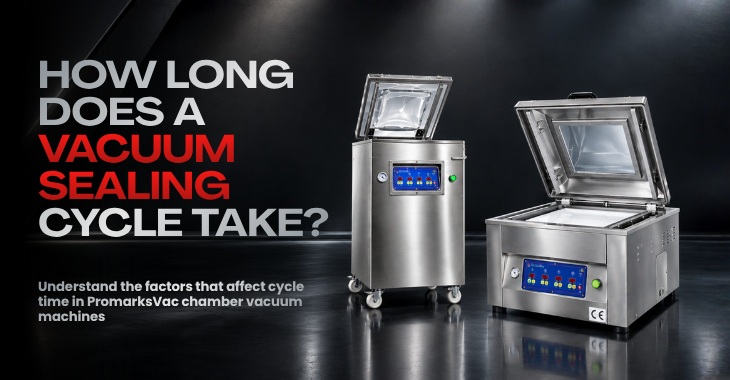
When choosing a commercial chamber vacuum sealer, one of the most important questions is how long it takes to complete a full packaging cycle. Cycle time directly affects production capacity, labor efficiency, and the number of packages a business can process per hour.
So, how long does a cycle take in a PromarksVac chamber vacuum machine?
A typical chamber vacuum packaging cycle can take approximately 20 seconds to several minutes, depending on the machine model, vacuum pump capacity, chamber size, product, packaging configuration, and programmed settings.
The vacuum stage is only one part of the cycle. A complete cycle can include vacuuming, optional gas flushing, sealing, cooling, and lid opening.
What Is a Vacuum Packaging Cycle?
A cycle is the complete sequence required to vacuum and seal a product before the machine is ready for the next load.
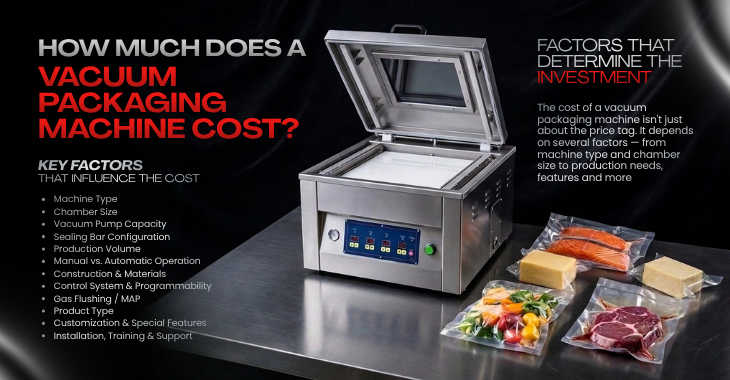
In a typical PromarksVac chamber machine, the operator places the product inside the chamber with the open end of the vacuum bag positioned across the sealing bar. Once the lid is closed, the machine removes air from the chamber and bag, seals the bag, releases the vacuum, and opens the chamber.
A typical cycle consists of:
- Loading the chamber
- Closing the lid
- Vacuuming
- Optional gas flushing
- Bag sealing
- Cooling
- Vacuum release
- Opening the lid and removing the package
The programmed machine cycle does not always represent the total time an operator needs to process a package. Loading and unloading time should also be considered when calculating actual production capacity.
Typical PromarksVac Chamber Machine Cycle Time
There is no single cycle time that applies to every PromarksVac chamber vacuum sealer.
For many applications, the programmed cycle may fall within a range such as:
| Cycle Stage | Typical Time |
|---|---|
| Vacuum | 20–60+ seconds |
| Gas flush, if used | Additional time |
| Sealing | 1–4 seconds |
| Cooling | 1–4 seconds |
| Vacuum release/lid opening | A few seconds |
| Typical complete machine cycle | Approximately 20 seconds to several minutes |
These figures are general examples rather than guaranteed cycle times for every PromarksVac model. A machine with a larger chamber or a different vacuum pump configuration may require different settings.
For an accurate production estimate, the specific PromarksVac model, pump configuration, product, bag size, and desired vacuum level should be considered.
1. Vacuum Time Is Usually the Largest Part of the Cycle
The vacuum stage generally accounts for the largest portion of the machine’s programmed cycle.
During this stage, the vacuum pump removes air from the chamber. Because the chamber and the inside of the package are connected, air is removed from the vacuum bag as the chamber pressure decreases.
The required vacuum time can vary considerably.
For example, a small package containing a relatively dry product may reach the desired vacuum level quickly. A larger package, larger chamber load, or product with a different physical structure may require more time.
The machine’s vacuum pump capacity also matters.
A higher-capacity vacuum pump can remove air more quickly under appropriate operating conditions, but pump size alone does not determine the final cycle time. Chamber volume, product arrangement, bag dimensions, hose and plumbing configuration, target vacuum level, and other factors also influence performance.
Factors that can affect vacuum time include:
- Vacuum pump capacity
- Chamber size
- Amount of air inside the package
- Bag size
- Number of bags loaded into the chamber
- Product size and shape
- Product moisture
- Target vacuum level
- Bag positioning
- Machine settings
- Condition of the vacuum system
This is why two products packaged on the same machine may require different vacuum times.
2. Sealing Usually Takes Only a Few Seconds
Once the desired vacuum level or vacuum time has been reached, the machine moves to the sealing stage.
The open end of the vacuum bag is positioned against the sealing bar. Heat is applied to the bag material to create an airtight seal.
Depending on the machine and packaging material, the programmed sealing time may be approximately 1–4 seconds.
However, sealing time should not be selected simply based on speed.
The correct sealing setting depends on factors such as:
- Bag material
- Bag thickness
- Film construction
- Sealing bar configuration
- Product application
- Machine model
- Required seal strength
A seal that is too short may not form properly, while excessive heat or sealing time can damage the packaging material.
The objective is not simply to achieve the shortest possible sealing time. The objective is to produce a consistent, strong, and reliable seal.
3. Cooling Time Helps Create a Reliable Seal
After heat is applied to the bag, the machine may use a short cooling period before completing the sealing process.
Cooling allows the sealed area to stabilize before the package is exposed to normal atmospheric pressure.
A typical cooling setting may be around 1–4 seconds, although the appropriate setting varies according to the packaging material and machine configuration.
Cooling time can be particularly important when packaging materials require additional time to establish a consistent seal.
4. Gas Flushing Can Increase Cycle Time
Some vacuum packaging applications use gas flushing, also called modified atmosphere packaging or MAP.
Instead of simply removing air and sealing the package, the machine removes air and then introduces a selected gas or gas mixture before sealing.
Gas flushing can be useful for certain food packaging applications because the package atmosphere can be modified according to the product and packaging requirements.
However, this additional process can increase the overall cycle time.
A gas-flush cycle may therefore look more like:
Vacuum → Gas Flush → Vacuum/Gas Sequence → Seal → Cool → Release
The exact sequence depends on the machine configuration and programmed settings.
Businesses comparing cycle times should therefore make sure they are comparing similar packaging processes. A basic vacuum cycle and a vacuum-plus-gas-flush cycle should not be expected to have identical cycle times.
5. Product Type Can Change the Cycle Time
The product being packaged is another important variable.
Different products behave differently during vacuum packaging.
For example, a solid, relatively dry product may behave differently from a product containing liquids, sauces, marinades, or other moisture.
Products with liquid can require particular attention because excessive vacuuming can cause liquid to move toward the sealing area or begin to boil under reduced pressure.
In these applications, operators may need to adjust the vacuum process rather than simply increasing vacuum time.
Common products packaged with chamber vacuum machines include:
- Fresh meat
- Processed meat
- Seafood
- Cheese
- Prepared foods
- Vegetables
- Fruits
- Sauces
- Marinated products
- Bakery products
- Medical products
- Industrial components
- Electronic components
- Other non-food products
The appropriate cycle settings can vary substantially between these applications.
6. Chamber Size Affects Cycle Requirements
The size of the vacuum chamber is another important consideration.
A larger chamber can accommodate larger products or more bags per cycle, but it also contains a greater volume of air that must be evacuated.
This means that a larger chamber does not automatically mean a faster cycle.
Instead, machine capacity should be evaluated together with:
- Chamber dimensions
- Vacuum pump capacity
- Number of bags per cycle
- Bag dimensions
- Product dimensions
- Desired vacuum level
For a high-volume operation, a machine that can package multiple bags in one cycle may provide higher overall productivity even if its individual cycle is longer than that of a smaller machine.
7. Number of Bags Per Cycle Matters
One of the most overlooked factors in calculating vacuum packaging productivity is the number of packages processed during each cycle.
Consider two hypothetical machines:
Machine A
- 30-second cycle
- 1 package per cycle
Machine B
- 50-second cycle
- 4 packages per cycle
Machine B has a longer individual cycle, but it can potentially process more packages during the same period.
This is why businesses should not evaluate chamber vacuum sealers based solely on the number of seconds per cycle.
The more useful measurement is often packages per hour.
How to Calculate Approximate Packaging Capacity
A simple way to estimate theoretical production is:
Packages per hour = Packages per cycle × 3,600 ÷ Cycle time in seconds
For example, if a machine completes a 60-second cycle and processes four packages per cycle:
4 × 3,600 ÷ 60 = 240 packages per hour
This is a theoretical calculation.
Actual production will normally be lower because operators need time to:
- Load products
- Position bags
- Arrange packages
- Remove finished packages
- Inspect seals
- Reposition products
- Perform other handling tasks
Therefore, businesses should distinguish between machine cycle time and real-world production throughput.
Why a 30-Second Cycle Does Not Mean 120 Packages Per Hour
It is easy to make a mistake when calculating production capacity.
If a machine has a 30-second programmed cycle, its theoretical maximum is:
3,600 ÷ 30 = 120 cycles per hour
But this does not necessarily mean the operator will produce 120 finished packages per hour.
If the machine processes two bags per cycle, the theoretical output becomes:
120 × 2 = 240 packages per hour
And if loading and unloading require additional time, actual output will be lower.
For this reason, production planning should consider the entire packaging workflow, not only the programmed vacuum time.
What Can Make a PromarksVac Cycle Longer?
Several factors can increase cycle time.
1. Higher vacuum requirements
If the application requires a deeper vacuum or longer evacuation period, the vacuum portion of the cycle may increase.
2. Larger bags
Larger bags generally contain more air that must be removed.
3. Larger chamber loads
A larger load can change the amount of air that needs to be evacuated and may affect the required cycle settings.
4. Gas flushing
Gas flushing adds another stage to the packaging process.
5. Liquid or moisture-rich products
Liquid products may require different vacuum settings and operating techniques.
6. Packaging material
Different bag materials and thicknesses can require different sealing and cooling settings.
7. Product arrangement
Poor positioning of bags can interfere with efficient evacuation or sealing.
8. Machine condition
A vacuum system that is not properly maintained may not perform as expected.
Worn gaskets, damaged seals, leaks, contaminated components, or vacuum-system problems can affect the ability of the machine to reach the desired vacuum efficiently.
Does a Larger Vacuum Pump Always Mean a Faster Cycle?
Not necessarily.
Pump capacity is an important part of vacuum packaging performance, but it is only one variable.
A larger pump may provide faster evacuation under suitable conditions, but the overall cycle is also affected by chamber volume, bag size, plumbing, vacuum level, product characteristics, and machine design.
For example, installing a larger pump does not automatically make every application twice as fast.
The complete system needs to be considered when selecting a vacuum pump and chamber machine.
How to Reduce Vacuum Packaging Cycle Time
If cycle time is affecting production, there are several areas worth evaluating.
Use the Correct Machine Size
Select a chamber size appropriate for the products being packaged.
A machine that is too small may limit the number or size of packages per cycle. A machine that is unnecessarily large may not provide the most efficient solution for a smaller operation.
Select an Appropriate Vacuum Pump
Pump capacity should match the chamber size and expected production requirements.
The goal is to select a pump and machine configuration that can achieve the required vacuum efficiently without paying for capacity that the application does not need.
Optimize Bag Placement
Proper bag positioning can help create consistent packaging cycles.
Operators should avoid unnecessary folds, overlapping bags, or positioning that interferes with the sealing area.
Use Appropriate Vacuum Settings
Do not automatically use the maximum possible vacuum time.
The correct setting should be based on the product, packaging material, desired vacuum level, and application requirements.
Optimize Sealing and Cooling
Sealing and cooling should be sufficient to create a reliable package without unnecessarily extending the cycle.
Consider Multiple Bags Per Cycle
For suitable applications, increasing the number of packages processed during each cycle can have a significant effect on overall throughput.
How Long Should You Expect a PromarksVac Cycle to Take?
There is no universal cycle time for every PromarksVac chamber vacuum machine.
As a general reference, a straightforward vacuum-and-seal application may have a cycle measured in tens of seconds, while larger loads, higher vacuum requirements, gas flushing, or other process requirements can extend the cycle to a minute or several minutes.
The exact time should be determined using the specific machine and application rather than relying on a generic cycle-time figure.
The most important specifications to evaluate are:
- Machine model
- Chamber dimensions
- Vacuum pump capacity
- Target vacuum level
- Bag dimensions
- Product type
- Number of bags per cycle
- Sealing time
- Cooling time
- Gas-flush requirements
- Operator loading and unloading time
Frequently Asked Questions
How long does a PromarksVac chamber vacuum cycle take?
A typical cycle can range from approximately 20 seconds to several minutes, depending on the machine model, pump capacity, product, vacuum settings, bag configuration, and whether gas flushing is used.
How long does vacuuming take?
Vacuuming may take approximately 20–60 seconds or longer, depending on the application and desired vacuum level. Larger chambers, larger bags, and higher vacuum requirements can increase the required time.
How long does the sealing process take?
The sealing portion of a cycle may take approximately 1–4 seconds, depending on the machine and packaging material.
Does gas flushing increase cycle time?
Yes. Gas flushing adds an additional process to the standard vacuum-and-seal cycle and can therefore increase the total cycle time.
Can PromarksVac machines process multiple bags at once?
Depending on the machine’s chamber dimensions and application, multiple bags may be positioned and processed during a single cycle. The number of packages that can be processed simultaneously depends on the product and chamber configuration.
What is more important: cycle time or packages per hour?
For production planning, packages per hour is often more useful than cycle time alone. A machine with a longer cycle can potentially produce more packages if it can process multiple bags during each cycle.
How can I determine the cycle time for my product?
The most accurate approach is to evaluate the specific PromarksVac machine, product dimensions, bag size, desired vacuum level, sealing requirements, and number of packages per cycle. Application testing can provide a more realistic production estimate than a generic cycle-time calculation.
Choose the Right PromarksVac Chamber Machine for Your Production
The right chamber vacuum machine is not necessarily the machine with the shortest advertised cycle. The better approach is to match the machine, vacuum pump, chamber size, packaging format, and production requirements to the application.
If you are planning to purchase or upgrade a commercial vacuum packaging system, the PromarksVac team can help determine the appropriate machine configuration based on your product, package size, desired vacuum level, and production volume.
Need help selecting a chamber vacuum packaging machine? Contact PromarksVac to discuss your application and production requirements.