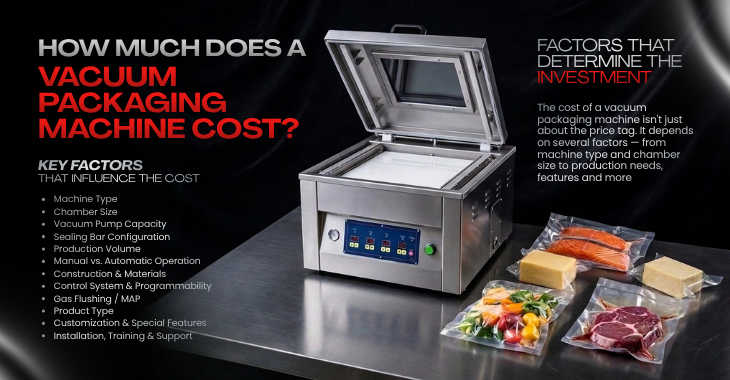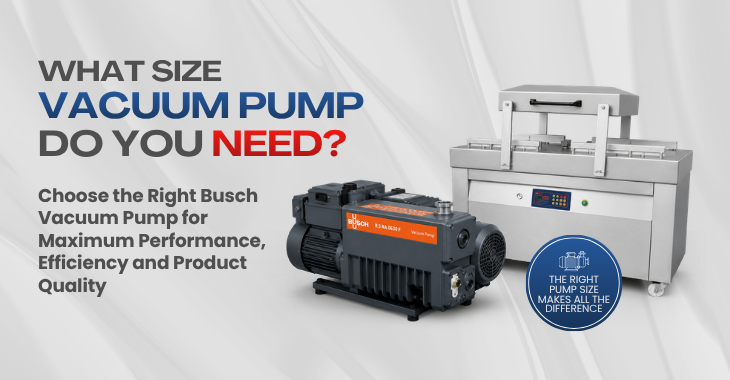
Choosing the right vacuum pump is one of the most important decisions when investing in a commercial vacuum packaging machine. While many buyers focus on seal bar size, chamber dimensions, or automation features, the vacuum pump is the heart of the system. It directly affects packaging speed, vacuum quality, production efficiency, operating costs, and ultimately the shelf life of your products.
A vacuum packaging machine is only as good as the pump inside it. Even the most advanced chamber vacuum sealer or thermoforming packaging machine cannot deliver consistent performance if the vacuum pump is undersized for the application.
Promarksvac Corp equips its commercial vacuum packaging machines with Busch vacuum pumps, one of the world’s most recognized vacuum technologies trusted across food processing, pharmaceutical, electronics, medical, and industrial manufacturing industries. Busch pumps are known for their reliability, deep vacuum capability, long service life, and worldwide service support, making them the preferred choice for demanding commercial operations.
This comprehensive guide explains how to determine the right vacuum pump size, why pump sizing matters, how Busch vacuum pumps improve packaging performance, and how to select the best configuration for your production requirements.
What Does Vacuum Pump Size Mean?
One of the biggest misconceptions is that a larger vacuum pump simply creates a stronger vacuum.
In reality, vacuum pump size refers to pumping capacity, usually measured in:
- Cubic meters per hour (m³/h)
- Cubic feet per minute (CFM)
The pumping capacity indicates how quickly air can be removed from the vacuum chamber.
A larger pump does not necessarily create a deeper vacuum than a smaller pump. Instead, it reaches the desired vacuum level much faster.
For example:
- 21 m³/h Busch Pump
- 63 m³/h Busch Pump
Both can achieve approximately the same final vacuum level when properly configured, but the 63 m³/h pump reaches that level much more quickly.
This difference significantly impacts production throughput.
Why Vacuum Pump Size Matters
The right vacuum pump affects nearly every aspect of packaging performance.
Faster Cycle Times
A larger pump evacuates air more quickly, reducing vacuum cycle times.
Instead of waiting 30–40 seconds per cycle, many commercial machines complete the vacuum stage in much less time.
Across hundreds or thousands of packages per day, these time savings become substantial.
Better Productivity
Higher pump capacity means:
- More packages per hour
- Reduced operator waiting time
- Increased production efficiency
- Higher daily output
For processors running multiple shifts, this translates into meaningful productivity gains.
Improved Vacuum Consistency
An appropriately sized pump maintains stable vacuum performance even during continuous operation.
Consistent vacuum levels help ensure:
- Uniform package appearance
- Reliable sealing
- Consistent shelf life
- Reduced product returns
Better Product Protection
Removing oxygen effectively helps protect:
- Fresh meat
- Poultry
- Seafood
- Cheese
- Processed foods
- Medical devices
- Electronics
A properly sized pump supports packaging that minimizes oxidation, freezer burn, discoloration, and contamination.
How Vacuum Packaging Works
Understanding the packaging process helps explain why pump selection matters.
During each packaging cycle:
- Product is placed inside the chamber.
- Chamber lid closes.
- Busch vacuum pump removes air.
- Desired vacuum percentage is achieved.
- Bag is heat sealed.
- Chamber returns to atmospheric pressure.
- Finished package is removed.
The vacuum pump performs the most demanding part of this sequence.
Its efficiency determines:
- Cycle duration
- Vacuum quality
- Production speed
Factors That Determine the Right Vacuum Pump Size
No single pump is ideal for every application.
Several factors influence proper sizing.
1. Chamber Volume
Larger chambers contain more air.
More air requires greater pumping capacity.
For example:
A compact tabletop chamber requires significantly less evacuation than a large double chamber machine.
As chamber size increases, pump capacity should also increase.
2. Production Volume
Consider how many packages your facility produces.
Typical production levels include:
Small businesses
- 100–500 packages/day
Medium processors
- 500–2,500 packages/day
Large commercial facilities
- 2,500–10,000+ packages/day
High-volume facilities benefit from larger Busch pumps that reduce cycle time.
3. Product Type
Different products influence vacuum requirements.
Examples include:
Fresh meat: Requires deep vacuum for maximum shelf life.
Cheese: Requires consistent vacuum without crushing.
Seafood: Often benefits from rapid evacuation.
Liquids: Need controlled vacuum cycles.
Medical products: Require highly repeatable vacuum performance.
Electronics: Need moisture and oxidation protection.
4. Bag Size
Large bags contain more air than smaller bags.
Packaging whole primal cuts requires more evacuation than sealing individual portions.
5. Continuous Operation
Facilities operating:
- One shift
- Two shifts
- Three shifts
place different demands on the vacuum system.
Heavy-duty operations require pumps designed for continuous industrial use.
6. Automation Level
Automatic systems, including thermoforming packaging machines, typically require larger pumps because they operate continuously with minimal downtime.
Understanding Busch Vacuum Pumps
Busch is recognized globally as a leading manufacturer of industrial vacuum technology.
Their oil-lubricated rotary vane pumps have become the benchmark for commercial vacuum packaging.
Key advantages include:
- Exceptional reliability
- High vacuum performance
- Long operational lifespan
- Worldwide service availability
- Proven food industry performance
- Energy-efficient operation
- Excellent spare parts availability
These characteristics make Busch pumps a preferred choice for commercial packaging equipment used around the world.
Why Promarksvac Uses Busch Vacuum Pumps
Promarksvac machines are engineered for commercial food processing environments where uptime, consistency, and durability are essential.
By integrating Busch vacuum pumps, Promarksvac offers customers several important benefits:
Reliable Performance
Busch pumps are designed for demanding industrial environments and continuous operation.
Faster Packaging Cycles
Efficient air evacuation reduces packaging time and increases production capacity.
Deep Vacuum Capability
Achieving high vacuum levels helps maximize shelf life while preserving product quality.
Long Service Life
Routine maintenance allows Busch pumps to operate reliably for many years.
Global Support
Busch maintains an international service network, making maintenance and spare parts readily available in many regions.
Common Busch Pump Sizes Used in Commercial Vacuum Packaging
While pump selection depends on machine configuration and application, common capacities include:
21 m³/h
Suitable for:
- Compact tabletop chamber machines
- Small butcher shops
- Restaurants
- Specialty food producers
40 m³/h
Ideal for:
- Medium-sized food processors
- Delicatessens
- Cheese producers
- Retail packaging operations
63 m³/h
Recommended for:
- Large single chamber machines
- Commercial meat processors
- High-volume packaging
100 m³/h
Commonly used in:
- Double chamber vacuum sealers
- Larger production facilities
- Continuous industrial packaging
160 m³/h and Higher
Often integrated into:
- Automatic thermoforming packaging systems
- Rollstock packaging machines
- Fully automated production lines
Bigger Isn’t Always Better
Many buyers assume selecting the largest available pump is the safest choice.
However, oversized pumps may:
- Increase purchase cost
- Consume more energy than necessary
- Provide minimal productivity improvement for low-volume operations
The objective is to match pump capacity to production requirements rather than simply choosing the largest option.
Matching Pump Size to Your Business
Small Operations
Examples:
- Farm shops
- Specialty food producers
- Independent butchers
- Restaurants
Recommended approach:
Compact chamber machine with an appropriately sized Busch pump.
Medium Businesses
Examples:
- Regional meat processors
- Seafood companies
- Cheese manufacturers
Recommended approach:
Mid-sized commercial chamber machine with higher pump capacity for faster throughput.
Large Industrial Processors
Examples:
- Meat plants
- Poultry processors
- Export facilities
- Large food manufacturers
Recommended approach:
High-capacity Busch pumps integrated into double chamber or thermoforming packaging systems.
Vacuum Pump Size and Shelf Life
Although shelf life depends on many variables including product type, hygiene, storage temperature, packaging material, and handling, the vacuum pump plays a critical role by helping remove oxygen consistently from every package.
Stable, repeatable vacuum performance contributes to:
- Reduced oxidation
- Better color retention in many products
- Lower risk of freezer burn
- Improved package integrity
- More consistent product presentation
For food manufacturers, combining a properly sized Busch vacuum pump with high-quality vacuum pouches or rollstock film and good manufacturing practices supports longer-lasting product quality.
Energy Efficiency Considerations
Modern industrial vacuum pumps are engineered for efficiency.
A properly matched pump can:
- Complete vacuum cycles faster
- Reduce unnecessary operating time
- Lower overall energy consumption per packaged product
- Improve production efficiency
Selecting the correct pump size is often more energy-efficient than choosing an oversized pump that operates below its optimal range.
Maintenance Tips for Busch Vacuum Pumps
Routine maintenance is essential for maximizing pump life and maintaining consistent vacuum performance.
Best practices include:
- Check oil levels regularly.
- Replace vacuum pump oil according to the manufacturer’s maintenance schedule.
- Inspect and replace oil filters when required.
- Keep cooling vents clean and unobstructed.
- Monitor for unusual noise or vibration.
- Replace worn seals and vanes during scheduled servicing.
- Follow the maintenance intervals recommended by both the pump manufacturer and the machine manufacturer.
Preventive maintenance minimizes downtime and helps ensure consistent packaging quality.
Frequently Asked Questions
Does a larger pump create a stronger vacuum?
Not necessarily. In most commercial packaging applications, the primary advantage of a larger pump is that it reaches the target vacuum level more quickly, reducing cycle times.
Can I upgrade my vacuum pump later?
Some commercial vacuum packaging machines can be upgraded with higher-capacity pumps, but compatibility depends on the specific machine design, chamber size, electrical requirements, and manufacturer recommendations. Always consult the equipment manufacturer before upgrading.
What is the best pump for meat processing?
The ideal pump depends on production volume, chamber size, desired cycle time, and operating schedule. Commercial meat processors often benefit from higher-capacity Busch pumps because they provide fast, consistent vacuum performance in demanding environments.
Why are Busch pumps popular?
Busch vacuum pumps have earned a strong reputation for reliability, deep vacuum capability, industrial durability, worldwide service support, and decades of proven performance across food packaging and manufacturing industries.
Choosing the Right Vacuum Pump with Promarksvac
Every packaging operation is different. A small butcher shop packaging premium steaks has different requirements than a large processor producing thousands of vacuum-sealed products each day.
Promarksvac evaluates factors such as:
- Product type
- Packaging material
- Chamber size
- Production volume
- Shift length
- Future growth plans
- Desired cycle time
Based on these requirements, the company recommends the most appropriate machine configuration and Busch vacuum pump capacity to deliver dependable performance and long-term value.
Final Thoughts
Selecting the correct vacuum pump size is about more than choosing a number on a specification sheet. It is about matching pump capacity to your production goals, packaging application, and long-term business needs.
An undersized pump can slow production and create bottlenecks, while an oversized pump may increase capital and operating costs without delivering proportional benefits. The best solution is one that balances chamber size, package volume, cycle time, and operational efficiency.
By combining commercial-grade packaging equipment with trusted Busch vacuum pump technology, Promarksvac provides reliable vacuum performance for businesses ranging from artisan food producers to high-volume industrial processors. Whether you operate a restaurant, butcher shop, seafood facility, dairy plant, or fully automated processing line, choosing the right pump helps ensure faster packaging cycles, consistent vacuum quality, dependable sealing, and efficient production.
If you are planning to invest in a new chamber vacuum sealer, double chamber machine, or thermoforming packaging system, consult with the Promarksvac team to identify the vacuum pump configuration that best aligns with your current production requirements and future growth plans. The right pump is an investment in productivity, product quality, and long-term operational success.