Enhance, Tenderize, Preserve: The Benefits of Vacuum Tumbling for Meat Products
In commercial meat processing, producing a consistent product is about much more than simply adding a marinade or seasoning to meat. Processors need to achieve the right flavor, texture, moisture retention, appearance, yield, and overall product consistency while maintaining an efficient production process.
This is where vacuum tumbling can play an important role.
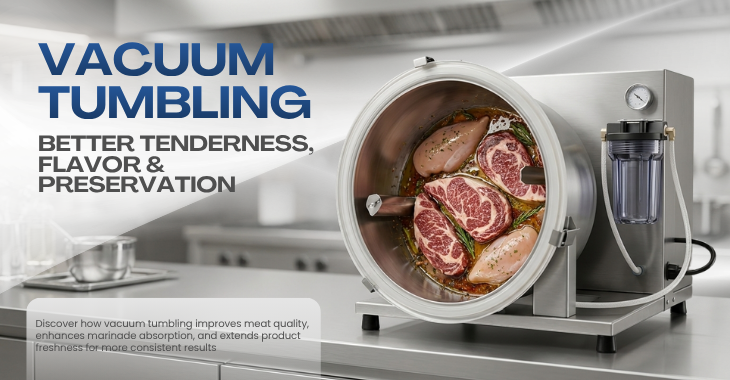
Vacuum tumbling is a mechanical processing method used to distribute marinades, seasonings, brines, and other ingredients throughout meat products while the meat is gently agitated inside a rotating drum under vacuum. The combination of controlled tumbling and reduced pressure can improve the way ingredients interact with the meat, while the mechanical action helps develop texture and improve the consistency of the finished product.
The process is used across a variety of meat applications, including poultry, beef, pork, seafood, deli products, marinated cuts, cooked products, and other processed foods.
However, vacuum tumbling is not simply a faster way to marinate meat. Its value comes from several related effects that take place during processing. Understanding these effects can help meat processors determine when vacuum tumbling is appropriate for their products and how to get better results from their equipment.
What Is Vacuum Tumbling?
Vacuum tumbling involves placing meat and a controlled amount of marinade, brine, seasoning solution, or other processing ingredients inside a tumbler. The drum is then placed under vacuum while it rotates at a controlled speed.
As the drum rotates, the meat is lifted and gently dropped or rolled through the processing chamber. This repeated movement creates mechanical action between the meat pieces and helps distribute the added ingredients.
The vacuum environment is an important part of the process.
Removing much of the air from the chamber changes the conditions surrounding the meat and can assist with the movement and distribution of liquid ingredients. It can also reduce the amount of air trapped between meat pieces during processing.
The exact results depend on several variables, including:
- Type and size of the meat pieces
- Meat temperature
- Marinade or brine formulation
- Amount of added solution
- Vacuum level
- Tumbling speed
- Tumbling time
- Drum design and internal paddles or baffles
- Loading percentage
- Product-to-liquid ratio
- Desired finished-product characteristics
Because of these variables, there is no single vacuum-tumbling program that works for every meat product. Commercial processors generally develop processing parameters based on the product, formulation, equipment, and desired result.
How Does Vacuum Tumbling Work?
The basic concept is relatively straightforward, but several processes are taking place at the same time.
First, meat is loaded into the tumbler along with the required marinade, brine, seasoning solution, or other ingredients. The chamber is then evacuated to the desired vacuum level.
As the drum rotates, the meat continuously moves through the chamber. The tumbling action creates mechanical contact between the meat pieces and the processing solution.
This mechanical action can help distribute the liquid more evenly than simply allowing meat to sit in a stationary marinade.
For products formulated with salt, phosphates, or other functional ingredients, tumbling can also encourage the extraction of certain soluble muscle proteins. These proteins can contribute to binding, water retention, and the texture of certain processed meat products.
The vacuum environment also helps remove air from spaces around and between the product pieces. This can improve contact between the meat and processing solution and can be particularly useful when the goal is to achieve a consistent distribution of ingredients.
The result is a controlled combination of mechanical action, ingredient contact, and vacuum processing.
1. More Even Distribution of Marinades and Seasonings
One of the most important reasons processors use vacuum tumblers is to improve the distribution of added ingredients.
When meat is simply mixed with a marinade, the liquid may not distribute evenly across every piece. Some pieces can receive more seasoning than others, while portions of the meat may receive relatively little.
Vacuum tumbling provides continuous movement during the process. As the meat rotates through the drum, the marinade or brine repeatedly comes into contact with different surfaces of the product.
This can help create a more uniform distribution.
For commercial processors, consistency matters. Customers expect the same product characteristics from one package to another. If one portion is heavily seasoned while another has little flavor, the final product can feel inconsistent even when the same formulation was used.
Vacuum tumbling can help reduce this variation when the process is properly controlled.
This is particularly useful for products such as marinated chicken, seasoned beef, pork products, prepared meat portions, and other products where flavor needs to be distributed consistently.
2. Improved Marinade Uptake
Vacuum tumbling can also improve the interaction between meat and a marinade or processing solution.
The combination of vacuum and mechanical movement can help processing liquids come into closer contact with the surface of the meat. Depending on the formulation and product structure, this can contribute to better uptake and distribution of the added solution.
This does not mean that vacuum tumbling automatically forces marinade deep into every piece of meat. The degree of penetration depends heavily on the characteristics of the meat and the formulation being used.
Muscle structure, meat temperature, piece size, solution viscosity, salt concentration, tumbling time, and vacuum level can all influence the final result.
For processors, this means that vacuum tumbling should be viewed as a controlled process rather than a shortcut.
The equipment provides the mechanical and vacuum conditions, but the formulation and processing parameters still need to be properly developed.
3. Better Flavor Consistency
Flavor consistency is closely connected to ingredient distribution.
If a marinade or seasoning solution is unevenly distributed, consumers can experience noticeable differences between pieces of meat in the same package.
Vacuum tumbling helps processors achieve a more consistent relationship between the meat and the ingredients added during processing.
For example, a processor producing marinated chicken portions may need the same seasoning profile across thousands of pounds of product. Instead of relying only on static soaking or manual mixing, a commercial vacuum tumbler provides controlled mechanical movement that can repeatedly expose the meat to the processing solution.
The result can be a more consistent finished product from batch to batch.
This is especially important for commercial operations producing branded or standardized products where customers expect the same flavor every time they purchase the product.
4. Improved Tenderness and Texture
Another major application of vacuum tumbling is the development of meat texture.
The mechanical action created during tumbling repeatedly moves the meat against itself and against the internal surfaces of the drum. This action can affect the structure of the product and, depending on the meat and process, contribute to a more tender eating experience.
The effect can be particularly useful for certain cuts and processed meat applications where tenderness is an important part of the final product.
However, it is important not to describe vacuum tumbling as a universal tenderizing solution.
Different cuts of meat respond differently to mechanical processing. Excessive tumbling can also negatively affect some products by damaging their structure, creating a mushy texture, or producing an appearance that is not desirable for the finished product.
For this reason, processors need to establish an appropriate tumbling time and intensity for each application.
The goal is not simply to tumble the product for as long as possible. The goal is to achieve the desired texture while maintaining the physical characteristics of the meat.
5. Better Moisture Retention in Processed Meat Products
Moisture retention is an important consideration in many processed meat applications.
When properly formulated and processed, ingredients such as salt and phosphates can influence the ability of meat proteins to bind and retain water. Mechanical action from tumbling can assist with the extraction and development of functional muscle proteins involved in this process.
This can be particularly relevant for products such as:
- Marinated poultry
- Deli meats
- Ham and pork products
- Formed meat products
- Cooked meat products
- Brined products
- Certain injected or seasoned meat products
Improved water retention can help produce a juicier finished product and may also affect processing yield.
However, moisture retention should not be attributed to vacuum tumbling alone. Product formulation, ingredient selection, meat quality, temperature, cooking conditions, and other processing variables all contribute to the final result.
6. Potentially Higher Processing Yield
Yield is a major consideration in commercial meat processing.
Every processor has to manage the relationship between raw material cost, ingredient cost, processing losses, cooking loss, packaging, and the amount of saleable finished product produced.
When a formulation is designed to incorporate a controlled amount of marinade or brine, effective processing can help achieve the desired uptake and retention.
Vacuum tumbling can support this process by providing controlled mechanical action and consistent contact between the meat and processing solution.
For example, a processor producing marinated poultry may have a defined target pickup percentage. The tumbler can be used as part of a controlled process to help reach that target consistently.
The important point is that yield improvement is not simply a result of “putting meat in a vacuum tumbler.” The formulation and process need to be designed around the target pickup, and the finished product needs to be monitored to confirm that the intended results are being achieved.
7. Faster and More Controlled Processing
Traditional marination can require extended holding periods, especially when meat is simply left in a liquid solution without mechanical agitation.
Vacuum tumbling can make the process more active.
Instead of allowing the product to sit relatively still, the tumbler continuously moves the meat through the marinade or processing solution. This can improve contact and reduce the time required to achieve a particular processing objective in some applications.
The actual processing time varies considerably.
A delicate product may require relatively gentle handling, while another product may tolerate more intensive tumbling. The formulation, product size, desired pickup, equipment design, and target texture all influence the appropriate cycle.
Commercial vacuum tumblers therefore allow processors to establish repeatable processing cycles rather than relying on manual mixing or inconsistent soaking times.
8. Greater Batch-to-Batch Consistency
Consistency becomes increasingly important as a meat-processing operation grows.
A small processor may be able to manually handle a limited number of batches. As production volume increases, however, manual processes can become difficult to control.
Two operators may mix a product differently. One batch may receive slightly more processing time. Another may be handled more aggressively.
These small differences can eventually appear in the finished product.
A commercial vacuum tumbler provides a more controlled environment in which processors can establish parameters for:
- Vacuum level
- Tumbling speed
- Tumbling direction
- Processing time
- Batch size
- Ingredient quantity
- Product temperature
Once these parameters have been validated for a particular product, operators can follow a repeatable process.
This is one of the biggest advantages of mechanical processing in a commercial production environment: the objective is not simply to process meat faster, but to make the process more predictable.
9. Reduced Air During Processing
Air can be undesirable in a number of meat-processing applications.
Air trapped around or between meat pieces can affect product appearance and can interfere with contact between the meat and liquid ingredients.
Vacuum tumbling reduces the amount of air in the processing chamber. This allows the meat and marinade to interact in a low-air environment.
The vacuum can also help minimize air pockets during processing.
However, vacuum processing should not be confused with a guarantee of extended food safety or shelf life.
The shelf life of a meat product depends on many factors, including the formulation, initial microbial load, sanitation, processing temperature, storage temperature, packaging method, oxygen exposure, handling practices, and regulatory requirements.
A vacuum tumbler is a processing machine, not a substitute for an appropriate food-safety program.
10. Useful for a Wide Range of Meat Products
Vacuum tumbling is not limited to one specific type of meat.
Depending on the equipment configuration and process requirements, tumblers can be used for a wide range of applications.
Poultry
Chicken and turkey processors commonly use tumbling for marinated, seasoned, or brined products.
Examples include:
- Chicken breasts
- Chicken thighs
- Chicken wings
- Turkey portions
- Marinated poultry
- Prepared poultry products
Beef
Beef processors can use tumbling for various marinated and seasoned products.
Applications may include:
- Beef strips
- Steak portions
- Marinated beef
- Seasoned cuts
- Certain processed beef products
Pork
Pork products can also benefit from controlled tumbling and marinade distribution.
Applications include:
- Pork chops
- Pork loin
- Pork portions
- Marinated pork
- Ham and other processed pork products
Seafood
Certain seafood applications can also use vacuum tumbling, although product characteristics need to be considered carefully because seafood can be more delicate than many meat products.
The appropriate equipment settings and processing intensity should therefore be determined according to the specific product.
Vacuum Tumbling vs. Traditional Marination
Traditional marination generally involves placing meat in a marinade and allowing it to remain there for a specified period.
This approach can work well for some products, but it may provide limited mechanical interaction between the meat and marinade.
Vacuum tumbling introduces controlled movement into the process.
Instead of relying primarily on time, the processor can use a combination of vacuum, rotation, and controlled mechanical action to improve contact between the meat and processing solution.
This does not necessarily mean that vacuum tumbling should replace every other marination method.
For some products, static marination may be completely appropriate. For higher-volume commercial production, however, vacuum tumbling can provide greater control and repeatability.
The right choice depends on the product, production volume, desired result, and available processing system.
Why Temperature Control Matters During Vacuum Tumbling
Temperature is an important consideration when processing meat.
Meat should remain within the appropriate temperature range established by the processor’s food-safety program throughout handling and processing. Excessive temperature increases can affect product quality and can create food-safety concerns.
Mechanical tumbling generates some friction, and long processing cycles can contribute to temperature changes.
For this reason, commercial processors should monitor product temperature and establish appropriate operating procedures rather than focusing only on vacuum level and tumbling time.
The tumbler should be integrated into the facility’s broader sanitation, refrigeration, handling, and HACCP procedures.
Avoiding Over-Tumbling
More processing does not always produce a better product.
One of the most common mistakes in mechanical meat processing is assuming that increasing tumbling time will automatically improve marinade distribution, tenderness, or yield.
Excessive tumbling can damage the physical structure of certain meat products.
Depending on the application, over-processing may lead to:
- Excessive protein extraction
- Soft or mushy texture
- Damaged meat surfaces
- Unwanted appearance
- Uneven product structure
- Increased purge or other quality issues
The correct tumbling cycle should therefore be established through product testing.
A processor should consider the desired appearance and texture of the finished product rather than simply trying to maximize processing intensity.
How to Choose the Right Vacuum Tumbler
Choosing a commercial vacuum tumbler requires more consideration than simply selecting the largest available drum.
The appropriate machine depends on the processor’s production requirements and the characteristics of the product.
Important factors include:
Batch Capacity
Determine how much product needs to be processed in a typical batch.
A machine that is too small may require excessive batches and additional labor. A machine that is too large may not operate efficiently when consistently underloaded.
Product Type
The physical characteristics of the product matter.
Whole muscle pieces, small meat portions, poultry, seafood, and processed products may require different tumbling conditions.
Desired Processing Time
Consider the production schedule and the amount of processing time available between receiving raw material and packaging the finished product.
Vacuum Requirements
The required vacuum level depends on the product and processing objective. The machine should provide appropriate vacuum control rather than simply maximizing vacuum.
Tumbling Speed
Variable speed control can be useful because different products require different levels of mechanical action.
Construction and Sanitation
A commercial food-processing machine needs to be designed with sanitation and cleaning requirements in mind.
Food-contact surfaces, drum construction, seals, access points, and overall machine design should all be evaluated as part of the purchasing decision.
Automation and Controls
Modern tumblers can provide controls for processing time, rotation speed, vacuum level, and other operating parameters.
Consistent controls can help operators reproduce validated processing cycles from one batch to another.
Vacuum Tumbling and Final Packaging
Vacuum tumbling and vacuum packaging are two different processes, although they can be used together in a meat-processing operation.
Vacuum tumbling is primarily used to process the meat and distribute ingredients.
Vacuum packaging is used later to remove air from the package and seal the finished product inside packaging material.
A typical production sequence might look like:
Prepare Meat → Add Marinade/Brine → Vacuum Tumble → Inspect/Portion → Vacuum Package → Refrigerate or Process Further
The exact sequence will depend on the product and production system.
Using a tumbler does not eliminate the need for proper packaging equipment. Once the meat has been processed, the processor may still require a commercial chamber vacuum sealer, tray sealing system, thermoforming machine, or another packaging solution depending on the product and packaging format.
Does Vacuum Tumbling Extend Meat Shelf Life?
This point requires careful explanation.
Vacuum tumbling itself should not be presented as a shelf-life extension method.
The vacuum environment used during tumbling may reduce the amount of air present during processing, but food safety and shelf life depend on the complete processing and packaging system.
Factors such as sanitation, formulation, microbial control, refrigeration, packaging atmosphere, oxygen transmission, storage temperature, and handling procedures all influence shelf life.
After tumbling, the product may be vacuum packaged or otherwise packaged under controlled conditions. That packaging step can have a significant effect on oxygen exposure and product stability, but it must be evaluated as part of the complete process.
Processors should establish shelf-life claims through appropriate validation and testing rather than assuming that vacuum tumbling alone provides a specific shelf life.
The Role of Vacuum Tumbling in Modern Meat Processing
Modern meat processors are under constant pressure to produce consistent products while controlling labor, processing time, ingredient usage, yield, and quality.
Vacuum tumbling can address several of these production challenges at the same time.
It provides controlled mechanical action for distributing marinades and seasonings, can support moisture and ingredient uptake in appropriately formulated products, and can contribute to desirable texture and consistency.
More importantly, it gives processors a repeatable process.
Instead of relying entirely on manual mixing or extended soaking, a commercial vacuum tumbler allows the processor to establish defined operating parameters and incorporate them into a standardized production procedure.
That repeatability becomes increasingly valuable as production volume grows.
Final Thoughts
Vacuum tumbling is an important processing technique for meat manufacturers looking to improve the consistency and quality of marinated, seasoned, brined, and processed meat products.
Its benefits go beyond simply helping a marinade contact the meat. Controlled tumbling can improve ingredient distribution, support marinade uptake, contribute to texture development, assist moisture retention in properly formulated products, and create a more repeatable production process.
At the same time, vacuum tumbling is not a substitute for proper formulation, temperature control, sanitation, food-safety procedures, or final packaging. The best results come from treating the tumbler as one component of a complete meat-processing system.
For processors, the objective should not be to tumble meat for the longest possible time or operate at the highest possible vacuum. The objective is to establish the right combination of vacuum level, tumbling speed, processing time, product temperature, formulation, and batch size for the specific product being manufactured.
When those variables are properly controlled, a commercial vacuum tumbler can become a valuable part of the production line helping processors produce meat products with more consistent flavor, texture, appearance, and processing results from batch to batch.
If you are evaluating a commercial vacuum tumbler for meat processing, the right machine depends on your product type, batch size, desired pickup, production volume, and processing requirements. Promarks offers commercial vacuum tumbling and massaging equipment designed for food-processing applications. Explore Promarks Vacuum Tumblers and Massagers or view the complete Promarks food-processing equipment range to identify equipment suited to your operation.