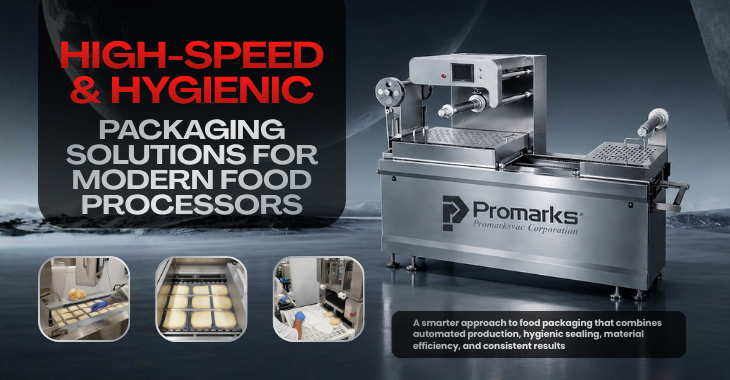
For a food processor, packaging is not simply the last step before a product leaves the production floor. It affects production speed, labor requirements, product protection, shelf life, presentation, material consumption, and ultimately the cost of putting that product in front of the customer.
That becomes especially important as production volumes increase.
A company packaging a few hundred products a day can often manage with manual bagging or a chamber vacuum sealer. But when production reaches thousands of packages per shift, the limitations of manual packaging become much harder to ignore. Workers spend more time loading bags, positioning products, removing air, sealing packages, trimming excess material, and handling finished products.
This is where a rollstock thermoformer packaging machine can change the way a packaging line operates.
Instead of using individual pre-made bags, a rollstock thermoformer uses continuous rolls of flexible film to form packages, load products, vacuum or gas flush the package, seal the top film, and cut the finished packages into individual units. The process can be configured for different products, package sizes, film structures, and production requirements.
For meat, poultry, seafood, cheese, prepared foods, and other products that require efficient and hygienic packaging, thermoforming can provide a practical way to increase throughput while maintaining consistent package quality.
What Is a Rollstock Thermoformer?
A rollstock thermoforming machine is an automated packaging system that forms packages directly from rolls of flexible packaging film.
Unlike a traditional chamber vacuum sealer, where an operator places a product inside a pre-made vacuum bag, a thermoformer creates the package during the packaging cycle.
The basic process is straightforward:
- A bottom film is unwound from a roll.
- The film is heated and formed into individual pockets.
- Products are loaded into the formed pockets.
- A top film is positioned over the product.
- Air is removed through vacuum packaging or the package is modified using MAP technology.
- The top and bottom films are heat sealed together.
- The finished packages are cut from the continuous web.
- The packaged products move to the next stage of production.
The exact configuration varies depending on the machine, film, product, package dimensions, and production requirements.
The important difference is that forming, filling, sealing, and cutting can be integrated into one continuous packaging operation.
For processors handling significant production volumes, that automation can make a substantial difference.
How Does a Thermoforming Packaging Machine Work?
Understanding the process helps explain why thermoformers are widely used in high-volume food packaging.
1. Bottom Film Unwinding
The packaging cycle begins with the bottom film. Instead of feeding individual bags into the machine, a continuous roll of film is unwound as the machine indexes forward.
The film must be compatible with the forming process and suitable for the product being packaged. Depending on the application, processors may use different film thicknesses, barrier properties, sealing characteristics, and forming capabilities.
2. Film Heating and Forming
The bottom film passes through a heating and forming station.
Heat makes the film flexible enough to be shaped into the required package cavity. A forming system then creates the pocket or tray where the product will be placed.
Package depth, shape, dimensions, and film characteristics all influence the forming process.
For example, a shallow pocket may be suitable for sliced cheese or prepared foods, while a deeper cavity may be required for larger portions of meat or poultry.
3. Product Loading
Once the pockets have been formed, operators or automated loading equipment place the products into them.
The loading stage is important because consistent product positioning helps maintain consistent package appearance and sealing quality.
In higher-volume operations, the thermoformer can be integrated with other equipment or loading systems to reduce manual handling.
4. Vacuum or Modified Atmosphere Packaging
After loading, the package moves into the sealing area.
Depending on the application, the packaging process may remove air from the package using vacuum or use Modified Atmosphere Packaging (MAP) to create the desired internal atmosphere.
Vacuum packaging can be particularly useful for products where removing oxygen is an important part of the packaging strategy.
MAP, meanwhile, uses a selected gas mixture to help maintain desired product characteristics and can be used for many fresh and prepared food applications.
The correct process depends on the product, film structure, distribution conditions, desired shelf life, and applicable food-safety requirements.
5. Heat Sealing
The top film is brought into position and sealed to the formed bottom film.
The sealing process needs to be consistent across the production run. Temperature, pressure, dwell time, film compatibility, and product contamination around the seal area can all affect seal quality.
A good thermoforming system is designed to maintain repeatable sealing conditions throughout production.
6. Cutting and Package Separation
After sealing, the continuous web is cut into individual packages.
Cutting can be configured according to the package dimensions and desired presentation. Depending on the application, packages can be produced in different shapes and configurations rather than being limited to the rectangular appearance of a conventional vacuum bag.
Why Are Rollstock Thermoformers Important for High-Volume Food Packaging?
The biggest reason processors move toward thermoforming is usually not a single feature.
It is the combination of speed, automation, material efficiency, consistency, and reduced manual handling.
When packaging is performed manually, every additional production step requires time and labor. Someone has to open the bag, position the product, remove air, seal it, inspect the package, and move it forward.
At high production volumes, those small tasks add up quickly.
A thermoformer brings many of these processes together into one automated packaging cycle.
1. Higher Production Throughput
Production speed is one of the primary advantages of thermoforming technology.
Instead of packaging each product individually in a separate pre-made bag, a continuous film web moves through the machine and multiple packages can be processed during each cycle.
This can significantly increase output compared with manual packaging methods.
The actual production rate depends on several factors, including:
- Package dimensions
- Number of lanes
- Product characteristics
- Package depth
- Vacuum requirements
- Sealing configuration
- Film type
- Machine indexing speed
- Loading method
- Operator efficiency
Therefore, processors should evaluate a thermoformer based on their actual production requirements rather than relying on a headline speed alone.
2. Reduced Dependence on Pre-Made Bags
Pre-made vacuum bags are convenient, but they also require additional manufacturing, packaging, storage, handling, and purchasing considerations.
Rollstock systems use continuous film rolls instead.
For high-volume operations, this can provide greater flexibility in packaging material management.
Film rolls can also allow processors to adjust package dimensions and formats according to production requirements.
Rather than maintaining large inventories of many different pre-made bag sizes, a processor may be able to simplify its packaging material strategy around the thermoforming system.
The right approach depends on the number of products being packaged and how frequently package dimensions change.
3. Better Material Utilization
Packaging material is a significant operating cost for food processors.
Using a roll of film gives the packaging machine the ability to form the package around the product rather than relying on a fixed pre-made bag.
This can help reduce unnecessary excess packaging material.
However, material savings should never be assumed simply because a machine uses rollstock. Actual consumption depends on the package dimensions, film thickness, trim configuration, product geometry, and machine setup.
A properly engineered packaging format can make a meaningful difference in material usage over a large production run.
Even a small reduction in film consumption per package can become significant when multiplied across hundreds of thousands or millions of packages.
4. Consistent Package Appearance
Retail packaging needs to look consistent.
Consumers expect products on the same shelf to have similar dimensions, presentation, and seal quality.
Manual packaging can introduce variation because every package depends heavily on operator technique.
A thermoformer automates many of the steps that influence package consistency.
When properly set up, the machine can repeatedly form pockets to the required dimensions, apply consistent sealing conditions, and cut packages to a repeatable format.
That consistency is valuable not only for appearance but also for downstream handling, labeling, transportation, and retail presentation.
5. Hygienic Packaging for Food Processing
Hygiene is a critical consideration in food-processing environments.
Packaging equipment used around meat, poultry, seafood, dairy, and prepared foods must be designed with sanitation and cleanability in mind.
Stainless-steel construction is commonly used in food-processing equipment because it provides durability and supports routine cleaning procedures.
A hygienically designed packaging line should also minimize unnecessary areas where product residue, moisture, or debris can accumulate.
Features such as accessible machine areas, appropriate guarding, suitable components, and designs intended for food-processing environments can make routine sanitation easier.
However, no packaging machine by itself makes a production environment “contamination-free.”
Food safety depends on the entire operation, including sanitation procedures, employee practices, product handling, facility design, environmental controls, and HACCP or other applicable food-safety programs.
That distinction matters when evaluating packaging equipment.
6. Vacuum Packaging Can Help Protect Product Quality
Vacuum packaging removes air from around the product before sealing.
For many food products, reducing oxygen exposure can help protect quality and contribute to longer storage life when combined with appropriate processing, refrigeration, packaging materials, and food-safety controls.
Vacuum packaging is widely used for products such as:
- Fresh meat
- Beef
- Pork
- Poultry
- Seafood
- Cheese
- Prepared foods
For processors, the benefit is not simply removing air.
The goal is to create a package that provides the right combination of product protection, appearance, seal integrity, storage performance, and distribution durability.
7. MAP Packaging for Fresh and Prepared Foods
Not every product is best packaged using a conventional vacuum-only process.
Modified Atmosphere Packaging can be used when a specific gas environment is desired inside the package.
Depending on the product and packaging system, MAP can be used to help manage oxygen exposure and maintain characteristics such as appearance and freshness during distribution.
The appropriate gas mixture, film barrier, package design, and process parameters depend heavily on the product.
Processors should therefore work with packaging specialists and, where appropriate, food-science professionals when developing a MAP application.
A thermoformer can provide the platform for these packaging formats while allowing the package design to be adapted to the product.
Choosing the Right Film for a Thermoformer
The machine is only one part of a thermoforming packaging system.
Film selection is equally important.
The film needs to work with the machine’s heating, forming, sealing, and cutting processes while providing the required performance for the finished package.
Important film characteristics can include:
Formability
The bottom film must be capable of forming the required pocket without unacceptable thinning, tearing, or deformation.
Sealability
The top and bottom films need to produce a reliable seal under the machine’s operating conditions.
Barrier Properties
Some products require films with stronger oxygen or moisture barrier characteristics.
Thickness
Film thickness influences forming behavior, package strength, material consumption, and overall package performance.
Puncture Resistance
Products with bones, sharp edges, shells, or irregular surfaces may require stronger packaging structures.
There is no single “best” thermoforming film for every product.
The appropriate film depends on the application.
Rollstock Thermoforming for Meat and Poultry
Meat and poultry processors are among the major users of thermoforming technology because these products often require high-volume packaging combined with strong product protection.
Applications can include:
- Beef steaks
- Ground beef
- Pork cuts
- Chicken portions
- Sausages
- Processed meats
- Marinated products
- Ready-to-cook products
The package format can be adapted to product dimensions and retail requirements.
For example, a processor packaging individual portions may require a different pocket depth and film structure than a processor packaging larger family-size cuts.
For products that contain bones or sharp edges, puncture resistance and package integrity become particularly important.
Seafood Packaging Applications
Seafood processors face additional packaging challenges because many products contain moisture, oils, shells, bones, or irregular shapes.
Thermoforming can be used for a variety of seafood products, including:
- Fish fillets
- Shrimp
- Salmon
- Shellfish
- Prepared seafood portions
- Frozen seafood products
The packaging system must be selected according to the product’s physical characteristics and storage requirements.
Seal contamination is another consideration.
Liquid, fat, or food particles around the seal area can interfere with sealing. Proper product loading, package design, film selection, and machine settings all play a role in achieving reliable seals.
Cheese and Dairy Packaging
Cheese processors can also benefit from automated rollstock packaging.
Sliced cheese, cheese portions, blocks, and other dairy products can require packaging that provides protection from moisture and oxygen while maintaining an attractive appearance.
Depending on the product, packaging may use vacuum or MAP formats.
The package needs to balance product protection with presentation. Clear packaging can allow consumers to see the product while appropriate barrier properties help protect it during storage and distribution.
Ready Meals and Prepared Foods
The prepared-food market has created another major application for thermoforming technology.
Ready-to-eat and ready-to-cook products may require packages that are convenient, consistent, and suitable for retail presentation.
Examples include:
- Prepared meals
- Pasta dishes
- Cooked meats
- Meal kits
- Deli products
- Portion-controlled foods
- Marinated foods
Thermoforming can create pockets or tray-style formats that accommodate these products while supporting automated sealing and cutting.
Medical and Non-Food Packaging
Although food processing is a major application, thermoforming technology is not limited to food.
Certain medical and industrial products can also be packaged using thermoformed packaging systems.
Medical-device packaging, for example, can require controlled package dimensions, reliable seals, and suitable packaging materials.
However, medical applications have their own regulatory, validation, sterilization, and material requirements. Equipment and packaging materials should therefore be selected according to the specific medical-device application and applicable standards.
Features That Matter in a Modern Rollstock Thermoformer
Not every thermoformer is built or configured the same way.
When comparing machines, processors should look beyond basic cycle speed and consider the features that affect long-term operation.
Automatic Chain Lubrication
An automatic chain lubrication system can help simplify routine maintenance by delivering lubrication to the chain system according to the machine’s design.
Promarks rollstock machines include an automatic chain lubrication system as a standard feature rather than requiring it as an expensive optional upgrade.
Remote Diagnostic System
When production equipment stops, troubleshooting time can quickly become expensive.
A remote diagnostic system can help technicians identify machine conditions and assist with troubleshooting without always requiring an immediate on-site visit.
This can be particularly valuable for processors operating high-volume production lines.
Electrical Cabinet Heating
Temperature and condensation management around electrical components can be important in demanding processing environments.
Promarks thermoforming equipment includes an electrical cabinet heating system as part of its machine configuration.
Stainless-Steel Construction
Food-processing equipment needs to withstand regular cleaning and demanding production environments.
A stainless-steel machine frame and appropriately selected components provide the durability expected in commercial food-processing operations.
Promarks rollstock machines also use a 5/8-inch stainless-steel chain designed for durability and operation in demanding packaging environments.
Thermoformer vs. Traditional Chamber Vacuum Sealer
A chamber vacuum sealer and a thermoformer can both produce vacuum-packaged products, but they serve different production requirements.
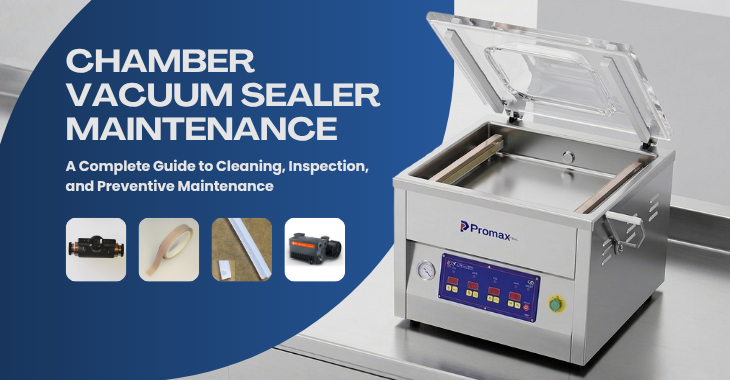
A chamber machine generally works with pre-made bags. An operator places the product inside the bag, positions it in the chamber, and starts the vacuum and sealing cycle.
This approach can be highly practical for smaller production volumes, variable products, restaurants, butcher shops, and businesses that do not need continuous automated packaging.
A thermoformer is designed for a different operating model.
It creates packages from rollstock and automates multiple stages of the packaging process.
For high-volume food processors, this can provide higher throughput and reduce repetitive manual packaging tasks.
The decision should therefore be based on production volume, product mix, available labor, packaging format, capital budget, and future growth not simply on which machine is “better.”
What Should You Consider Before Buying a Rollstock Thermoformer?
Buying a thermoformer is a significant investment, so processors should evaluate the complete packaging application before selecting equipment.
Product
What are you packaging?
Meat, seafood, cheese, prepared foods, medical products, and industrial products can require different packaging configurations.
Package Size
Determine the minimum and maximum package dimensions you need.
Production Volume
How many packages do you need per hour or per shift?
Your target output will influence machine configuration and cycle requirements.
Film
What film structure, thickness, barrier properties, and forming characteristics are required?
Vacuum or MAP
Determine whether the application requires conventional vacuum packaging, MAP, or another packaging process.
Product Loading
Will products be loaded manually or integrated with automated equipment?
Sanitation
Consider how the machine fits into your existing cleaning and sanitation procedures.
Maintenance
Ask about access to wear parts, lubrication systems, diagnostics, technical support, and spare parts.
Future Growth
A machine should meet today’s requirements without unnecessarily restricting tomorrow’s production plans.
Why Packaging Automation Matters as Production Grows
Many processors initially focus on the purchase price of a packaging machine.
That is only one part of the equation.
The real cost of packaging also includes labor, film, maintenance, downtime, rejected packages, product loss, cleaning time, and production capacity.
Suppose a processor increases production but continues using a packaging method designed for a much smaller operation. The company may eventually need additional workers simply to keep the packaging station running.
Automation can change that equation.
Instead of adding labor to perform every repetitive packaging task, a processor can use automated equipment to increase output while allowing employees to focus on product loading, quality control, machine operation, sanitation, and other higher-value activities.
That does not mean automation eliminates labor.
It changes how labor is used.
Is a Rollstock Thermoformer Right for Your Operation?
A rollstock thermoformer may make sense when a processor has:
- High or growing production volumes
- Repetitive packaging formats
- Significant manual bagging labor
- A need for consistent package presentation
- Requirements for vacuum or MAP packaging
- A desire to reduce reliance on pre-made bags
- Multiple products that can be accommodated through suitable tooling
- Long-term plans to increase packaging capacity
For a small operation with highly variable products and low daily volume, a chamber vacuum sealer may remain more practical.
The right packaging system depends on the actual production environment.
Final Thoughts
Rollstock thermoforming has become an important packaging technology for food processors that need to combine production efficiency with consistent package quality.
The technology brings several packaging steps together from film forming and product loading through vacuum or MAP, sealing, and cutting. When properly matched to the product and production environment, this can help processors increase throughput, manage packaging materials, improve consistency, and reduce repetitive manual work.
But selecting a thermoformer should not be based on speed alone.
Film compatibility, package dimensions, product characteristics, vacuum requirements, sanitation, maintenance, loading methods, production volume, and future capacity all need to be considered.
Promarks designs rollstock thermoforming equipment for demanding commercial packaging applications, with features such as automatic chain lubrication, remote diagnostics, electrical cabinet heating, and a stainless-steel chain included in the machine configuration.
Whether you are replacing an older thermoformer, moving away from pre-made vacuum bags, or building a new automated packaging line, the right machine configuration starts with understanding your product and production requirements.
Need help determining which rollstock thermoformer configuration fits your application? Contact Promarks to discuss your product, package dimensions, film requirements, and production volume.